

Over 3.5 million children in Bangladesh have dangerous Lead levels in blood: UNICEF

UNICEF has revealed that over 3.5 million children in Bangladesh have dangerously high levels of lead in their blood, with the country ranking fourth globally in terms of children affected by lead pollution.
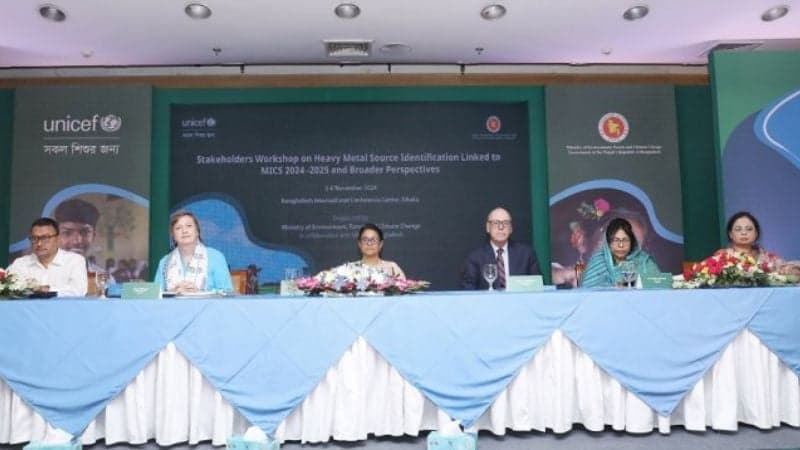
The alarming findings were shared at a national workshop on 'International Lead Pollution Prevention Week,' organized by the Ministry of Environment, Forests and Climate Change and UNICEF on Tuesday (November 5).
The workshop, held at BICC, presented results from studies conducted in collaboration with the Institute of Epidemiology, Disease Control and Research (IEDCR) and ICDDR,B.
Testing of 980 children across Khulna, Tangail, Patuakhali, and Sylhet, along with 500 children in Dhaka, found that 40% of samples from four districts and 80% from Dhaka had lead levels above the World Health Organization’s safe limit.
UNICEF has also raised concerns about lead in children's blood and urged the interim government to develop a strategy for a lead-free Bangladesh.
UNICEF and experts at the workshop stressed that lead exposure is linked to severe neurological and physical damage in children, highlighting it as a major public health concern, particularly in light of the growing environmental health crisis driven by urbanization and industrialization.
Environment, Forest and Climate Change Adviser Syeda Rizwana Hasan, UNICEF Bangladesh Representative 'Rana Flowers', and other notable figures delivered speeches as chief guests at the workshop.
Leave A Comment
You need login first to leave a comment