
Massive transformation across Indian Ocean
Ports on sea, shadow of power on horizon

Vast in size but calm by nature. Seen from afar, the Indian Ocean may appear that way. Blue waters. Long maritime routes. Rows of commercial vessels. But over the past decade, the picture has changed. Major construction projects have begun across the ocean. Deep-sea ports in some places. Long runways in others. Military bases elsewhere.
Officially, these are projects for trade, connectivity and security. Yet the defence and strategic calculations behind port construction are becoming increasingly clear.
India is building ports. China is not sitting idle either. Australia is expanding the runways of its airbases. In the middle of the Indian Ocean, Diego Garcia hosts a joint military base operated by the United States and the United Kingdom. The countries are different. The stated reasons are different. But the words are almost the same—trade, security, connectivity and strategic interests.
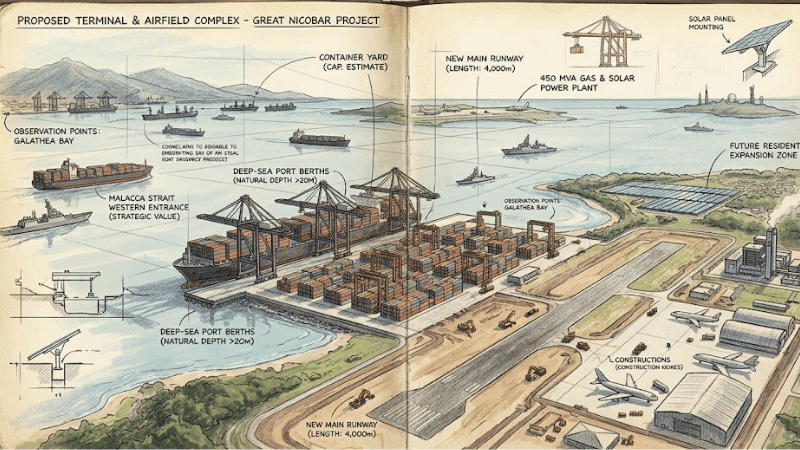
The new focal point of this power projection is India's Great Nicobar Island. New Delhi has plans to build a deep-sea port, an international airport, a power plant and a new settlement there.
According to India's Press Information Bureau (PIB), the project will reduce India's dependence on foreign transshipment ports. At the same time, it will strengthen the country's defence capabilities and maritime presence.
Great Nicobar is the southernmost island of the Andaman and Nicobar Islands. It lies close to the western entrance of the Malacca Strait.
Geography has played a major role in selecting the location. According to PIB data, the proposed port at Galathea Bay will be about 40 nautical miles from the east-west international shipping route.
The natural water depth there is more than 20 metres. Large ships require deep water to operate.
Planners have seen economic opportunities in that deep water. They have also seen security needs.
The official name of the project is the Great Nicobar Project. Its main infrastructure will be an international container transshipment terminal.
According to PIB estimates, the port will have an annual capacity of 14.2 million TEUs. TEU refers to the equivalent of a 20-foot-long container. The project will also include an international airport.
During peak periods, it will be capable of handling 4,000 passengers per hour. A gas and solar power plant with a capacity of 450 megavolt-amperes will also be built. A new settlement will be developed across an area of 16,610 hectares.
One island. A gigantic undertaking. Port, airport, power plant and city—all together. Calling it merely a construction project would be an understatement. It is a massive transformation.
The economic rationale for the project is also clear to the Indian government. PIB has said that many Indian ports do not have berths deep enough to accommodate large container ships. As a result, some Indian goods are first transported by smaller vessels to Colombo in Sri Lanka, Singapore or Port Klang in Malaysia. There, the containers are transferred onto larger ships. This system is known as transshipment. It takes time. It increases costs.
Revenue from port services also goes to other countries.
PIB says one of the main objectives of building the Great Nicobar port is to reduce this dependence. But the port will not simply be used to count containers. There are indications of that in PIB's own description. The agency says the project also aims to strengthen national security, defence presence and India's position in the Andaman Sea and Southeast Asia.
When a commercial port and military facilities exist side by side, surveillance accompanies shipping. In modern geopolitics, the distance between cranes and radar is not very great.
Geopolitical Monitor has described the Great Nicobar Project as an integrated initiative combining India's economic and military strategies. Its analysis says the island's location near the Malacca Strait will give India an opportunity to expand its presence alongside a major international shipping route.
Huge volumes of goods and energy are transported along this route between East Asia and the Indian Ocean. The island may be small on the map. But the number of ships passing beside it is not.
One reason for India's growing activity can be seen in China's activities in the surrounding region. The US-based research institution Center for Strategic and International Studies (CSIS) says Chinese state-owned enterprises are involved in the Kyaukphyu deep-sea port and Special Economic Zone project in Myanmar's Rakhine State.
According to CSIS data, companies led by China's CITIC Group were awarded responsibility for developing the port and industrial zone there in 2016. There are also oil and gas pipelines running from Kyaukphyu to China's Yunnan province.
In other words, there is a port. There are roads. There are pipelines. There is energy. There is trade. And there is strategy.
According to Geopolitical Monitor, China has also invested in Pakistan's Gwadar port and Sri Lanka's Hambantota port. India has been monitoring Chinese activities around these ports for years. For New Delhi, therefore, Great Nicobar is not an isolated infrastructure project. It is part of the broader competition for influence centred around ports across the Indian Ocean.
Meanwhile, Australia is also strengthening its position. According to Australia's Department of Defence, the runway at the airbase in the Cocos (Keeling) Islands in the Indian Ocean is being expanded and strengthened. The runway, taxiways, lighting and drainage systems are being upgraded to make the facility suitable for operating large military aircraft.
A permanent construction wharf is also being built there. Initial construction work began towards the end of 2024. The entire project is planned for completion by 2029.
In the middle of the Indian Ocean lies Diego Garcia. According to UK government information from 2025, the island hosts a joint military base operated by the United States and the United Kingdom.
The UK government describes the base as an important centre for the two countries' military presence and logistical support in the Middle East, the Indo-Pacific region and Africa.
As a result, the waters of the Indian Ocean are now casting the shadows of military aircraft alongside commercial ships.
The Great Nicobar Project formally began several years ago. According to documents from India's National Green Tribunal, the terms of reference for the project's environmental assessment were approved on 25 May 2021.
The project is being implemented by the Andaman and Nicobar Islands Integrated Development Corporation Limited.
According to PIB, the entire project will cover an area of 166.10 square kilometres. Of this, 35.35 square kilometres consist of government revenue land, while the remaining 130.75 square kilometres are forest land.
The work will be carried out in three phases. The first phase will run from 2025 to 2035. The second phase from 2036 to 2041. The final phase will run from 2042 to 2047.
In other words, the plan is being made today, but it will take more than two decades to complete. The clock moves slowly on major projects. But their impact begins much earlier.
For the Indian government, Great Nicobar means a deep-sea port, an airport, power generation, employment, transshipment revenue and a stronger military presence.
Leave A Comment