
President of Bangladesh: Limited powers, extensive privileges
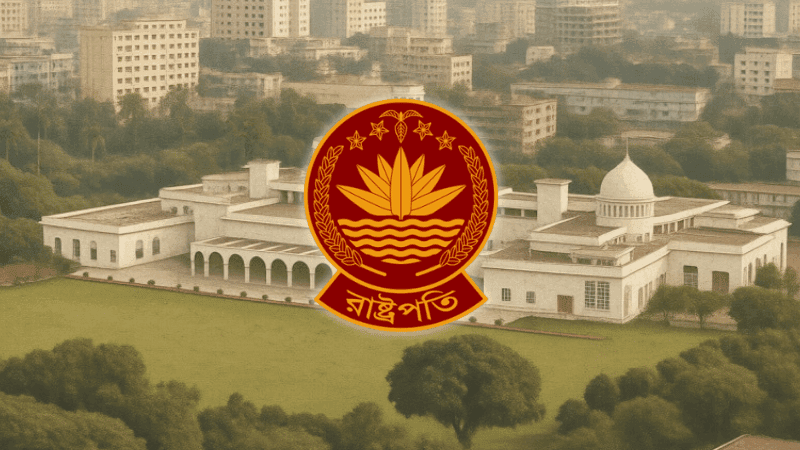

Voting to elect Bangladesh's 23rd President is taking place today, Thursday. Polling will be held in the National Parliament chamber from 2pm to 5pm. However, with the ruling BNP holding more than a two-thirds majority in Parliament, the election is largely expected to be a formality. The numbers suggest that Mirza Fakhrul Islam Alamgir, the BNP's recently retired Secretary General and the party's candidate, is set to become President.
A total of 349 Members of Parliament are eligible to vote in the presidential election. The BNP has 247 MPs. In contrast, the Jamaat-e-Islami-led 11-party alliance has nominated Oli Ahmed, chairman of the Liberal Democratic Party (LDP), as its candidate.
The alliance has 90 MPs. As Oli Ahmed is not an MP, he cannot vote in the election. Mirza Fakhrul, being an MP, is eligible to cast his vote.
Under the Constitution of Bangladesh, the President is the country's highest constitutional office-holder. However, under the parliamentary system of government, the President is not the head of government.
Executive power is primarily exercised by the Prime Minister and the Cabinet. As a result, although the President enjoys the highest constitutional status, the office has relatively limited executive powers in practice.
Article 48(3) of the Constitution provides the President with two important powers that he exercises independently.
One is the appointment of the Prime Minister and the other is the appointment of the Chief Justice. When a party secures a majority in a parliamentary election, the President generally appoints the leader of that party's parliamentary group as Prime Minister.
However, if no party secures a clear majority, the President's constitutional role in the formation of a government can become significant.
The President also has constitutional authority to appoint the Chief Justice. Apart from these areas, the President is required to act largely in accordance with the advice of the Prime Minister.
The Prime Minister keeps the President informed about matters of state and foreign policy. If the President wishes to refer a matter for consideration by the Cabinet, the Prime Minister places it before the Cabinet.
Another important power of the President is the authority to grant pardons, reprieves, remissions or reductions of sentences.
Article 49 of the Constitution confers this power. Within the constitutional framework, the President may pardon or reduce a sentence imposed by a court, tribunal or other authority.
The President also enjoys constitutional immunity while in office. No criminal proceedings can be initiated against the President during his term, nor can a court issue a warrant for his arrest or imprisonment.
However, the President can be impeached through a parliamentary process on grounds of violating the Constitution or committing gross misconduct. There are also constitutional provisions for removing the President in cases of physical or mental incapacity through a prescribed procedure.
The President serves a five-year term and may hold office for a maximum of two terms. After assuming office, the President cannot remain a Member of Parliament. Therefore, if Mirza Fakhrul Islam Alamgir is elected President and assumes office, his parliamentary seat will become vacant and a by-election will subsequently be held in that constituency.
The people do not directly vote for the President. The President is elected by Members of Parliament.
One MP proposes a candidate and another seconds the nomination. If there is more than one valid candidate, the person receiving the highest number of votes from MPs is elected. In the event of a tie, the result is determined by lottery. With more than one candidate in the race, a presidential election is being held for the first time in 35 years.
Although the President's powers are limited, the office comes with extensive privileges. Under the law, the President receives a monthly salary of Tk 120,000, which is tax-free. The state provides an official residence at Bangabhaban, official vehicles and transport, allowances for foreign visits, hospitality and medical treatment, among other benefits.
The President and members of his family receive medical treatment at state expense within Bangladesh, while the government also covers the cost of treatment abroad when necessary.
The President also has access to a discretionary fund of Tk 200 million a year. The money can be used at the President's discretion to provide assistance to individuals or organisations. An annual air travel allowance is also available to the President.
Even after retirement or resignation from office, the President is entitled to certain government benefits under the law. However, the principal strength of the presidency lies not in financial or administrative authority, but in its constitutional status and symbolic leadership of the state.
In situations such as political crises, a hung Parliament or uncertainty over government formation, the President's role can become significant.
But when a political party has a clear majority in Parliament, the practical scope for exercising those powers remains considerably limited.
This is why, although the President is the highest constitutional office-holder in Bangladesh, the office is not the centre of government.
The President is primarily the Head of State, while executive leadership of the government rests with the Prime Minister. Today's election will complete the formal constitutional process for choosing the country's new President within that framework.
Leave A Comment