
Presidents of Bangladesh since Independence: The journey of 19 individuals
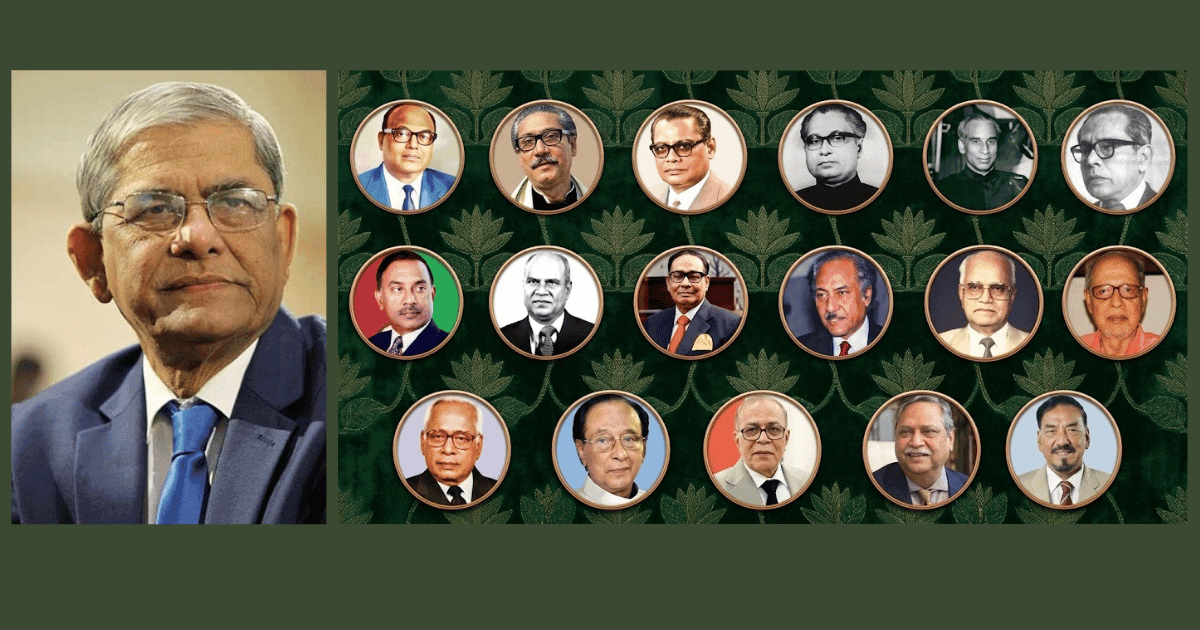

Over the 54-year history of Bangladesh since independence, the office of the President has witnessed numerous political upheavals, military coups, mass movements and constitutional changes. During this period, 22 individuals have been elected or served as President through the constitutional succession. However, if full, acting and temporary presidents are all taken into account, a total of 19 individuals have served as President of Bangladesh since independence. Several of them served as acting or temporary presidents.
Presidential elections have been held 23 times. The last contested presidential election was held in 1991. After that, seven presidents were elected unopposed over an extended period, each being the sole candidate backed by the ruling party. Opposition parties did not nominate candidates. As a result, after a gap of 35 years, a contested election for the presidency was held once again this year.
On 24 July, the 22nd President, Mohammed Shahabuddin, resigned before completing his term. Without any major prior announcement, he submitted his resignation to the Speaker of the National Parliament. Following his resignation, National Parliament Speaker Major Hafiz Uddin Ahmed assumed the duties of Acting President in accordance with the Constitution until a new President was elected.
Subsequently, following a day-long vote on 20 August, former Secretary General of the Bangladesh Nationalist Party (BNP), Mirza Fakhrul Islam Alamgir, was elected as the country's 23rd President. His rival was Colonel Oli Ahmed, the candidate of the Jamaat-led 11-party alliance. The final result was announced by Chief Election Commissioner A. M. M. Nasir Uddin.
With this, the veteran leader has assumed the highest constitutional office of the country after a long political career.
Bangabandhu Sheikh Mujibur Rahman
Bangabandhu Sheikh Mujibur Rahman was born on 17 March 1920 in Tungipara, Gopalganj. Through the Proclamation of Independence issued on 10 April 1971, he was declared the first President of Bangladesh.
He remained imprisoned in Pakistan from the time of the Liberation War until the first week of January 1972. In his absence, Syed Nazrul Islam served as Acting President.
Sheikh Mujibur Rahman returned to Bangladesh on 10 January 1972. When the parliamentary system of government was introduced on 12 January, he assumed the office of Prime Minister. On 25 January 1975, the Fourth Amendment to the Constitution introduced a presidential system of government, and he once again assumed the office of President. He was assassinated along with most of his family members in a military coup on 15 August 1975.
Syed Nazrul Islam
During the Liberation War, Syed Nazrul Islam served as Acting President of Bangladesh in the absence of Bangabandhu. He was the first Acting President of independent Bangladesh and one of the principal leaders of the wartime government.
On 3 November 1975, he was assassinated along with three other national leaders inside Dhaka Central Jail.
Justice Abu Sayeed Chowdhury
Justice Abu Sayeed Chowdhury was born on 31 January 1921 in Nagbari, Kalihati, Tangail. When Sheikh Mujibur Rahman assumed office as Prime Minister on 12 January 1972, he became the second President of Bangladesh.
He was elected President for a second time on 10 April 1973. However, he resigned on 24 December of the same year. The precise reason for his resignation was never officially made clear. He died in London on 2 August 1987 while undergoing medical treatment.
Mohammad Mohammadullah
Mohammad Mohammadullah was born on 21 October 1921 in Raipur, Lakshmipur. Following the resignation of Justice Abu Sayeed Chowdhury, he assumed the duties of Acting President.
He was subsequently elected President on 24 January 1974 and took the oath of office on 27 January. He remained in office until the presidential system of government was reintroduced on 25 January 1975.
Following Bangabandhu's assassination on 15 August 1975, he was appointed Vice-President under the government of Khondaker Mostaq Ahmad. After subsequent political changes, he largely withdrew from active politics. He died on 11 November 1999.
Khondaker Mostaq Ahmad
Khondaker Mostaq Ahmad was born in 1919 in Dashpara, Daudkandi, Cumilla. Following the assassination of Bangabandhu Sheikh Mujibur Rahman on 15 August 1975, he assumed the presidency.
His presidency lasted only 83 days. Following the assassination of the four national leaders inside Dhaka Central Jail on 3 November, the political situation became even more unstable. He was removed from power in a military coup on 6 November. He died on 5 March 1996.
Justice Abu Sadat Mohammad Sayem
Justice Abu Sadat Mohammad Sayem was born on 8 July 1916 in Rangpur. Following the military coup of 6 November 1975, he assumed the presidency.
He declared martial law and also served as Chief Martial Law Administrator. On 29 November 1976, he handed over that responsibility to the then Chief of Army Staff, Ziaur Rahman. On 21 April 1977, he stepped down as President, citing health reasons. He died on 8 July 1997.
Ziaur Rahman
Ziaur Rahman was born on 19 January 1936 in Bagbari, Gabtali, Bogura. When Justice Sayem stepped down as President on 21 April 1977, he assumed the office.
He won the 1978 presidential election. During his presidency, he took initiatives to restore a multi-party political system and founded the Bangladesh Nationalist Party (BNP) on 1 September 1978. He was assassinated during an attempted military coup in Chattogram on 30 May 1981.
Justice Abdus Sattar
Justice Abdus Sattar was born on 1 March 1906 in Birbhum, West Bengal. Following Ziaur Rahman's assassination, he assumed the duties of Acting President.
He subsequently won the presidential election held on 15 November 1981 and became President. However, he was removed from power on 24 March 1982 in a military coup led by Chief of Army Staff Hussain Muhammad Ershad. He died on 5 October 1985.
Justice A. F. M. Ahsanuddin Chowdhury
Justice A. F. M. Ahsanuddin Chowdhury was born on 1 July 1915 in Gauripur, Mymensingh. Following the military coup of 1982, he assumed the presidency.
During his tenure, much of the effective power of the state remained in the hands of Army Chief Ershad. Following disagreements with Ershad, he stepped down as President on 11 December 1983. He died on 30 August 2001.
Hussain Muhammad Ershad
Hussain Muhammad Ershad was born on 1 February 1930 in Dinhata, Cooch Behar, West Bengal. Following Ahsanuddin Chowdhury's resignation, he assumed the presidency.
He founded the Jatiya Party in 1986 and won the presidential election held that same year. During his rule, political opposition and mass protests gradually intensified.
In the face of a mass uprising, he was forced to resign on 6 December 1990. He died on 14 July 2019 while undergoing treatment at the Combined Military Hospital in Dhaka.
Abdur Rahman Biswas
Abdur Rahman Biswas was born on 1 September 1926 in Shaistabad, Barishal. Following the restoration of the parliamentary system in 1991, he was elected President on 8 October.
He was one of the Bangladeshi presidents to complete a full term in office. His tenure ended on 8 October 1996. He died on 3 November 2017.
Justice Shahabuddin Ahmed
Justice Shahabuddin Ahmed was born on 1 February 1930 in Kendua, Netrokona. Following the fall of Ershad in 1990, he became Acting President and led the caretaker government.
Under his leadership, the fifth parliamentary election was held in 1991. In 1996, he was elected President unopposed and served a full term. He died on 19 March 2022 while undergoing treatment at the Combined Military Hospital in Dhaka.
A. Q. M. Badruddoza Chowdhury
A. Q. M. Badruddoza Chowdhury was born on 11 October 1930 in Cumilla. After the BNP won the 2001 general election, he assumed the presidency on 14 November.
However, amid political differences and pressure from within his own party, he resigned as President on 21 June 2002. He also resigned from the BNP. He died on 5 October 2024 while undergoing treatment.
Dr Iajuddin Ahmed
Dr Iajuddin Ahmed was born on 1 February 1931 in Naya Gaon, Munshiganj. He assumed the presidency on 6 September 2002. During the political crisis of 2006, he also took on the role of Chief Adviser to the caretaker government while serving as President. He stepped down as Chief Adviser on 12 January 2007.
After completing his term as President, he retired in February 2009. He died in Bangkok on 10 December 2012 while undergoing medical treatment.
Zillur Rahman
Zillur Rahman was born on 9 March 1929 in Bhairab, Kishoreganj. In 2009, he was elected President unopposed. He died on 20 March 2013 at Mount Elizabeth Hospital in Singapore while still serving as President.
Abdul Hamid
Abdul Hamid was born on 1 January 1944 in Mithamoin, Kishoreganj. During Zillur Rahman's illness, he served as Acting President.
On 29 April 2013, he was elected President unopposed. In 2018, he was re-elected for a second term, again without opposition. His tenure as President ended on 24 April 2023. He became the longest-serving President in the history of Bangladesh.
Mohammed Shahabuddin
Mohammed Shahabuddin was born on 10 December 1949 in Shibrampur, Pabna. On 13 February 2023, he was elected as the 22nd President of Bangladesh.
He remained in office following the political changes of 2024. However, on 24 July 2026, he resigned from the presidency before completing his term. Following his resignation, National Parliament Speaker Major Hafiz Uddin Ahmed assumed the duties of Acting President until a new President was elected.
Major Hafiz Uddin Ahmed
Following Mohammed Shahabuddin's resignation, National Parliament Speaker Major Hafiz Uddin Ahmed assumed the duties of Acting President in order to maintain constitutional continuity.
He remained in the role until a new President was elected. With his assumption of the office, his name was added to the list of individuals who have served as Acting or temporary President since independence.
Mirza Fakhrul Islam Alamgir
Mirza Fakhrul Islam Alamgir was born on 26 January 1948 in the Kalibari area of Thakurgaon town. After obtaining bachelor's and master's degrees in economics from the University of Dhaka, he began his professional career as a teacher.
In 1972, he passed the Bangladesh Civil Service examination and joined the Education Cadre. He began teaching as a lecturer in the Economics Department of Dhaka College and subsequently taught at several government colleges.
Mirza Fakhrul became actively involved in politics during the 1980s. In 1988, he was elected Chairman of Thakurgaon Municipality. He later joined the BNP and held a number of important positions within the party.
In the 2001 general election, he was elected Member of Parliament from the Thakurgaon-1 constituency. He subsequently served as Minister of State for Agriculture and later as Minister of State for Civil Aviation and Tourism in the BNP government.
In 2009, he was elected Senior Joint Secretary General of the BNP. Following the death of Khandaker Delwar Hossain in 2011, he became Acting Secretary General. At the BNP's sixth national council on 19 March 2016, he was elected Secretary General.
Throughout his long political career, he has been imprisoned several times and faced numerous cases and political challenges, while leading the party through various periods of crisis.
Following a day-long vote on 20 August, former BNP Secretary General Mirza Fakhrul Islam Alamgir was declared the winner and elected as the 23rd President of Bangladesh. His opponent was Colonel Oli Ahmed, the candidate of the Jamaat-led 11-party alliance.
The election marked the return of a contested presidential election in Bangladesh after a long gap of 35 years. At the same time, it opened a new chapter in Mirza Fakhrul's long political career. In his personal life, Mirza Fakhrul Islam Alamgir is married to Rahat Ara Begum. They have two daughters—Shamaruh Mirza and Safaruh Mirza.
The history of Bangladesh's presidency since independence is therefore not merely a history of individuals succeeding one another. It is also a reflection of changes in the country's system of government, military rule, the restoration of democracy and constitutional continuity. The inauguration of Mirza Fakhrul Islam Alamgir as the 23rd President adds a new chapter to that long and eventful history.
Leave A Comment