
Presidents who resigned in Bangladesh's history
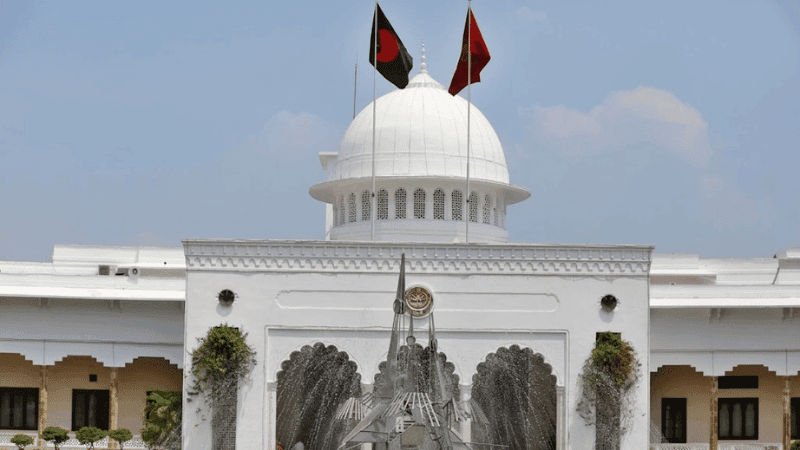

President Mohammad Shahabuddin unexpectedly resigned before completing his constitutional term, without any prior public announcement on 24 July.
He submitted his resignation to the Speaker of the Jatiya Sangsad, who assumed the responsibilities of Acting President in accordance with the Constitution until a new President is elected.
However, this is not the first time a Bangladeshi President has left office before completing a full term. Throughout the country's 54-year history since independence, several Presidents have failed to complete their tenure for various reasons. Some were assassinated while in office, some died of natural causes, others were removed through military coups, while a number resigned voluntarily or under political pressure.
Only four Presidents have completed their constitutional terms in office: Abdur Rahman Biswas, Justice Shahabuddin Ahmed, Iajuddin Ahmed and Abdul Hamid, the longest-serving President in Bangladesh's history.
By contrast, Bangabandhu Sheikh Mujibur Rahman and President Ziaur Rahman were assassinated while serving in office, while President Zillur Rahman died during his tenure due to illness.
The following are the Presidents who resigned before completing their terms.
Justice Abu Sayeed Chowdhury
Following Bangladesh's transition to a parliamentary system on 12 January 1972, Bangabandhu Sheikh Mujibur Rahman assumed office as Prime Minister, and Justice Abu Sayeed Chowdhury became the country's second President. He was re-elected in April 1973 but resigned on 24 December of the same year. He was later appointed as the President's Special Envoy on Foreign Affairs with the rank of a Cabinet Minister. The exact reasons behind his resignation were never officially disclosed.
Justice Abu Sadat Mohammad Sayem
Justice Sayem assumed the presidency on 6 November 1975 amid intense political and military turmoil. He simultaneously served as Chief Martial Law Administrator. In November 1976, he relinquished the martial law authority to Major General Ziaur Rahman and, citing ill health alongside the prevailing political circumstances, stepped down as President on 21 April 1977.
Justice A. F. M. Ahsanuddin Chowdhury
Following the military takeover in 1982, retired Justice A. F. M. Ahsanuddin Chowdhury was appointed President. However, differences with the military ruler Lieutenant General Hussain Muhammad Ershad soon emerged. Under mounting pressure, he resigned on 11 December 1983, after which Ershad assumed the presidency himself.
Hussain Muhammad Ershad
Ershad took over the presidency in 1983 and later secured the office through the 1986 presidential election. His rule was marked by widespread opposition, pro-democracy protests and growing public discontent. Facing a nationwide mass uprising and losing the support of the armed forces, he resigned on 6 December 1990, bringing an end to nearly nine years of military-backed rule and paving the way for the restoration of parliamentary democracy.
A. Q. M. Badruddoza Chowdhury
Physician-turned-politician A. Q. M. Badruddoza Chowdhury assumed office as President on 14 November 2001. However, after serving for only seven months, he resigned on 21 June 2002 amid political controversy and growing pressure from within his own party, the Bangladesh Nationalist Party (BNP). He also resigned from the party on the same day.
Mohammad Shahabuddin
Mohammad Shahabuddin was elected unopposed as the 22nd President of Bangladesh on 13 February 2023. Following the dramatic political developments of August 2024, he remained in office and oversaw the constitutional transition of power to the interim administration. On 24 July 2026, however, he resigned before completing his five-year constitutional term, citing serious health complications. Under the Constitution, his tenure was scheduled to expire in 2028.
Presidents Who Were Removed Rather Than Resigned
Not every President who left office did so voluntarily. Some were removed through military intervention.
Khondaker Mostaq Ahmad declared himself President on August 15, 1975 following the assassination of Bangabandhu Sheikh Mujibur Rahman. His presidency lasted only 83 days before he was overthrown during a counter-coup and later arrested.
Justice Abdus Sattar, who was elected President in 1981 following the assassination of Ziaur Rahman, was forced from office during General Hussain Muhammad Ershad's military coup on 24 March 1982.
A Reflection of Bangladesh's Political History
The history of Bangladesh's presidency mirrors the country's broader political evolution. Since independence, the office has witnessed constitutional transitions, military interventions, political crises and democratic movements. While some Presidents completed their constitutional mandates, many others left office prematurely under extraordinary circumstances.
President Mohammad Shahabuddin's resignation has now become another significant chapter in that long and eventful constitutional history.
Leave A Comment