
Rabindranath Tagore's 85th death anniversary today
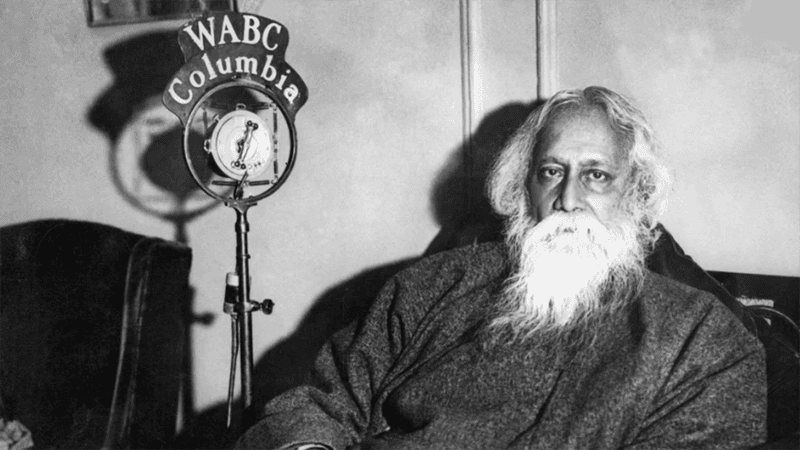

The monsoon rains fell over Bengal today as they have every year on this date for eight decades, and once again, they carried with them the weight of remembrance. Today marks 22 Shrabon on the Bengali calendar — the day Rabindranath Tagore, the towering figure of Bengali literature and culture, drew his last breath in 1941 at his ancestral home in Jorasanko, Kolkata, at the age of 80.
Shrabon, the second month of the Bengali monsoon, has long been associated with heavy downpours, grey skies and a quiet, aching nostalgia — a mood that seems to deepen every year on this particular day. For Bengalis at home and scattered across the world, 22 Shrabon is no ordinary date on the calendar. It is a day of collective pause, when the rain outside seems to mirror the reflection within.
To mark the occasion, cultural organisation Chhayanaut will stage the musical drama "Shyama" this evening at 7:00pm at the Chhayanaut Auditorium in the capital. The performance, open to all, stands as one of the day's key tributes to the poet whose music and words continue to shape Bengali cultural life.
Tagore's stature extends far beyond the borders of literature. In 1913, he became the first non-European ever awarded the Nobel Prize in Literature, honoured for his collection "Gitanjali" — a recognition that placed Bengali letters on the global stage for the first time. But to call him merely a poet is to undersell him. He was a lyricist and composer, novelist and playwright, essayist and short story writer, educator, philosopher and painter — a polymath in the truest sense, whose creative reach touched nearly every discipline he approached.
His ambitions, though, were never confined to the page. Tagore was a visionary thinker who believed deeply in rural upliftment and reform of education. He founded Santiniketan, an experimental school built on principles far ahead of its time, which would later grow into Visva-Bharati University. Away from the classroom, he threw himself into grassroots work — promoting agricultural cooperatives and mass education in Patisar in Naogaon, Shilaidaha in Kushtia, and Santiniketan itself. In a gesture that spoke to his convictions, he donated part of his Nobel Prize money to fund these very initiatives.
At the heart of his life's work lay an unwavering commitment to humanism, freedom and indigenous knowledge — ideas that, nearly a century later, feel no less urgent in a world still wrestling with the same questions. His songs and philosophy remain woven into the everyday cultural and intellectual fabric of both Bangladesh and India, sung in classrooms, hummed in homes, and recited at gatherings just like the one planned for this evening.
For many, Tagore has long ceased to be simply a historical figure confined to textbooks. He endures instead as a guiding presence — a voice that continues to speak to the soul of Bengal, monsoon after monsoon, Shrabon after Shrabon. And so, as the rains fall once more this year, Bengal does what it has always done on this day: it remembers not just the poet's passing, but the vast, living legacy of his words, his ideas and his dreams.
Leave A Comment