
Rajshahi silk regains glory, prospects grow in Chinese market
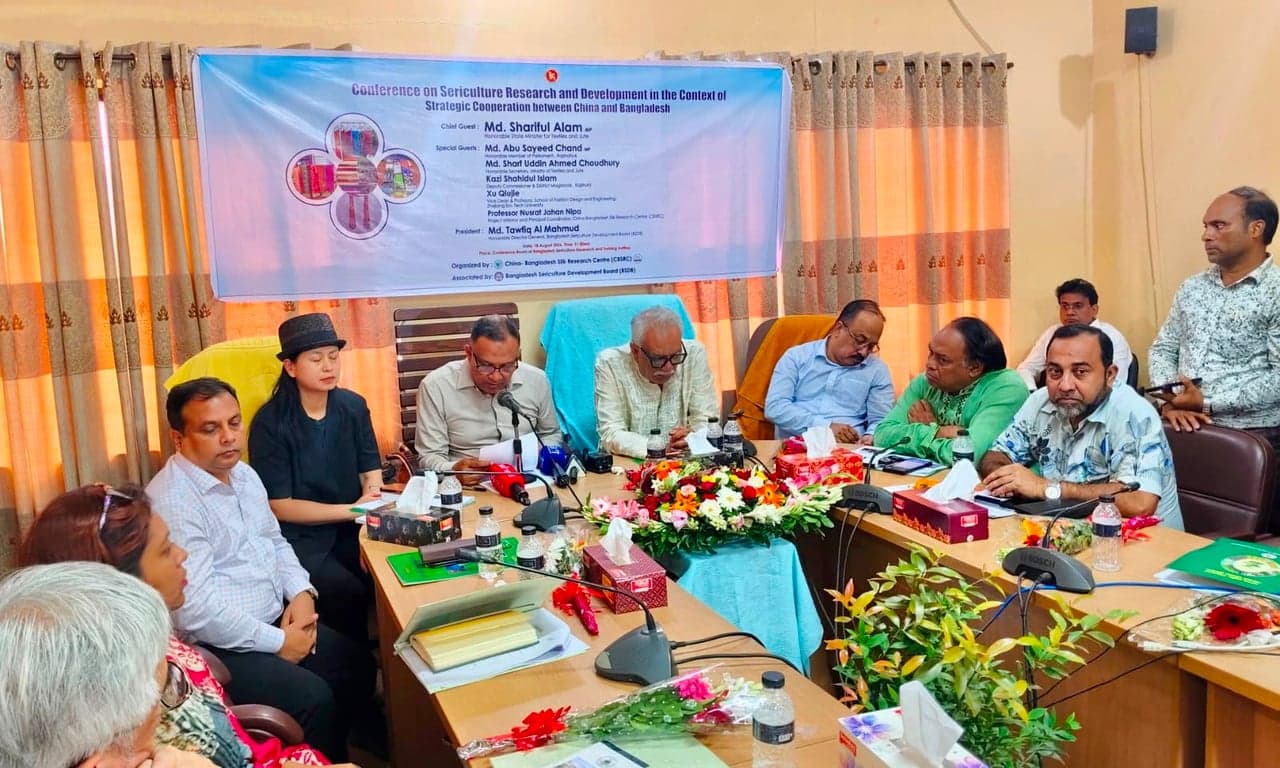

Silk thread weaves not just fabric but also stories of history, tradition and possibility. Rajshahi silk was once synonymous with elegance, beauty and Bengali heritage. Over time, the industry's lustre faded due to various challenges. However, new initiatives in research, technology and international cooperation have revived hopes for the resurgence of Rajshahi silk. The prospect of exporting Bangladeshi silk to China's vast market has opened new horizons for the industry. Against this backdrop, a conference on silk research and development was held in Rajshahi as part of strategic cooperation between Bangladesh and China.
The conference was held at the Bangladesh Silk Research and Training Institute on Tuesday morning, August 18. Textiles and Jute Minister Md Shariful Alam, MP, was the chief guest. Earlier, he visited the Bangladesh Silk Factory and the Silk Research and Training Institute.
Highlighting the vast potential for silk exports to the Chinese market, the minister said the government has taken various field-level initiatives to modernise Rajshahi's traditional silk industry and restore its lost glory. Emphasis is being placed on rejuvenating the sector through modern technology, research and training, improving silk cultivation methods, expanding mulberry cultivation and enhancing the quality of silk yarn.
He said Rajshahi silk is not just an industry but part of the country's heritage and pride. The government is working to revive the sector through modern technology, research and training.
The minister further said initiatives have been taken to reopen closed state-owned factories as per the election manifesto. Alongside reopening closed factories, plans are in place to expand market reach and attract domestic and foreign investment. Work is also underway to improve marketing policies for the development of Rajshahi's silk industry. China's market represents a promising opportunity for Bangladesh's silk industry. If Bangladeshi silk can carve out a distinct position in the Chinese market—one of the world's largest silk producers and consumers—the benefits could directly reach Rajshahi's silk farmers, weavers and entrepreneurs. Alongside producing quality silk yarn and fabric, adopting modern designs, packaging, branding and marketing strategies could establish 'Rajshahi Silk' as a strong brand in the international market.
The conference also highlighted the historical significance of the silk industry. The minister noted that the 'Rajshahi Silk Board' was established in 1977 under the leadership of then president Ziaur Rahman. Various initiatives were subsequently taken to develop the industry. In continuation of that, the current government aims to make the silk industry more modern and competitive through research and innovation.
The production scenario of Rajshahi's silk industry also offers encouraging signs. Since its reopening in 2018, a total of 59,468 metres of silk fabric have been produced at the factory until June 2026. Various high-quality silk products, including traditional garments, printed sarees, fabric for panjabis and Balaka silk, are being sold directly at the factory's own showroom.
Experts said if research findings can be applied at the field level, both the quantity and quality of silk production can be increased. Enhancing knowledge and technology exchange with China could make the sector more competitive, alongside producing improved mulberry varieties and silkworms, providing modern training to farmers and developing technology-driven production systems. The conference, organised by the China-Bangladesh Silk Research Centre, is therefore not limited to discussions on research and development alone. Rather, it is seen as an important step in transforming Rajshahi silk from a local heritage product into a promising commodity for international trade. Access to the Chinese market could boost exports, investment and employment, while also impacting the rural economy.
Special guests at the conference included Rajshahi-6 MP Abu Sayeed Chand, Textiles and Jute Ministry Secretary Sharf Uddin Ahmed Chowdhury, Professor and Vice Dean of Zhejiang University of Science and Technology's School of Fashion Design and Engineering Professor Xu Qiuzi, and Project Entrepreneur and Chief Coordinator of the China-Bangladesh Silk Research Centre Professor Nusrat Jahan Nipa. The session was chaired by Bangladesh Silk Development Board Director General Md Tawfik Al Mahmud. The keynote paper was presented by Senior Scientific Officer of the Bangladesh Silk Research and Training Institute Dr Md Shakhawat Hossain. The China-Bangladesh Silk Research Centre organised the conference with the support of the Bangladesh Silk Development Board.
Leave A Comment