
TRNB seminar
Traders for reviewing telecom policy adopted by interim government
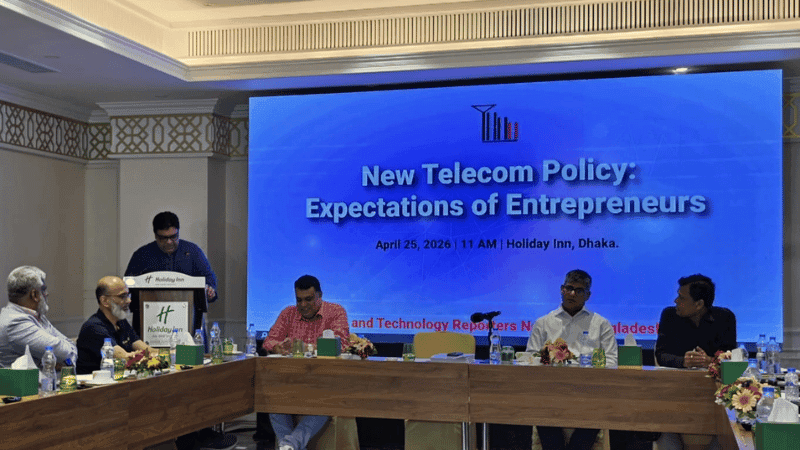

The current administration has implemented a comprehensive strategy aimed at enhancing Bangladesh's digital capabilities by emphasizing 'connectivity', as stated by Rehan Asif Asad, the Prime Minister's Adviser on Posts, Telecommunications, Information Technology, and Science.
He remarked that in order to thrive in today's global landscape of information technology, all participants in the telecommunications sector must advance through collaborative efforts.
He made these comments while speaking at a seminar hosted by the Telecom and Technology Reporters Network Bangladesh (TRNB) on Saturday.
In his address as the chief guest, Rehan Asif Asad expressed that the present government aims to develop a Bangladesh that is proficient in digital technology, aligned with global standards. To achieve this, the priority will be on enhancing connectivity first.
He pointed out that Bangladesh still lags significantly in mobile internet and broadband usage, asserting that to address this deficiency, robust connectivity must be established, and all service providers and stakeholders should collaborate effectively.
He stated, 'Digital sovereignty is crucial at this moment, and its significance will only grow in the future. Policies need to be developed to tackle this challenge.'
Additionally, he revealed plans to create an integrated platform to provide digital identification to every citizen, enabling access to all government services and financial transactions through this digital ID.
The event was presided over by TRNB President Sameer Kumar Dey, while General Secretary Masuduzzaman Robin delivered the welcome address.
During the event, TRNB President reminded attendees that in a seminar prior to the elections, the current government's Finance and Planning Minister Amir Khasru Mahmud Chowdhury had pledged to reassess the network infrastructure policy that was adopted in a non-transparent manner during the interim government. This was due to significant concerns raised by domestic entrepreneurs regarding that policy.
IT expert Sumon Ahmed Sabir presented the keynote address at the seminar. In his keynote address, he stated that the network infrastructure guidelines implemented during the interim government's period have favored foreign-owned enterprises. 'While foreign companies have been granted the chance to obtain licenses across all tiers, the operational scope for local entrepreneurs has been significantly restricted. This situation poses a substantial threat to the viability of domestic businesses. Nevertheless, in today's global landscape, digital sovereignty is being regarded with the same significance as military sovereignty.'
Among others, BTRC chairman Maj Gen Md Emdad Ul Bari (retd), senior journalist Masud Kamal, Fiber@Home Chairman Moynul Haque Siddiqui, ISPAB President Aminul Islam Hakim, AMTOB Secretary General Lt Col Mohammad Zulfikar (Retd), IGW Operators Forum Chief Operating Officer Mushfiqur Manzur, and AIOB Member Secretary Nurul Alam spoke.
The speakers expressed their belief that the policy prioritizing domestic entrepreneurs should be implemented. Participants from various levels of domestic entrepreneurship at the seminar urged for a reassessment of the policy established by the interim government.
BTRC Chairman Maj Gen Md Emdad Ul Bari (retd) stated that the network infrastructure policy was developed through a non-transparent process or hastily during the interim government — this claim is inaccurate.
He mentioned that the views of all stakeholders have been considered over the past year. Nevertheless, despite hearing from all parties, it was not feasible to meet every demand, which is unattainable in any situation.
He further emphasized that the primary objective of the interim government's policy was to shift from voice call services to data services, necessitating collaboration from all stakeholders.
Journalist Masud Kamal noted that while mobile internet is relatively accessible in urban areas, no operator's network functions adequately in rural regions.
Consequently, he utilizes SIM cards from four different operators.
However, he remarked that he experiences reliable broadband internet connectivity in both urban and rural settings. He also asserted that there should be no room for bias in any policy.
Fiber@Home Chairman Moynul Haque Siddiqui stated that entrepreneurs seek a definitive law that clearly delineates the boundaries of their respective roles through established regulations. Experience indicates that often those who encounter failure in their endeavors attempt to overstep these boundaries, transitioning from one level to another in a bid to preserve their viability.
He remarked, 'Significant advancements have been achieved in narrowing the digital divide through the issuance of NTTN licenses under the ILDTS policy in 2008. Domestic entrepreneurs have invested substantially to address this digital gap. They ought to be encouraged to continue such investments.'
He expressed the view that substantial progress in the IT sector is also attainable through the revenue generated by the telecom sector, provided that appropriate policy support is extended.
ISPAB President Aminul Islam Hakim noted that the introduction of NTTN services under the ILDTS policy has led to a considerable reduction in the cost of internet transportation within the country, enabling the provision of broadband services to remote regions.
He emphasized the necessity of reviewing the current policy to ensure equitable opportunities for all within the national framework.
Secretary General of AMTOB Secretary General Lt Col Mohammad Zulfikar (Retd) remarked that mobile operators have played a pivotal role in developing the infrastructure for digital services in Bangladesh. It is disheartening to dismiss that contribution and label mobile operators as 'thieves.'
He asserted that with adequate policy support, mobile operators can further broaden the reach of digital services.
Leave A Comment