
RU removes billboard amid student protests over war criminal images
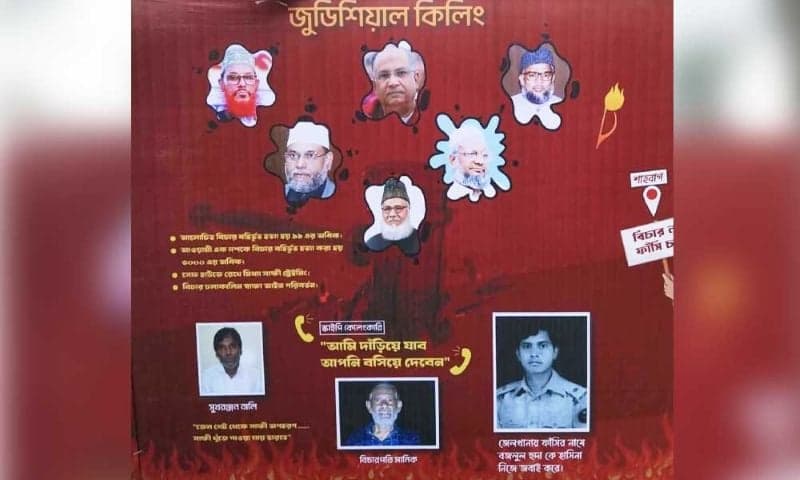

Rajshahi University (RU) authorities have removed a controversial billboard featuring images of several individuals convicted of crimes against humanity during Bangladesh's 1971 Liberation War, following nearly six hours of student protests demanding its removal.
A revised version of the billboard was noticed on Monday morning (August 3) along the university's Paris Road, replacing the original display. The new version excludes the images of those convicted by the International Crimes Tribunal (ICT) and includes two alternative photographs instead.
The billboard, titled "Judicial Killing," had been erected by Novo-Culture, an education and cultural organisation formed after the July Uprising. The group's director is Salahuddin Ammar, general secretary of the Rajshahi University Central Students' Union (RUCSU).
The display quickly sparked widespread criticism on social media and across the campus after students alleged that it portrayed convicted war criminals in a manner that questioned the legitimacy of verdicts delivered against them.
Student groups and independent protesters argued that the billboard attempted to recast individuals convicted of crimes against humanity as victims under the guise of debating judicial processes.
Demonstrations began on Saturday evening outside the university's administrative building. As talks with university officials failed to produce an immediate resolution, protesters continued a sit-in for nearly six hours, insisting that the billboard be removed.
The controversy deepened after Ammar attended a meeting at the university's Proctor Office later that night. Protesters accused him of making an obscene gesture while leaving the meeting—an allegation that further intensified tensions on campus.
University Proctor Professor Mahbubur Rahman said the administration decided to dismantle the billboard after those responsible refused to remove it voluntarily.
RUCSU Vice President Mostakur Rahman Jahid distanced the student union from the incident, saying the organisation had neither organisational nor financial involvement in the initiative.
Defending the display, Ammar said the billboard was intended to raise questions about alleged instances of judicial killings and encourage debate over whether certain past trials had been politically influenced. He insisted the initiative was not meant to absolve anyone convicted of crimes against humanity.
Student organisations, however, rejected that explanation. In separate statements, the Socialist Students' Front, Bangladesh Students' Rights Council, and the Rajshahi University unit of Jatiyatabadi Chhatra Dal said there was no place on a university campus for displaying images of convicted war criminals. They described the incident as an attempt to create confusion over a highly sensitive national issue and demanded a full investigation.
Earlier, Pro-Vice Chancellor (Administration) Professor Abdul Alim said the billboard had not received prior approval from the university administration and that the matter was under review.
Leave A Comment