
Six months of BNP government: Promises under weight of reality
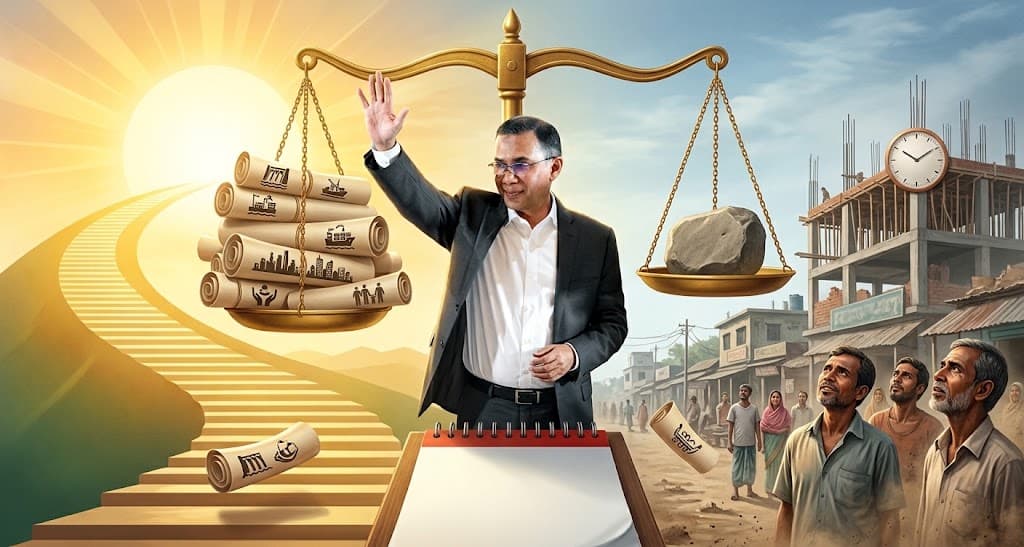

Tarique Rahman took oath as prime minister on 17 February. Exactly six months, or 180 days, have passed since then. In numerical terms, six months may seem like a relatively short period, but for a state, such a span can sometimes feel as weighty as a decade.
When a government takes charge anew after weathering a storm of political change, its first six months are no longer merely a series of calendar pages; they become a quiet testing ground between public trust and state power. How deeply have the promises written in the election manifesto taken root in the hard soil of reality, and how many have remained merely words on paper? The search for answers to these questions marks the beginning of the government’s real test.
The Tarique Rahman government is no exception; if anything, the test is more difficult because of the circumstances it inherited. The road before it was far from smooth. It has had to move forward amid a fragile economic structure, a banking sector weakened by years of strain and a shaky foundation of law and order.
After six months in such an adverse environment, the question is therefore simple but unforgiving: how much ground has actually been covered, and how much remains confined to promises on paper, yet to reach the doorstep of ordinary people?
From the government camp, however, the message remains one of confidence. At a discussion meeting, Mahdi Amin, spokesperson for the Prime Minister’s Office, said it was unrealistic to expect any government to fully resolve all problems within such a short period as six months. He maintained, however, that the government was making no compromises when it came to integrity and accountability.
As evidence, he pointed to a decision taken at the first Cabinet meeting to waive interest-bearing loans of up to Tk 10,000 for farmers, a measure that, according to the government, benefited around 1.3 million farming families.
The government argues that such swift action demonstrates its seriousness about implementing its election manifesto.
Yet while this account of success sounds compelling, reality is considerably less smooth. The Bangladesh Bank’s tight monetary policy has produced some results in containing inflation. Point-to-point inflation fell to 9.4 per cent in May.
However, average inflation for the 2025-26 fiscal year remains around 8.68 per cent. In other words, although the statistics show some improvement, its impact has yet to be fully felt in the marketplace. For ordinary people, the gap between the numbers and everyday reality is perhaps most visible in their daily household budgets.
The list of policy reforms is by no means insignificant. Several legal initiatives have been undertaken during these six months, including laws aimed at preventing gambling and addressing enforced disappearances. New committees have also been formed on issues such as food safety, climate change, carbon credits and energy generation from waste.
There is also a measurable achievement in the environmental sector. Against a target of planting 51.5 million saplings in 2026, more than 22.2 million had reportedly been planted in the first six months. Progress has also been reported in canal excavation programmes.
In the education sector, the government has identified 43 areas in line with its election manifesto and formulated short-, medium- and long-term plans. Although some progress has been made in infrastructure development, teacher training and digital education, a significant portion of the initiatives remains at the project-proposal or feasibility-study stage. This indicates that the gap between planning and implementation remains considerable.
In infrastructure, the government has remained active on projects such as the Teesta Master Plan, water buses on Dhaka’s waterways, solar power in government buildings and waste management. It has also emphasised future-oriented sectors such as technology, semiconductors, artificial intelligence and biotechnology.
In diplomacy, efforts have been made to strengthen ties with Saudi Arabia, the United States and South Korea. However, complications with India remain unresolved, and the environment for a visit by the prime minister to Delhi has yet to become favourable.
The government’s most important political test, however, lies in the price of essential goods and the availability of energy. Although inflation has declined somewhat, the prices of everyday necessities remain beyond the comfortable reach of many people. This has been compounded by power disruptions and frequent load-shedding caused by gas shortages, placing pressure on both public life and industrial production. In August, the government was forced to impose fresh restrictions on electricity consumption to manage the situation, demonstrating that the crisis remains structural rather than temporary.
The law-and-order situation is also increasingly becoming a source of discomfort for the government. Despite repeated pledges to take a firm stance against people taking the law into their own hands, mob violence and public beatings, such incidents have not been completely brought under control.
Dr Abdur Razzaq Khan, a Dhaka University teacher and political analyst, offers a pointed assessment. He says he is not satisfied with the government’s performance over the past six months. According to him, mob violence that emerged following the political transition has not stopped, while rising prices and the energy crisis have made life even more difficult for ordinary people. His assessment provides an important counterpoint to the government’s official narrative.
The weakness of the banking sector remains one of the most difficult economic inheritances facing the government. In its recent assessment, the International Monetary Fund (IMF) also highlighted significant challenges in Bangladesh’s financial sector, revenue system and inflation. Its message is clear: problems involving weak banks require swift and credible action.
Even more concerning is the outlook for economic growth. The IMF has warned that if necessary reforms are not implemented quickly, Bangladesh’s growth could fall to 3.5 per cent in fiscal year 2026-27 and potentially drop below 3 per cent in the medium term. This makes economic reform an even more urgent priority for the government.
Despite these criticisms, the BNP remains relatively confident, although its position is not entirely defensive. Newly appointed Standing Committee member Ruhul Kabir Rizvi has said that the government has succeeded in many areas and is moving towards success in others. However, he believes six months is not enough time to properly assess a government’s performance. He said the government’s activities would be reviewed every six months and expressed optimism that the fundamental problems facing the people could be addressed within a relatively short period.
Another Standing Committee member, Dr Farhad Halim Donar, struck a somewhat different note. He claimed that the prices of essential goods had become considerably more tolerable and that alternative measures were being taken to address the gas supply crisis. He criticised the previous interim government, arguing that it had failed to establish a sustainable gas supply system.
On law and order, he blamed the politicisation of the police administration during the previous Awami League government. According to him, the overall situation has improved considerably compared with the past.
The Prime Minister’s Press Wing has also published an e-book documenting the government’s activities during its first six months. It highlights initiatives relating to state reform, the economy, agriculture, social protection, education, healthcare, investment, employment and the strengthening of democratic institutions.
The document represents the government’s own account of its achievements. At the same time, criticism of the government within society has continued unabated.
Ultimately, it is difficult to describe these first six months simply as either a success or a failure.
Perhaps the government’s biggest achievement has been its attempt to establish a new direction for long-term reform, economic reconstruction and development planning. But its biggest weakness is equally clear: many of these initiatives remain at the planning or procedural stage, with limited impact on the everyday lives of ordinary citizens.
The IMF’s warnings, market instability, the energy crisis and mob violence together point to the government’s greatest challenge: turning plans into results. Over the next six months, it will be outcomes rather than announcements, visible improvements in people’s lives rather than political rhetoric, and tangible achievements rather than promises that will become the true measure of this government’s performance.
[Author: Anjan Kar, Sub-Editor, Views Bangladesh]
Leave A Comment