

Speakers call for early elections with minimal reforms
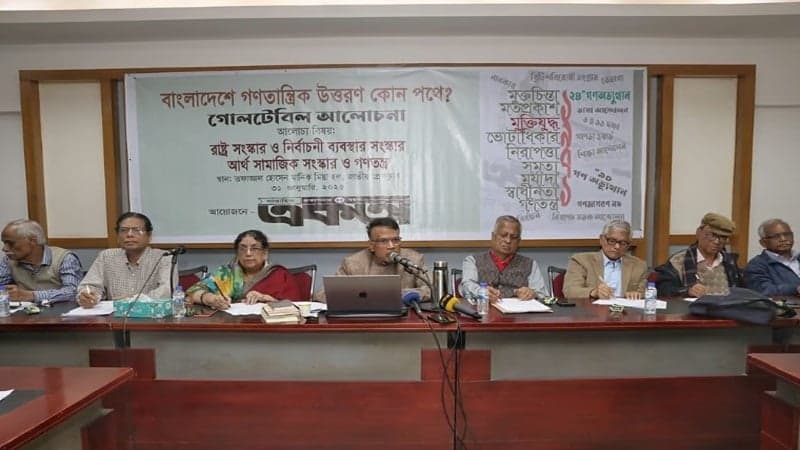

Speakers at a roundtable meeting held in Dhaka commented that in the current reality, early elections should be held with minimal reforms, otherwise the crisis will worsen. The speakers at the meeting also said that reforms within political parties are essential to turn the state into a people's state. Without reforms in the political party, no other reform will be permanent.
On Friday (January 31), leaders of various political parties and civil society, socio-cultural organizations participated in the roundtable meeting titled 'Which way is Bangladesh's democratic transition?' organized by Weekly Ekota at the National Press Club.
Eminent economist Professor Anu Muhammad suggested setting a retirement period for political leaders. He said that if a leader stays in office permanently, then dictatorship is born. It is important to have elected representatives at every level in the political party and an age limit should also be set for them.
He also said that a national-level political party must have a balance of religion, caste and gender, otherwise the development of political power on the part of the people is not possible.
Stressing the need for early elections, Communist Party of Bangladesh (CPB) President Shah Alam said that the crisis will worsen if elections are not held soon. He admitted that they could not catch the first phase of the student-public uprising in July, which strengthened the right wing. He called for a united stance of the left democratic forces in preparation for the elections.
Professor Badiur Rahman, President of the Bangladesh Udichi Shilpigoshthi, criticized the proposal to change the four basic principles of the current constitution. He said that in the past, military governments did not try to rewrite the constitution, but rather ruled by maintaining the constitution. But now an attempt is being made to rewrite the constitution.
Journalist Mozammel Hossain Manju called for opening the way to democracy through elections by making minimum reforms.
Professor Tajul Islam said that the previous government created an undemocratic environment to create opportunities for looting. Therefore, it is important to restore the democratic system through elections. He believes that the democratic system will be normal only after two or three elections.
BAS General Secretary Bazlur Rashid Firoz commented that although the constitution has been amended 17 times, there are many good things included in it, but no one is following them. He said that no other reform will be effective except for reforms in political parties.
CPB General Secretary Ruhin Hossain Prince said that the Chief Adviser assured them in a meeting that the reform process would be taken forward after discussing with the political parties. He urged to start these discussions quickly.
The roundtable meeting was chaired by Afrojan Nahar Rasheda, editor of Weekly Ekota and CPB presidium member. In her closing speech, she expressed disappointment over the lack of participation of women in the discussion meeting. Bangladesh JSD leader Mushtaq Hossain, Gono Forum General Secretary Mizanur Rahman and others also spoke.
Nazrul Islam, former head of development research at the United Nations and professor at the Institute of South Asian Growth, presented an article on the report of the Constitutional and Electoral Reform Commission at the roundtable meeting. Moreover, Professor MM Akash, Chairman of the Economic Research Bureau of Dhaka University, presented an article on Bangladesh's democratic transition and socio-economic reforms.
Professor Nazrul Islam questioned that the report of the Constitutional Reform Commission mentioned the need to rewrite the constitution, but how necessary is it? He said that reforms can be brought by incorporating the aspirations of the students and the people of July's uprising. Regarding the bicameral legislature, he said that its necessity has not been clarified, and there are also no clear instructions on the jurisdiction and sharing of power between the two houses.
He said that proportional elections are the most effective method. The reform commission has talked about proportional elections in the upper house, but in fact it is most necessary for the lower house.
Professor Nazrul Islam sees the recommendation to strengthen the local government system in the report of the Constitutional and Election Reform Commission as positive. However, he questioned the need for the National Constituent Assembly and expressed concern that it could become another center of power.
Professor MM Akash said in his article that reforms in the financial sector, energy system and market system are necessary, otherwise social unrest will increase, the signs of which are already visible.
He also said in the article that those among the police, education officers, bureaucrats and businessmen who have unfairly helped the previous government should be identified and tried. However, fair trial should be ensured instead of giving justice to the unruly crowd (mob justice) in the case of minor criminals. He emphasized on returning the huge amount of money that was laundered as a relatively big crime.
At the end of the article, he said, ‘No matter how uncertain the future is, at least no new conflict or civil war should arise over settled issues like the Liberation War.’
Professor Mostafizur Rahman, Honorary Fellow of the Center for Policy Dialogue (CPD), said that according to the white paper, $16 billion has been laundered abroad. He warned that the launderers will unite and oppose in an effort to bring this money back, but this cannot be done.
He said that the current government needs to focus on increasing direct taxes by reducing its dependence on VAT and supplementary duties to increase its revenue. Even if there was an opportunity to reduce the trend of tax evasion, the government would have used it.
Leave A Comment
You need login first to leave a comment