
Thousands of families face livelihood crisis as bandit gangs trrorise Sundarbans
Students stage awareness march, protest and human chain in coastal communities

Thousands of families dependent on the Sundarbans for their livelihoods are facing severe hardship as forest bandits continue to terrorise the mangrove forest. Unable to earn a living, many families are struggling to meet even their basic needs.
Fear of abduction and extortion has prevented many forest-dependent people from entering the Sundarbans to catch fish and crabs or collect golpata (nipa palm leaves). With their sources of income cut off, families are facing growing financial uncertainty, while their children's education is also under threat.
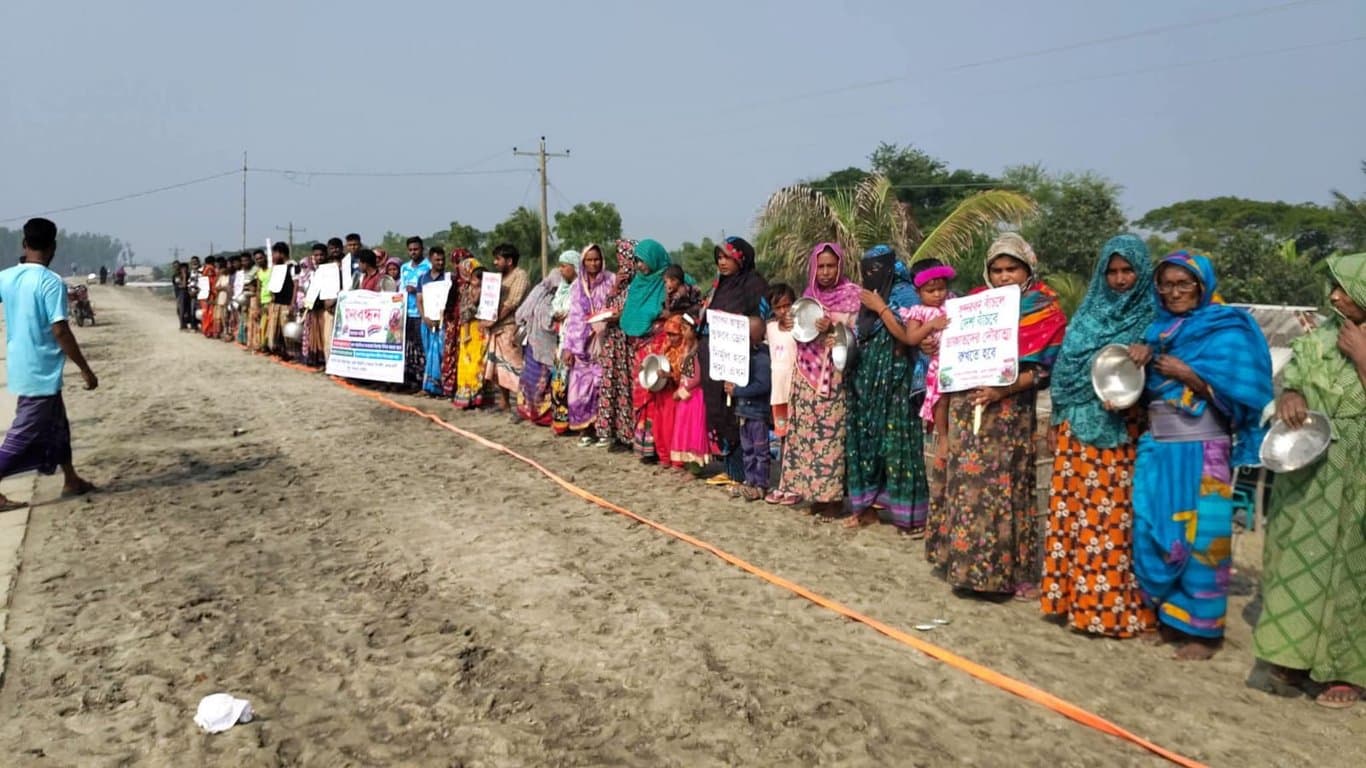
Against this backdrop, students from communities along the Sundarbans coast have taken to the streets, demanding protection for their families' livelihoods and the right to continue their education.
On Friday (27 November), an unusual awareness march, protest and human chain began at around 11:30am from the grounds of Sora Independent Ebtedayi Madrasa in Gabura Union.
Carrying books, notebooks, banners and placards, students raised slogans across the coastal area. At one point, they tore pages from their notebooks and threw them into the water as a symbolic protest. Their speeches highlighted the growing helplessness of families dependent on the forest.
Hafiza Khatun, a ninth-grade student, said: “Our parents' unemployment is taking away our books and notebooks. The authorities must launch an intensive operation to eliminate the forest bandits without delay.”
Another student, Sakila Parvin, said her father could no longer enter the forest because of fear of the bandits.
“There is not enough food at home. We cannot afford examination fees or new books. We want to survive and continue our education,” she said.
Student Hira Moni questioned who would take responsibility if an entire generation in the coastal region were deprived of education because of the bandits' activities.
Parents also expressed deep concern about their children's future. Monowara Khatun said the loss of their source of income had made it increasingly difficult to run the household and pay for their children's education. She called for urgent government assistance and relief.
Kamrul Islam, another parent, warned that unless the activities of the forest bandits were stopped, families dependent on the forest would be pushed into hunger and illiteracy.
Other students who spoke at the programme included Russell Rana, a tenth-grade student at Chandnimukha MM Secondary School; Junaid Hossain, a ninth-grade student at Chandnimukha Parijan Alim Madrasa; Sakila Parvin, Ashura Khatun, Ayesha Qurruni, Munni Akter, Rakib Hossain, Tutul, Zillur Rahman and Hira Moni.
The programme was chaired by Ziarul Islam, an honours student of English literature, and conducted by college student Ashikur Rahman.
Hafez Md Shafiqul Islam, imam of Gazibari Jame Mosque, along with Monowara Khatun and Kamrul Islam, expressed solidarity on behalf of parents. Teachers Master Abdur Rahim and Shahidul Islam also voiced their support.
The protesters called for effective operations against forest bandits in the Sundarbans, an end to abductions and extortion, guaranteed safety for people earning their livelihoods in the forest, and urgent financial assistance for students from families affected by the crisis.
According to local accounts, 12 forest bandit groups are currently active in the forests under the Satkhira Range of the western Sundarbans. People entering the forest are reportedly forced to pay regular extortion money. Paying one group does not necessarily ensure safety: those who fail to pay another group risk being abducted. Fishermen and other forest workers are often released only after ransoms are paid.
For a long time, residents of Gabura, Padmapukur and Burigoalini unions in Shyamnagar have been campaigning through protests and human chains to make the Sundarbans free of bandits. Forest workers and female members of their families have taken part in these demonstrations. The latest development is the involvement of their school-going children, who have joined the movement to defend their families' livelihoods and their own future.
Leave A Comment