

The ‘Covert Politics’ debate and…
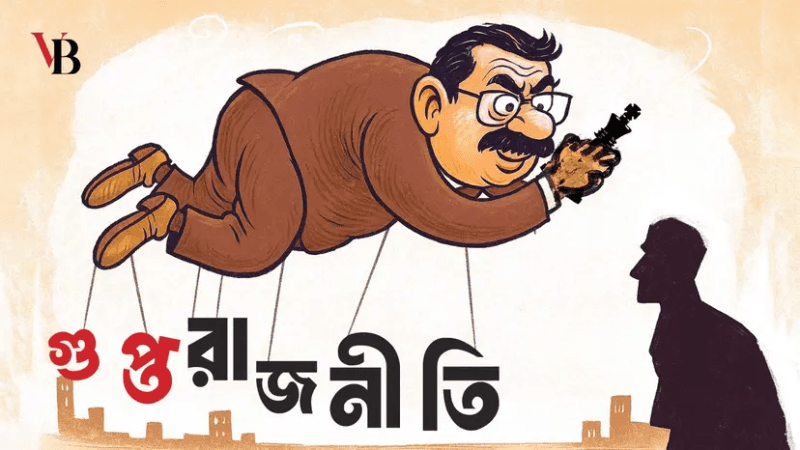

As the 13th National Parliamentary Election draws closer, political discourse in Bangladesh is becoming increasingly sharp—marked by heightened rhetoric, strategic wordplay, and intensified efforts to politically weaken opponents. A recent and notable example of this trend is the public war of words between the BNP and Jamaat-e-Islami over the use of the term “ Guptho (covert).”
On one side, the BNP has been labeling Jamaat as a “covert organization” in various public rallies. In response, Jamaat has countered by accusing the BNP’s top leadership of engaging in “covert politics.”
This exchange is not merely an expression of party-level tension; rather, it reflects deeper dynamics tied to electoral strategy, fractures in alliance politics, the reconfiguration of vote banks, and long-standing mutual distrust shaped by past political experiences—calling for in-depth analysis.
In Bangladeshi politics, the word “covert” carries more than its literal dictionary meaning. It functions as a political label, often used to accuse a party or leadership of operating opaquely, unconstitutionally, or under the influence of unseen forces. Historically, the term has surfaced in contexts involving military rule, shadow governments, or behind-the-scenes political deals.
In the current context, when the BNP describes Jamaat as a “covert organization,” it is not merely questioning Jamaat’s organizational status. Rather, it is attempting to send a calculated message to voters by invoking issues such as international pressure, registration complications, and Jamaat’s past political role.
An analysis of the BNP’s recent statements suggests that the party is deliberately trying to create visible political distance from Jamaat-e-Islami. There appear to be several possible reasons behind this approach.
First, the international context. The BNP has long portrayed itself as a democratic and liberal political force. To maintain this image before Western countries and the international community, any visible alliance or dependence on Jamaat may be perceived as politically uncomfortable for the party.
Second, internal vote-bank considerations. Within the BNP, a significant segment believes that excessive closeness to Jamaat alienates moderate and young voters. By labeling Jamaat a “covert organization,” the BNP may be signaling that it does not rely on any banned or controversial political force.
Third, past experience. According to several political analysts, while Jamaat once served as an ally in coalition politics, in some instances it also became a liability for the BNP. That historical memory may now be driving the BNP to clarify its position in advance.
Following the BNP’s remarks, Jamaat’s sharp reaction is not merely emotional; rather, it reflects a political expression of the party’s existential crisis. When Jamaat leaders label the BNP’s top leadership as practitioners of “covert politics,” they are essentially trying to convey two key messages.
One objective is for Jamaat to present itself as an openly active and organized political force. By doing so, it seeks to argue that it is not operating in secrecy, and instead suggests that a major party like the BNP is the one engaged in behind-the-scenes politics.
Another aim is to remind the BNP of Jamaat’s past role in political movements, electoral politics, and power-sharing. Through its reaction, Jamaat appears to be warning that it will no longer remain silent if its past contributions are ignored under the current political circumstances.
This raises a key question: Does this public war of words signal a genuine political rupture, or is it merely a strategic political drama?
Bangladesh’s political history shows that as elections approach, parties often create visible distance in public while maintaining communication behind the scenes—a practice commonly referred to as “strategic distancing.”
However, analysts believe the current situation may be somewhat different. Jamaat is now in a weakened position both organizationally and legally. The BNP has publicly stated that it is preparing to lead political movements and electoral efforts independently. Moreover, the tone of statements from both parties clearly reflects deep mutual distrust. These factors suggest that this is not merely political theater, but rather a phase of long-term relationship reassessment.
Ultimately, this debate over the term “covert” has revived a long-standing dilemma in Bangladeshi politics: transparency versus backroom politics. While parties accuse one another of secrecy, many voters have long remained skeptical about hidden deals and unseen political alignments. If this controversy remains limited to rhetorical sparring without contributing any positive message toward improving political culture, it will offer little benefit to democracy.
As the 13th National Parliamentary Election approaches, the growing tension between the BNP and Jamaat-e-Islami over the use of the term “covert” is far more than a mere battle of words. It reflects the lingering calculations of past alliance politics, the pressures of present-day strategy, and efforts to shape future political positioning.
Where this conflict will ultimately lead—toward a complete rupture or a quiet understanding—will depend on timing, political realities, and electoral arithmetic. One thing, however, is clear: in election-driven politics, words are no longer just words; they have become strategic weapons on the path to power.
Author: Fasih Uddin Mahtab is a journalist
Leave A Comment
You need login first to leave a comment