

The first protest against Punjabi discrimination
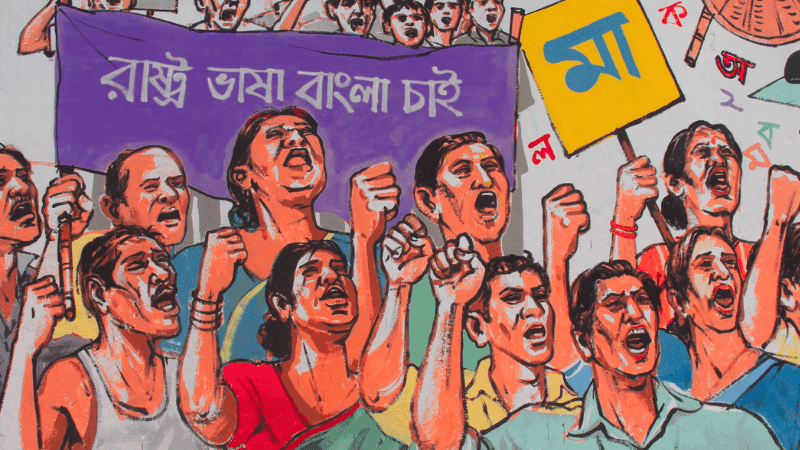

The Language Movement marked the awakening of the Bengali nation. What began in 1947 reached its culmination in the blood-soaked spring of 1952. Yet this movement was not merely a linguistic awakening; it emerged from accumulated deprivation and the betrayal of the Pakistani ruling elite.
The idea of the peculiar state called Pakistan originated with the Lahore Resolution. On March 23, 1940, Bengal’s Prime Minister Sher-e-Bangla A.K. Fazlul Huq presented this resolution in Lahore. The people of East Bengal stood at the forefront of the struggle to establish a state based on justice and equality. Bengali Muslim League leaders led the movement for autonomous and sovereign Muslim-majority units. In the final days, slogans such as “Haath mein bidi, muh mein paan, larke lenge Pakistan” echoed as people voted for Pakistan, hoping to end zamindari exploitation and establish social justice, an aspiration for economic emancipation.
Sir Cyril Radcliffe, a British lawyer, was entrusted with the task of partitioning India in 1947. Through his arbitrary demarcation, the state of Pakistan was born alongside India, an oddly shaped, geographically divided country separated by more than 1,200 miles. There was no common language, culture, or even food habits between its two wings; the only shared element was religion. Even at the time, many questioned whether religion alone could sustain a modern state. When the partition became final, the last Viceroy, Lord Mountbatten, reportedly told Jawaharlal Nehru that Pakistan would be an artificial state unlikely to survive more than 25 years. Ironically, though the political role of East Bengal’s people was crucial in creating Pakistan, they soon became victims of severe discrimination within the new state. Their dreams were shattered from the outset, prompting renewed struggle immediately after Pakistan’s birth.
In the new Islamic state, the Punjabi-dominated ruling class quickly consolidated power. Almost all key positions were occupied by West Pakistanis. In the Pakistan of Governor-General Quaid-e-Azam Muhammad Ali Jinnah, ministers were West Pakistani, bureaucrats were West Pakistani, and the army was overwhelmingly under their control. Notably, in 1947 the proportion of Bengalis in Pakistan’s military remained below 10 percent, despite Bengalis constituting nearly half of the population. Economically, East Bengal contributed the lion’s share, yet the capital was established in Karachi, leaving Dhaka neglected. In effect, British rulers were replaced by West Pakistanis, primarily Punjabi elites.
Amid this continuing discrimination, the language issue emerged as the first flashpoint. One of Pakistan’s fundamental weaknesses was that its two wings did not share a common language. In 1971, West Pakistan comprised four provinces, each with its own language: Punjabi in Punjab, Sindhi in Sindh, Balochi in Balochistan, and Pashto in the North-West Frontier Province. Although some people spoke Urdu, the scripts of these languages were similar, based on the Urdu script. In contrast, the language of almost all people in East Bengal (except in the hill tracts) was Bangla, with a completely different script rooted in Sanskrit.
The Pakistani rulers were well aware of this linguistic divide. They sought to forge unity by imposing Urdu—considered by them the language of Islam—as the sole state language. They believed that declaring Urdu the state language would create an unbreakable bond between the two wings. It was a deeply unrealistic plan.
This decision proved disastrous for the Punjabi rulers. When the process of stripping Bengalis of their linguistic rights began, the entire province ignited in protest. For the first time, the people of Bengal united against Pakistan’s discriminatory state structure. Youths, leftists, and even the then right-leaning Awami Muslim League stood together in support of the Language Movement. Exceptions included Khwaja Nazimuddin’s Muslim League and certain hardline Islamist groups. Another influential group opposing Bangla consisted of Old Dhaka–based elites and members of ruling Muslim families. Many among these elites never fully embraced Bangla as their own language and therefore supported Urdu. Nevertheless, the majority of Bengalis firmly stood for Bangla. The Bengali people were deeply emotional and sensitive about their language. As a result, soon after the new country’s birth in August 1947, a strike was called in Dhaka in December of the same year over the language issue. On December 13, 1947, the first general strike was observed on this question—a significant milestone.
It is worth noting that Pakistan made every effort to impose Urdu over Bangla. During his visit to Dhaka in 1948, Pakistan’s leader Muhammad Ali Jinnah declared at a special convocation at the University of Dhaka on March 24 that Urdu alone would be the state language. He argued that Islamic culture and Muslim heritage had flourished most in Urdu and that it stood on par with the languages of other Muslim states. The Bengali nation rejected this declaration. Students protested at the very event. Ultimately, in the Language Movement of 1952, the blood of martyrs stained the streets of Dhaka, preserving the dignity of the mother tongue. That path eventually led, in 1971, to the birth of a language-based state—Bangladesh.
Author: Assistant Professor, Department of Mass Communication and Journalism, Jagannath University
Leave A Comment
You need login first to leave a comment