
The world builds corridors but we stands at the crossroads
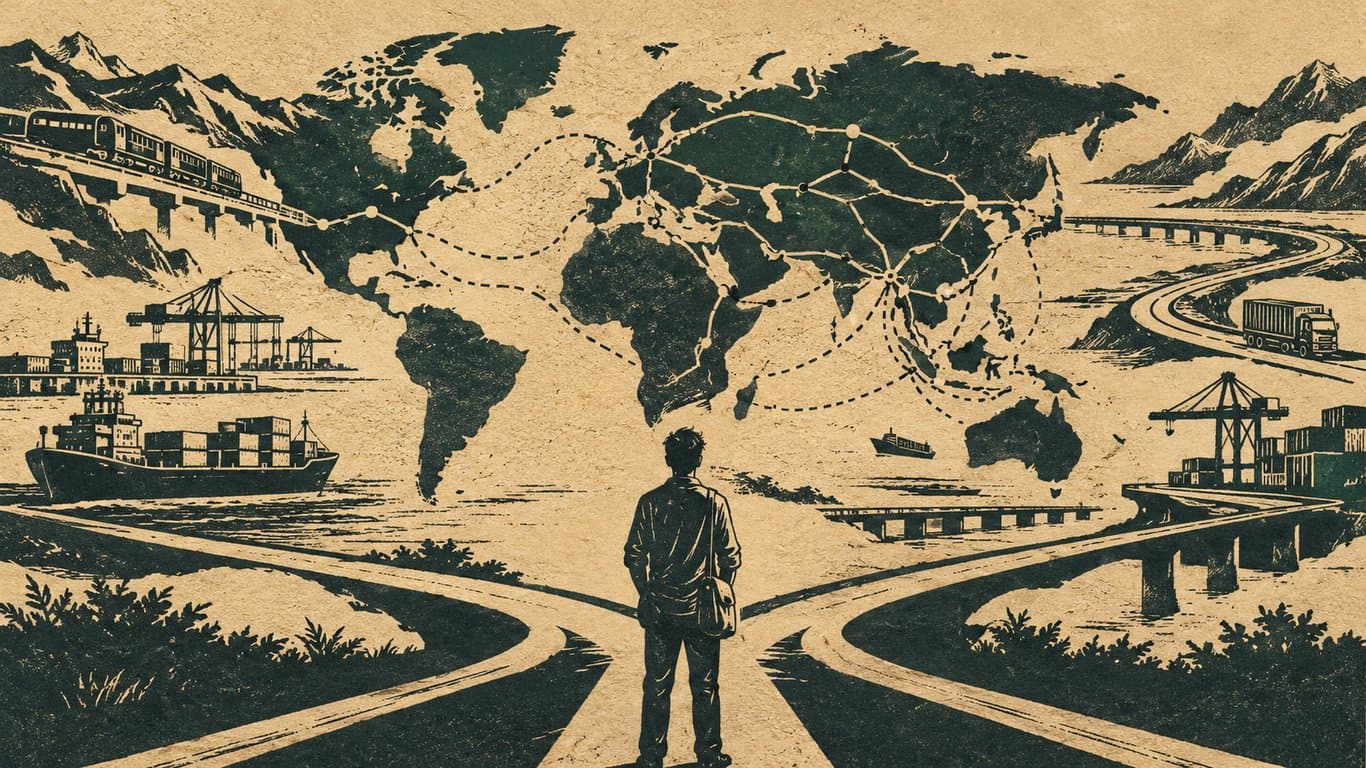

Spread out a map of the world today, and it looks rather like a sprawling house undergoing renovation. Someone is cutting through mountains to lay railway tracks, someone is building roads across the desert, someone else is connecting one port to another. China is expanding its routes to Europe. India is planning a passage west through the Arabian Peninsula. Kazakhstan, Türkiye and Laos are all busy drawing more trade through their own backyards. Bangladesh stands at a crossroads surrounded by possibilities. Only the destination of our own journey remains unclear.
Geography has not been ungenerous to us. India’s vast market lies next door; Nepal and Bhutan are nearby. To the east, Myanmar offers a passage towards Southeast Asia; to the south lies the Bay of Bengal. Given such a location, a trader would first think of opening a shop. We often prefer to stand by the window and admire the view. But trade does not come knocking merely because a country occupies a favourable spot on the map. We have to give it a reason to come, open the door and make room for business.
Competition in the global economy once centred largely on whose workers were cheaper and whose production costs were lower. The calculation now also includes the time needed to cross a border, the hours cargo spends waiting at a port and the days it takes to reach a buyer. If the money saved on the factory floor is swallowed up by delays at the port, cheap labour offers little cause for celebration.
The Middle Corridor illustrates this changing calculation. Efforts are under way to improve connections running from China through Kazakhstan, across the Caspian Sea and onwards through Azerbaijan and Georgia towards Europe. These countries have not acquired a new geography. They are finding new uses for the geography they already have. They understand that carrying another country’s goods across their territory can generate more than transport revenue. It can create demand for warehousing, processing, banking, insurance and a host of other businesses.
Türkiye, too, seeks to turn its position between Europe and Asia into commercial strength. Laos is using the China-Laos Railway to overcome some of the disadvantages of being landlocked. Thailand is weighing the prospects of a land bridge between two seas. These projects are not equally successful, nor have all the plans materialised. But a clear purpose runs through the discussion: how to earn more from where a country happens to stand.
India has chosen to keep several doors open. To the west lie the proposed India-Middle East-Europe Economic Corridor and efforts to reach Afghanistan and Central Asia through Iran’s Chabahar port. To the east are the India-Myanmar-Thailand highway and the Kaladan project. Security concerns, financing constraints and political obstacles remain. Yet the search for alternative routes continues. International trade does not sit on the veranda sipping tea, waiting for a neighbour to be accommodating.
Pakistan’s China-Pakistan Economic Corridor also faces debt, security and implementation challenges. There is considerable distance between the promise of Gwadar and its reality. Announcing a corridor, therefore, is no guarantee of prosperity. Bangladesh should learn from both the achievements and the disappointments. Alongside deciding which route to take, we need to establish what it will cost, what it will deliver and who will bear the risks.
It would be unfair to suggest that Bangladesh has nothing to work with. We have roads, bridges, railways, waterways and ports, as well as initiatives for regional connectivity. The problem is that we often treat them as separate projects. A bridge is inaugurated, work advances on a road, a port development plan is announced. But the larger picture — which industries all this infrastructure will connect to which markets — remains indistinct.
Our ambition could be to become an efficient maritime gateway for Nepal, Bhutan and India’s northeastern states. It could also be to develop into a regional centre for production, processing and distribution. Allowing other countries’ vehicles to pass through would not, by itself, achieve either goal. How much business Bangladeshi firms will secure, how many jobs our workers will gain and how many new buyers our industries will reach must sit at the centre of agreements and planning.
Our corridor debate, however, tends to hurry straight to the toll booth. How much money was collected and who used the road are important questions. But a shop cannot grow into a thriving business merely by charging people to enter. Connectivity becomes more valuable when goods are stored and processed here, when Bangladeshi banks and insurers participate, and when local suppliers win business. Toll receipts then become one small part of a much larger income.
None of these benefits will emerge on their own. They require reliable electricity, skilled workers, a predictable investment environment, straightforward customs procedures and timely cargo clearance. A fast train loses much of its advantage if the same information has to be submitted repeatedly at the border. Cargo may travel at impressive speed, but if its paperwork remains on its knees before an official’s desk, the destination will keep receding. Administrative efficiency must advance alongside infrastructure.
Bangladesh therefore needs a practical national corridor strategy. It must identify which goods will come from where, where value will be added and how those goods will reach the ports. Connectivity with Nepal and Bhutan has to move from meeting papers to regular freight services. Cooperation under BIMSTEC must extend beyond conference photographs into arrangements that businesses can use. Uncertainty in Myanmar calls for careful, long-term preparation for eastward connectivity.
This also requires continuity in diplomacy. Investors cannot plan with confidence if the country’s trade priorities keep changing with its governments. Cooperation with neighbours must secure Bangladesh’s interests, security and a fair economic return through clear terms. Emotion can furnish a speech on friendship; freight schedules require dependable arrangements. Foreign partners, too, will want to know whether the rules under which they dispatch goods today will still apply tomorrow.
Where the caravans of the Silk Road stopped, inns, markets and settlements of artisans grew. Containers have replaced the caravans, but the underlying economic principle has not changed. Routes must have livelihoods and markets growing around them.
Bangladesh’s task, then, is to connect the roads it builds with the lives its people hope to build. The greatest danger is not the absence of a road. It is the failure to decide where to go.
Standing at a crossroads, we can watch every vehicle pass.
Only our own journey fails to begin.
Leave A Comment