
There is no 'indigenous' group in Bangladesh, everyone is 'Bangladeshi': Home Minister

In the context of geographical and constitutional reality, all citizens living within the territory of Bangladesh share a single identity—"Bangladeshi." Home Minister Salahuddin Ahmed has remarked that there are no "indigenous" groups in the country.
He stated, "We are all inhabitants of Bangladesh. According to the constitution, the rights, and privileges of every citizen of the country are equally protected."
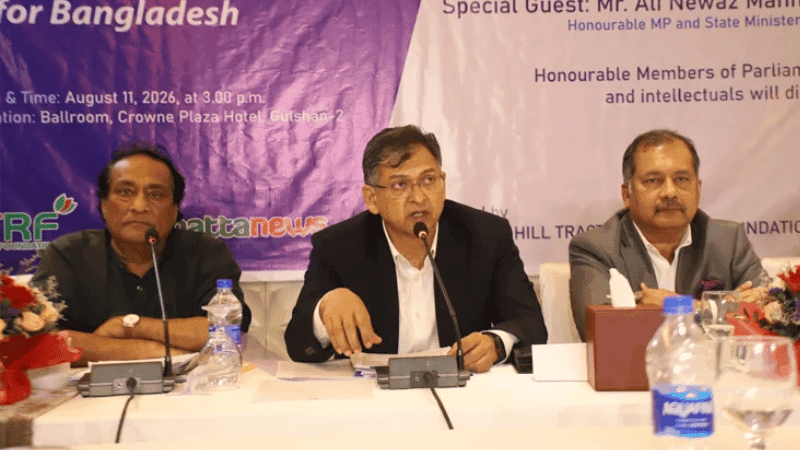
He made these remarks while serving as the chief guest at a roundtable discussion titled "The Identity 'Indigenous' is Irrelevant for Bangladesh," organized by the Chattogram Hill Tracts Research Foundation (CHTRF) at a hotel in Gulshan, capital, on Tuesday evening. The Home Ministry later disclosed his remarks through a press release.
Chaired by CHTRF Chairman Mehedi Hasan Palash, the event featured Information and Broadcasting Minister Zahir Uddin Swapon and State Minister for Cultural Affairs Ali Nawaz Mahmud Khayyam as special guests.
The Home Minister said that all citizens residing within the geographical boundaries of Bangladesh enjoy equal rights. He also claimed that in the "July National Charter"—a document of political consensus—all political parties and stakeholders unanimously agreed that the identity of people at all levels across the territory of Bangladesh will be "Bangladeshi."
Salahuddin Ahmed said that this national unity and political commitment serve as one of the foundational bases for protecting the country's sovereignty and integrity.
However, highlighting the constitutional protection for disadvantaged populations, the Home Minister stated that the state is committed to protecting, developing, and preserving the religious, social, and cultural heritage of small ethnic groups, tribes, and various communities.
Citing examples of neighboring multilingual and multinational states, the Home Minister noted that although hundreds of languages are practiced in those countries, separate "indigenous" identities have not been granted state recognition. Instead, backward populations have been integrated into the mainstream through various facilities and benefits.
He also spoke regarding the "United Nations Declaration on the Rights of Indigenous Peoples," adopted by the UN on September 13, 2007. He claimed that Bangladesh maintained a clear stance from the very beginning regarding that declaration and abstained from the voting, noting that many influential countries in the world also took a position against it.
The Home Minister further stated that the international declaration or International Labour Organization (ILO) Convention 169 is not applicable to Bangladesh, nor is Bangladesh a party to it.
Leave A Comment