
Tk 80 crore jute produced on Jamuna chars amid lack of supervision
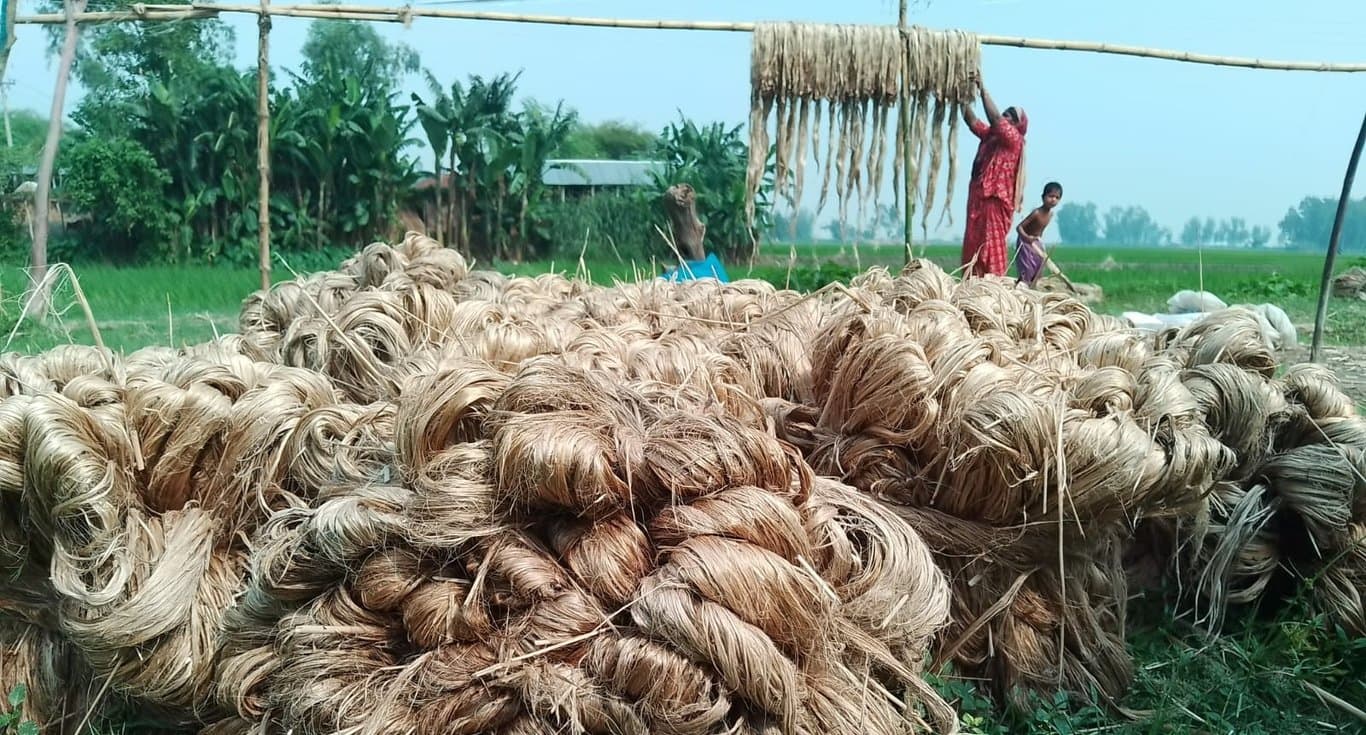

It was around 12:30pm. As we spoke to several farmers after reaching a char in the Jamuna River, 35-year-old Mariam Begum came forward.
“We have never received even a handful of mustard seeds from the government. Many people receive different kinds of support—some get fertiliser, others get seeds. We get nothing. We have to buy seeds and fertiliser from the market and cultivate our land ourselves. We barely manage to make ends meet,” she said.
Mariam is not the only farmer making such complaints. Speaking to at least 50 farmers in the Jamuna chars, most of them reported similar experiences. Despite cultivating crops year after year, their names do not appear on government agricultural incentive lists.
The farmers allege that receiving incentives requires repeated visits to agricultural offices, approaching political leaders and obtaining their recommendations. They do not do these things, they said, and consequently receive no government assistance.
Sixty-seven-year-old farmer Sahedzaman, a resident of Shalukarchar, said he last received one kilogramme of mustard seeds from the agricultural office about three years ago. He has never received fertiliser. He also said no one from the agricultural office had visited them in the past three years.
This was the picture observed during a visit to the Jamuna riverine chars in Sariakandi upazila of Bogura on Monday (September 7).
Speaking to farmers in Charbatia and Shalukarchar, it was learnt that they have long been deprived of government agricultural incentives. Yet agriculture is the main source of livelihood for virtually all of them. Most of the farmers here do not own land and cultivate plots belonging to others under informal lease arrangements.
According to agricultural office data, there are around 15,000 farmers living in the chars. In the current season, however, only 270 farmers received government incentives.
As incentives, these farmers were given one kilogramme of jute seeds, five kilogrammes of DAP fertiliser and five kilogrammes of MOP fertiliser.
Nili Begum, 50, from Charbatiya village, said she received one kilogramme of mustard seeds about two years ago. “Since then, I have not received any government assistance. No one has come to us. We do not even know how to apply for incentives. The agricultural office gave us mustard seeds only once, after taking down our names and addresses,” she said.
Lemon Islam, 30, of Shalukarchar, cultivated jute on eight bighas of land this year. He too received one kilogramme of mustard seeds about a year ago. Apart from that, he has received no assistance from the agricultural office. He has never received fertiliser either.
Mantezar Mondal, 40, a farmer from Shalika Char, cultivated jute on five bighas of land. He has been engaged in farming for around 20 years but has never received agricultural incentives.
“No one from the agricultural office has ever come to me. In most cases, people affiliated with the ruling party receive the assistance. It seems these incentives are not meant for us,” he alleged.
Seventy-five-year-old farmer Azizar Pramanik made a similar complaint. He received jute, maize and wheat seeds, as well as fertiliser and mustard seeds, three years ago. He has received nothing since.
“We are farmers, yet we no longer receive incentives. On the other hand, people who are not farmers are receiving them. This is how everything is being run,” he said.
Field-level observations also found that the lack of government assistance is not the only challenge faced by char farmers; high production costs are another major burden. At least 12 labourers are needed to cut, rett and wash jute grown on one bigha of land. Each worker is paid Tk 800. Farmers also have to bear the cost of seeds and fertiliser. According to them, around one and a half sacks of fertiliser are required for one bigha. Each sack currently costs around Tk 1,600.
According to agricultural office sources, producing jute on one bigha of land costs between Tk 16,000 and Tk 17,000.
The farmers said it takes around six months from planting jute to taking it to market. After deducting all expenses, they earn around Tk 8,000 from selling the jute produced on one bigha of land.
Despite the shortage of government support and inadequate supervision, however, farmers in the Jamuna chars have not fallen behind in jute production.
Mohammad Ali Jinnah, Sariakandi upazila agriculture officer, told Views Bangladesh that the target for jute cultivation in the upazila this season was 3,105 hectares. In reality, jute was cultivated on 5,055 hectares—around 2,000 hectares more than the target. Of this, 3,000 hectares were in the Jamuna char areas. The average jute yield in the upazila was around 2.8 metric tonnes per hectare.
According to data from the Department of Agricultural Extension in Sariakandi, jute was cultivated in 19 of the 37 blocks in the Jamuna chars.
Agricultural office figures show that around 8,400 metric tonnes of jute were produced on 3,000 hectares of land in the Jamuna chars.
Jute is currently selling for around Tk 3,800 per maund. At that rate, the market value of 8,400 metric tonnes of jute stands at approximately Tk 79.8 crore.
Field-level observations found that most farmers in the chars have been victims of river erosion. Their homes and land have been swallowed by the Jamuna. They now live on and cultivate other people’s land in the chars, making a living through farming.
The farmers said they regularly struggle with poverty and would benefit significantly from government assistance.
Asked about the issue, Sariakandi Upazila Nirbahi Officer (UNO) S M Mikail Islam told Views Bangladesh that only 270 out of thousands of farmers in the area had received incentives, which was clearly inadequate.
“We will soon take the necessary steps to bring more farmers under the incentive programme,” he said.
Leave A Comment