
Discussion Meeting on Rokeya Day
Urgent need for swift passage of tobacco control law amendments to protect women’s health
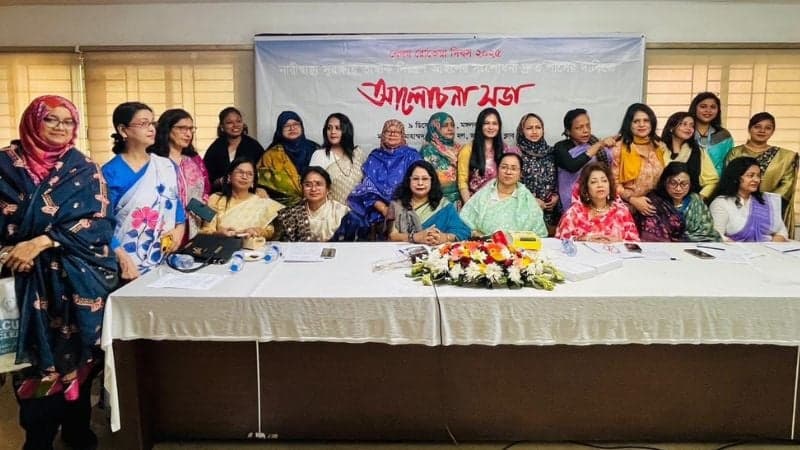

Professionally diverse groups of women have demanded the immediate passage of the proposed amendments to the tobacco control law to ensure women’s health protection.
The call was made at a discussion meeting marking Begum Rokeya Day 2025 on Tuesday morning (December 9).
The event was jointly organised by the Bangladesh Women Journalists Forum and Nari Maitree, held at the Moulana Mohammad Akram Khan Auditorium of the National Press Club.
At the event, the Bangladesh Women Journalists Forum also conferred the Begum Rokeya Award on journalists Mamtaz Bilkis, Mokbula Parvin, and Rozi Ferdous.
Speakers noted that Begum Rokeya was a pioneer in advancing women’s rights and leadership. On this Rokeya Day, we recall her progressive vision—a vision that called for women’s freedom, expanded access to education, and a society free from discrimination. In this context, the demand for amending the tobacco control law is not only a matter of public health; it is essential for protecting women’s health, ensuring women’s rights, and building a just society.
The discussion highlighted that in Bangladesh, 30% of women at workplaces and 21% of women in public places are affected by secondhand smoke (Source: Global Adult Tobacco Survey 2017). Women are also exposed at home. Smoking by fathers, brothers, or husbands at home, colleagues at workplaces, and strangers in public transport and public spaces exposes women to secondhand smoke, increasing risks of asthma, breast and lung cancer, and pregnancy complications.
According to the Bangladesh Cancer Society, women who spend even one hour daily near a smoker face double the risk of breast cancer compared to others.
Non-communicable diseases associated with tobacco use—such as heart disease, diabetes, chronic respiratory diseases, cancer, kidney disease, and injuries—are on the rise. According to the WHO Tobacco Atlas 2025, tobacco-related diseases claim about 130,135 lives annually in Bangladesh—that’s roughly 357 deaths every day.
The discussion was presided over by Masuma Alam, President of Nari Maitree. Special guest Nilufa Chowdhury Moni, Assistant Secretary of the central committee of the Bangladesh Nationalist Party (BNP), was also present at the event.
In her remarks, Nilufa Chowdhury Moni said, “The rising rate of tobacco use among women poses a serious threat to women’s health. Globally, tobacco companies are targeting women, placing them at increasing health risks. Beyond direct and secondhand smoking, women involved in tobacco cultivation and processing face severe health hazards. As a result, they suffer from reduced fertility, low birth weight babies, stillbirths, preterm deliveries, and other complications.”
President of the Women Journalists Forum, Fahmida Akhter, said: “Every year, Bangladesh incurs economic losses of about Tk 39,200 crore due to tobacco use. According to Johns Hopkins University, government revenue from tobacco in fiscal year 2023–24 was about Tk 40,000 crore, yet the combined cost of treatment for tobacco-related diseases and environmental damage amounts to Tk 84,000 crore. This overwhelming impact makes tobacco a true epidemic. To curb this epidemic, we need a strong law. Therefore, we demand immediate passage of the amendment proposed by the Ministry of Health.”
In her presidential speech, Masuma Alam said: “Bangladesh was the first country to sign the WHO Framework Convention on Tobacco Control (FCTC). According to the latest WHO report, Bangladesh has still not met the highest standards in creating smoke-free environments or banning advertising and promotion of tobacco products. Despite some recent government steps, Bangladesh continues to have the highest rate of tobacco use in South Asia. Passing the proposed amendments would significantly reduce tobacco use and mitigate its severe health and economic consequences.”
Speakers at the meeting presented six key proposals for amending the existing Tobacco Control Act: eliminating designated smoking zones in public places; a complete ban on the display and advertisement of all tobacco products; protection of youth from the harmful effects of e-cigarettes; banning the sale of single sticks of cigarettes and bidis; prohibiting tobacco companies’ corporate social responsibility (CSR); and increasing the size of pictorial health warnings on tobacco product packaging to 90 percent.
Also present as guests at the discussion meeting were Fahmida Akhter, President of the Women Journalists Forum; Dr. Khaleda Islam, Convener of the Nari Maitree Anti-Tobacco Teachers Forum; and Shibani Bhattacharya, Convener of the Nari Maitree Anti-Tobacco Mothers Forum.
Leave A Comment
You need login first to leave a comment