
Women are dying of dengue at higher rates — no one knows why
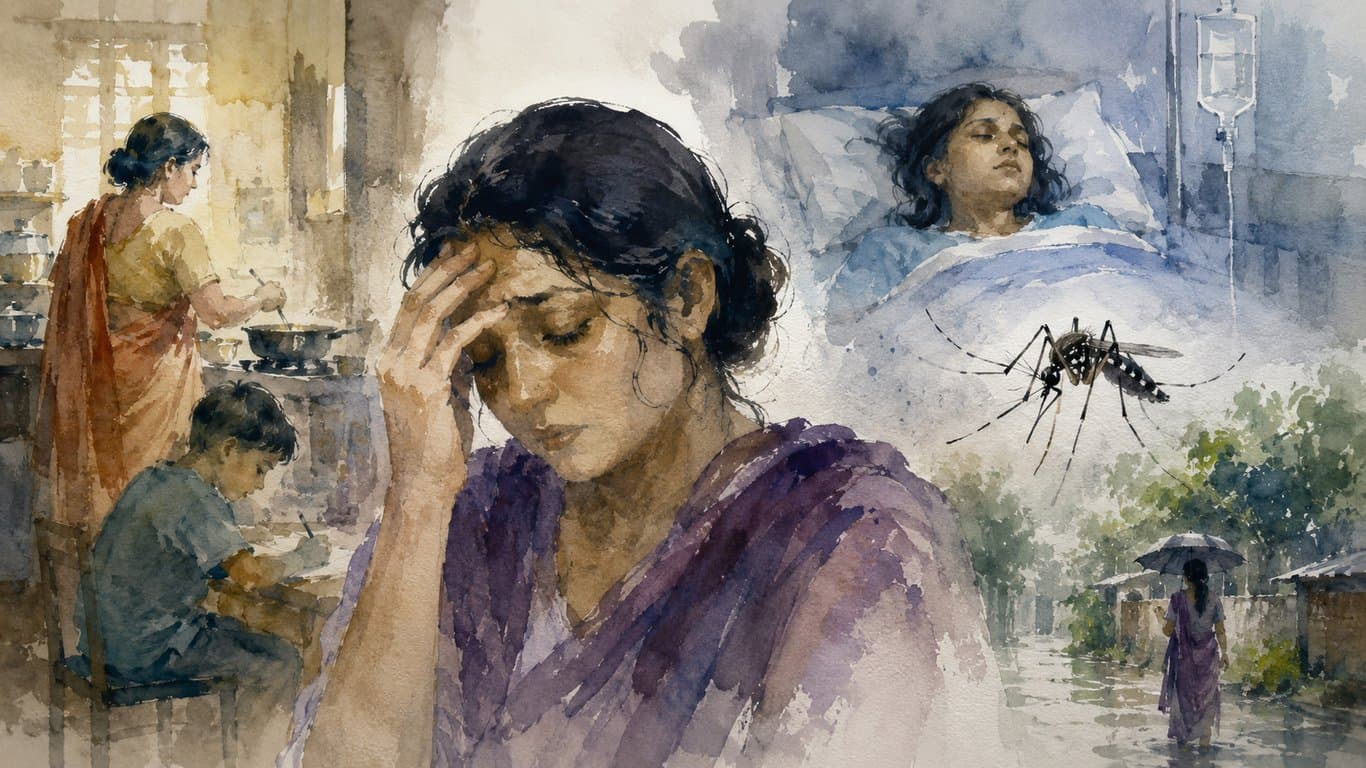

Every afternoon, the Directorate General of Health Services (DGHS) sends out a bulletin. The media runs it as routine. Amid a thousand other national crises, what is actually happening with dengue rarely stirs readers — or makes them think twice.
The DGHS bulletin issued on July 30 recorded 53 dengue deaths so far this year — 32 women, 21 men. The number is not new. Neither is the ratio. A 2019 analysis by the Institute of Epidemiology, Disease Control and Research (IEDCR) found that 65 percent of hospitalised dengue patients that year were men, yet nearly 54 percent of those who died were women. In 2024, women accounted for 51.2 percent of dengue deaths. This year, that figure has already crossed 60 percent. In just four days — July 26 to 30 — ten people died of dengue; seven were women.
Fewer women are being hospitalised. More women are dying. This is not a statistical quirk. It is a consistent, repeating, measurable disparity.
The question is why.
To that question, Bangladesh's health system has exactly one answer: "possibly."
Possibly, delay. Dengue treatment hinges overwhelmingly on timely fluid management. IEDCR itself has said that early detection and proper treatment can keep the fatality rate below one percent. Time is the only currency that matters — and it is precisely that time women lose most.
The reasons are more social than medical. In many households, when someone falls sick with fever, the decision of who gets taken to a doctor first is often not the woman's own to make. Under pressure to keep the household running, women are more likely to dismiss a fever as ordinary and treat it with paracetamol from the local pharmacy. Hospitalisation means the cooking stops, the children go unattended, elderly in-laws go uncared for — a calculation that frequently pushes the decision back by a day or two. In dengue, those two days can be decisive.
Possibly, repeated infection. Dengue has multiple serotypes; a second infection with a different serotype carries a well-established, medically documented risk of more severe disease. Aedes mosquitoes bite during the day — and women disproportionately make up those who spend the bulk of daylight hours in and around the home: homemakers, elderly women, women working from home. Who is closest to the stagnant water breeding mosquitoes in a household corner is not a difficult question to answer.
Possibly, biology. This is the reason discussed least. Dengue lowers platelet counts and raises bleeding risk. That risk is compounded when infection coincides with menstruation or pregnancy — a factor experts have flagged for years as one of the possible contributors.
Yet this is almost never said aloud. Public health messaging — on television, on posters — is uniform: don't let water stagnate, use mosquito nets, see a doctor if fever develops. Sound advice. But no campaign has ever stated that unusually heavy bleeding during menstruation is a dengue warning sign that warrants immediate hospital care, without waiting. No poster tells a pregnant woman diagnosed with dengue that she needs medical supervision from day one.
In a society where many young women hesitate even to raise such matters with their own mothers, life-saving information on exactly this subject goes undelivered — and the cost of that silence is written into the number 32.
Equally overlooked is another critical fact: the 24 to 48 hours after fever breaks are the most dangerous window in dengue. Many patients believe they are recovering; that is often when complications begin. Severe abdominal pain, persistent vomiting, bleeding from the gums or nose, reduced urination, restlessness or lethargy — any one of these warning signs means immediate hospitalisation. Delivered clearly, repeatedly, and in language that speaks to women's everyday reality, these messages could plausibly have prevented some of the deaths already recorded.
But none of this "possibly" is proven. Because no research has ever been conducted into why Bangladesh's dengue fatality rate is higher among women.
And that is the real story. Bangladesh has one of the highest dengue fatality rates in the world. In 2023 alone, 1,705 people died. Year after year, women have made up a disproportionate share of that toll. Yet no effort has been made to find out why.
This is not a lack of knowledge. It is a lack of will.
The data already exists. DGHS conducts a "death review" for every dengue fatality, and gender is recorded — which is how the numbers 32 and 21 are known at all. Adding a few more fields would not be difficult: How many days after fever onset did the patient reach hospital? How many times was medicine bought from a pharmacy before that? Who made the decision to go to hospital? Was the deceased woman pregnant, or menstruating? Where did the bleeding begin?
Answering these questions requires no new project, no foreign grant, no additional manpower. It requires only a decision — the decision to ask.
It is easy to say "women need to be more aware." But awareness is built on information, and that information has not been given to them. More importantly, awareness alone is not enough. Even when a woman recognises the danger herself, going to hospital is rarely hers to decide alone — transport, someone to accompany her, who looks after the children, who pays for tests: each step carries its own obstacle. These are not failures of personal awareness. They are structural realities. And structural problems are not solved with personal advice.
August and September mark the peak of dengue season. Of the 50 deaths recorded in the first seven months of this year, 32 came in July alone. The numbers ahead will almost certainly rise further — and women will almost certainly continue to make up the larger share.
When they do, bulletins will go out, lists will be published, headlines will run. The question is whether, on this same date next year, Bangladesh will have anything more to say than "possibly."
Shimul Zabaly. Poet & Journalist
shimulzabaly@gmail.com
Leave A Comment