

Youths tried to stop tanks by cutting down trees, placing dustbins on the roads : Kamal Lohani
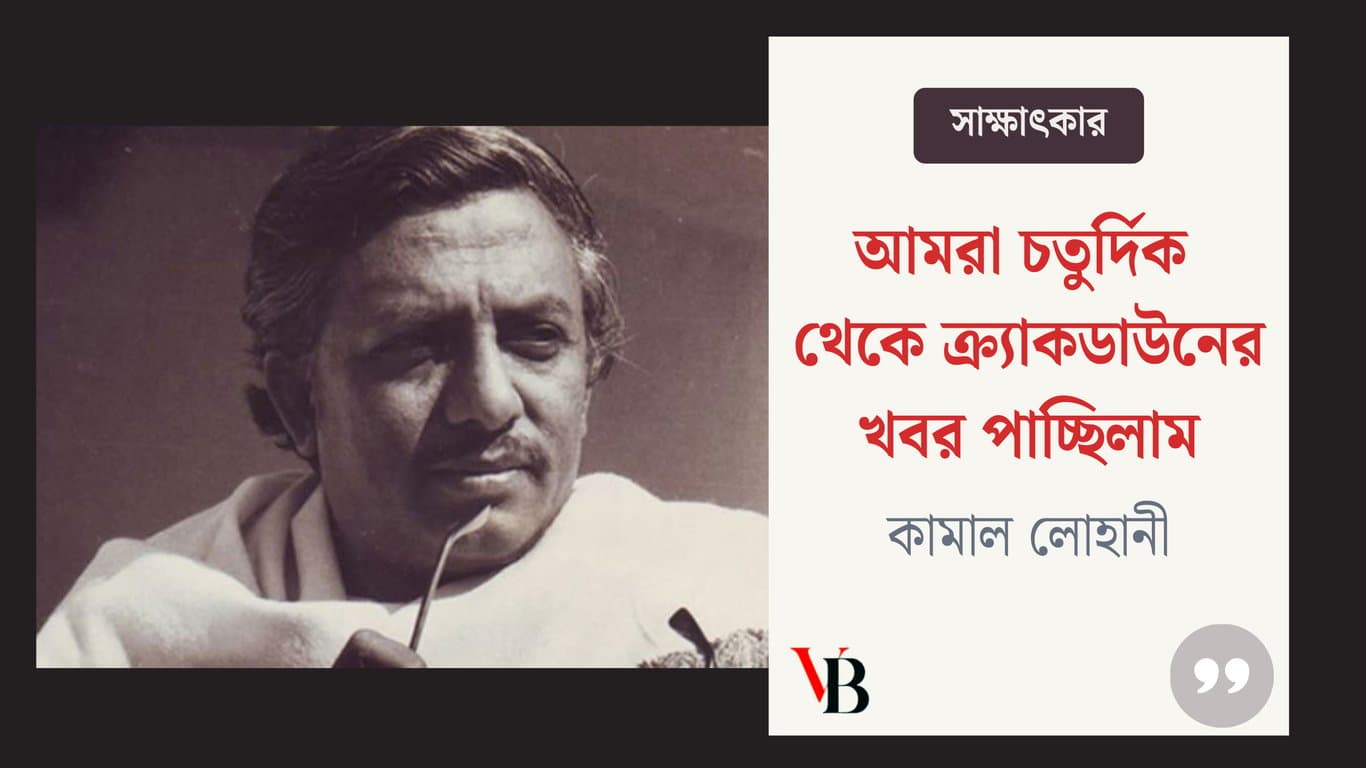
Kamal Lohani’s full name was Abu Nayeem Mohammad Mostafa Kamal Khan Lohani. He was a renowned journalist, cultural activist, and political figure in Bangladesh. Lohani began his career in journalism with the newspaper Dainik Millat. Later he joined Sangbad, where he initially worked as a senior sub-editor and was later promoted to shift-in-charge.
In 1969 he briefly worked for Paygam. After that, Kamal Lohani joined Dainik Purbodesh, a publication of the Observer Group. He served there as shift-in-charge. While working at this newspaper, he witnessed the March 25 crackdown very closely. Later he joined the Swadhin Bangla Betar Kendra during the Liberation War.
Let us try to learn from him about the horrific night of March 25. This interview was taken in March 2018 at Kamal Lohani’s residence in Dhanmondi. He passed away on June 20, 2020.
Rahat Minhaz: To begin with, could you tell us where you were working and in what position in 1971?
Kamal Lohani: In 1971 I was working as the Chief Sub-Editor of the daily Purbodesh. After the March 25 crackdown, our News Editor, Ehtesham Ahmed Chowdhury, temporarily left Dhaka to move his family to a safer place. At that time there was an attempt to assign me the responsibility of News Editor. However, I declined.
A.N.M. Golam Mostafa and I told the newspaper authorities that we already had a News Editor and that he would definitely return. Therefore, there was no question of taking over that responsibility.
Let me mention another thing. At that time I was the General Secretary of the East Pakistan Journalists’ Union. During the Non-Cooperation Movement, from our union we issued identification cards to both local and foreign journalists so that the police could identify them as journalists.
Rahat Minhaz: Could you tell us a little about your newspaper? Dainik Purbodesh was among the leading newspapers of that time, wasn’t it?
Kamal Lohani: The newspaper was originally founded in Noakhali. At first it was a weekly publication. Later, in 1969, it became a daily newspaper. The name was suggested by Badrul Haque, the younger brother of Kamrul Hasan. He was also a journalist. At that time Kazi Rahman Idris served as the acting editor.
Later, when the newspaper became a daily, Haji Mohammad Yusuf joined it. Badrul Bhai did not join because he was working at a college then. Those of us who worked there were very dedicated to the paper.
Rahat Minhaz: Let us come to the night of March 25. Where were you that night, and how did you witness Operation Searchlight?
Kamal Lohani: At that time the Director of the Central ISPR was a Brigadier. He was a West Pakistani and a Bihari. That Brigadier came to the Observer office and told us to prepare ourselves for independence. At that time Musa Bhai, K.G. Bhai and I were present.
My close West Pakistani friend Asrar Ahmed was also there. He was then the Pakistan representative of UPI (United Press International). During our conversation, the Brigadier said, “You will soon become independent, but what will happen to us? We Biharis will remain refugees.”
After that we all became very anxious. Suddenly we received news from the direction of Dhanmondi 32 that a crackdown was about to begin and that tanks had already rolled out. It was probably around midnight.
Rahat Minhaz: What did you see afterwards?
Kamal Lohani: We saw a tank coming in front of the Press Club and stopping near the office of the daily Pakistan. People had set up barricades there. In many neighborhoods people were building barricades to stop the tanks. They were using concrete blocks, cutting down trees, placing dustbins on the roads and using various other materials to block the way.
The soldiers cleared those barricades and opened the road. From there they began firing in different directions. They noticed a “Joy Bangla” flag flying on top of a water tank in Fakirapool. The flag was not very large. They fired several shots at it but could not bring it down.
Rahat Minhaz: Did you witness all this from the office?
Kamal Lohani: Yes. The office of Purbodesh had a fairly open space around it and there were no buildings nearby. Since it was located right beside the main road, we could see everything happening on the street.
There was a long veranda connecting the newsroom and the administration section. From there we could clearly see the road to the left. We saw people coming out to the streets trying to build barricades.
At the same time we were receiving news from different places about the crackdown. We heard that Rajarbagh was on fire. I went up to the roof of our office because my house was near Rajarbagh and I was worried about my family. We also received news that the military had attacked Pilkhana.
Rahat Minhaz: What else happened that night?
Kamal Lohani: It was probably around 11:30 at night. Our work had already ended and we had decided that the newspaper would not be published the next day.
At one point I spoke over the phone with Dr. Fazle Rabbee. His home was in Pabna. He used to treat me and my family. When I called him he said, “Lohani Sahib, don’t worry. Our boys have also learned to respond. They are fighting back.”
He was speaking from Siddheshwari, which meant resistance was taking place in areas like Mouchak and Khilgaon. While we were talking, suddenly the telephone line was cut off.
Rahat Minhaz: What did you do afterwards that night?
Kamal Lohani: I also called Badrunnessa Ahmed, who lived next to Bangabandhu’s house at Dhanmondi 32. I asked her about Bangabandhu’s situation. She said Bangabandhu was fine. But soon that line was also cut off.
After that we saw that all communication systems — telephone, telegram and teleprinter — had stopped. Curfew had been imposed.
Rahat Minhaz: How were your fellow journalists reacting?
Kamal Lohani: I must mention senior journalist Foyez Ahmed Bhai. On March 25, during the crackdown, he was not at home. He had come to the Press Club thinking it would be a safe place. He was lying on a sofa on the second floor.
But during the night the Press Club came under shelling and he was injured. The next morning he received treatment and went back home. Fortunately, no one died inside the Press Club.
Later several journalists were killed during the war. Journalist Shahid Saber was killed inside the Sangbad office. The office of The People newspaper was burned down. During the days of the Non-Cooperation Movement, Abidur Rahman of The People had written extremely bold headlines against the military regime. I do not know whether it was strategy or recklessness, but his words were like bombshells against the military authorities.
Rahat Minhaz: What did you do afterwards? Later you joined the Swadhin Bangla Betar Kendra.
Kamal Lohani: After the March 25 crackdown I went to Srinagar. On the way Foyez Bhai called me from the second floor of his house. His home was in Nagorhat village near Srinagar police station.
He asked where I was going. I told him I was planning to cross the border. He said I should inform him before leaving so that we could go together.
Later, about eleven of us, including Foyez Bhai and myself, travelled together to Tripura in India. Afterwards we went to Kolkata. On May 22 we went to Ballygunge Circular Road. In front of the Bangladesh Mission there, Aminul Haque Badsha almost pulled me along to another place nearby.
From there Swadhin Bangla Betar Kendra formally began broadcasting on May 25, 1971, the birth anniversary of rebel poet Kazi Nazrul Islam. I was given responsibility for the news section.
Leave A Comment
You need login first to leave a comment