

10 earthquakes in Feb, fears of major disaster
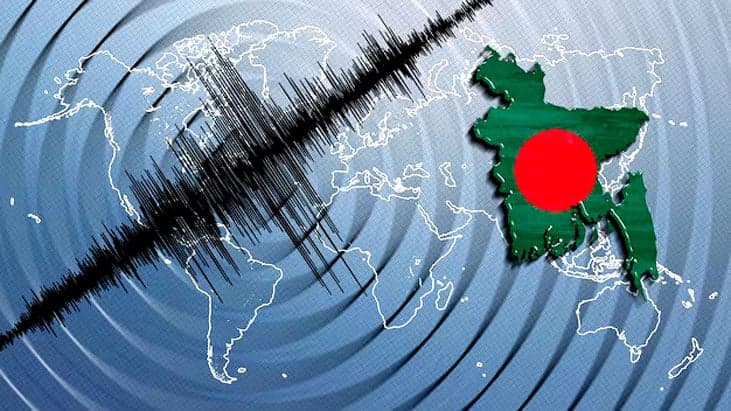

Bangladesh has been hit by an unusual number of earthquakes throughout February this year. In just 27 days, at least 10 mild to moderate tremors have been recorded in different parts of the country, which has raised concerns among experts.
A 5.3 magnitude earthquake was felt at 1:54pm on Friday (February 27). Its epicenter was Asashuni Upazila of Satkhira district. The tremor was felt immediately after Friday prayers, spreading panic among people across the country.
The previous day, earthquakes were also felt in different parts of the country , on Thursday (February 26). The European-Mediterranean Seismological Centre (EMSC) said that the magnitude of the tremor was 3.7, with its epicenter in the Indian state of Sikkim, bordering Bangladesh.
Although no major damage has been reported in these earthquakes so far, the frequent tremors are raising concerns among the public.
Statistics for February say that this series began with a magnitude 3 earthquake in Sylhet on February 1. Two consecutive tremors were felt on the night of February 3, the epicenter of which was Myanmar. A magnitude 4.1 tremor was recorded in Kolaroa, Satkhira, early in the morning of the same day. In addition, earthquakes of magnitude 3.3 and 4 struck the Sylhet region on February 9 and 10, respectively. Another earthquake of magnitude 4.1 occurred in Chhatak Upazila of Sunamganj on February 19.
A moderate tremor of magnitude 5.1 was also felt on the night of February 25, the epicenter of which was north-northwest of Maniwa town in Shangai region of Myanmar.
According to experts, the major cause of concern is the earthquake's origin moving inside the country. While earlier the epicenter of major tremors was usually confined to India or Myanmar, in recent times areas like Madhavadi in Narsingdi, Baipail in Savar and Badda in the capital are also being identified as epicenters. This indicates that the country's internal tectonic plates are becoming active.
Geologists say that energy stored for a long time inside the crust can be partially released through small tremors. However, if large amounts of energy are not released for a long time, it can turn into a devastating earthquake. Bangladesh is historically at risk of earthquakes because it is located at the junction of the Indian and Eurasian tectonic plates.
Meanwhile, dense and unplanned urbanization has made the situation even more risky. Experts believe that even a moderate earthquake can cause major damage due to Dhaka's soft soil structure and weak infrastructure. They are emphasizing the implementation of building codes, the preparation of a list of risky buildings and increasing public awareness.
Nature is repeatedly giving us warning signals. If coordinated preparations are not made now, the country may have to pay a heavy price in the future for major natural disasters.
Leave A Comment
You need login first to leave a comment