
Jahangirnagar University research
20 dolphins surviving in Buriganga
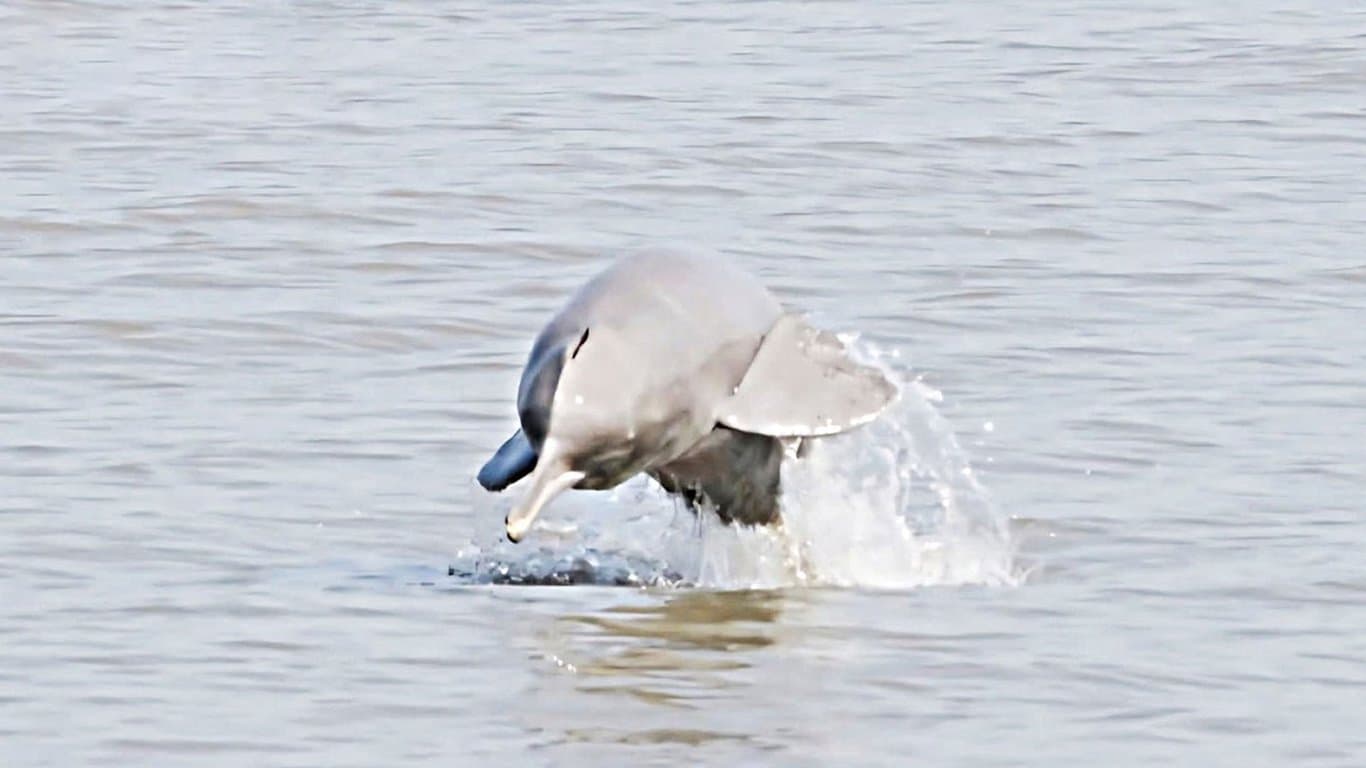

The Ganges river dolphin or local river shushuk is continuing a silent struggle of survival behind the deep water of the toxic, oil-coated blackish water of the Buriganga river where it has become impossible for ordinary aquatic animals to survive. According to the environmental scientists, these animals have taken a new strategy as the last desperate attempt to save life in the extremely adverse environment. They have now changed their behaviour. Earlier they usually moved alone. Now they are moving in groups.
Such information has come up in a research article recently published in the Journal of Asia-Pacific Biodiversity. The title of the research was ‘Population Status, Spatiotemporal Distribution, and Habitat Drivers of Endangered Ganges River Dolphins in the Buriganga River, Bangladesh’.
This research was conducted for 12 months (September 2023 to August 2024) under the leadership of Professor Dr Mohammad Abdul Aziz of the Zoology Department of Jahangirnagar University. Sumaiya Khatun, Amir Hamza, Md Aminur Rahman and Jakia Sultana Sraboni were also associated in the research.
They moved at a speed of 5-6 kilometres per hour on an engine-powered boat in the morning along the middle of the river to identify the dolphins. Following the N-mixture model analysis they found that about 20 dolphins are still alive across 27 kilometres of the Buriganga in Dhaka. Dolphins have been found at an encounter rate of 0.18 per kilometre, which was 0.29 in 2012 and 0.48 in 2015. That is, the density of dolphins in the Buriganga has decreased alarmingly in the last one decade. This is the lowest in the country compared to the Padma (0.53), Sangu-Karnaphuli (1.36) or Halda (0.76) rivers.
It has been seen in the research that earlier the Ganges river dolphins mainly used to roam alone. To survive in the adverse environment they are now roaming in groups. 80.70 percent of the dolphins found in the survey were in groups. On average 4.18 dolphins have been seen per group. Besides, in the crisis of local fish in the polluted water of the Buriganga the dolphins are now surviving by eating harmful ‘sucker fish’.
It is seen in the research that among the total recorded dolphins 84.21% were adults and 15.79% were calves. The calves have mainly been seen in these two periods—November to January and April to June. This proves that the reproduction of dolphins has not stopped despite the toxic environment, however there remains deep doubt whether these calves are getting a suitable environment to grow up.
It is seen in the research that the presence of dolphins was the highest in December (encounter rate 0.44/km). No dolphin was seen in the river in October and the monsoon (July-August). In the dry season as the water of the river decreases and the density of toxic waste increases excessively they leave the upstream flow and move towards the downstream Dhaleshwari river.
The Ganges dolphin is almost blind and completely dependent on the method of echo of sound for hunting and movement. It is seen in the analysis that the presence of dolphins is at zero level in those parts of the river where the movement of vessels is high. On average more than 665 heavy vessels move per month in the parts adjacent to Sadarghat, Hasnabad and the dockyards of large launches. The intense sound of the engines of launches and large cargos creates such a ‘sound monster’ under the water that disables the hearing power of the dolphins. As a result they cannot identify the prey.
The depth of the river has been identified as the strongest positive driver of the presence of dolphins in the research. Deep water gives protection to the dolphins from the sound of the engines and the man-made disturbances of the surface and ensures adequate flow of water.
It is seen in the research that the average amount of dissolved oxygen in the water of the Buriganga is 1.06 milligrams/litre, which has decreased to 0.05 milligrams/litre in places. A minimum of 4 milligrams/litre of oxygen is needed for the survival of the aquatic environment and fish. Extreme scarcity of local species of fish has appeared in this toxic water due to the chemical waste of the industries being dumped continuously through 57 points. As there is no fish the food chain of the dolphins is breaking, due to whose indirect effect they are being forced into starvation and relocation.
It is seen in the mapping and heatmap analysis of the researchers that instead of being spread across 27 kilometres the presence of dolphins is mainly concentrated in three specific ‘pockets’ or deep parts of the river. The highest movement or density has been seen in Bosila area (44.06%), as the average depth of the river is higher and the sound pollution is less the highest roaming of the dolphins has been found in this part. Besides, the presence of dolphins has been found 30.16% in Ghatarchar and 25.78% in Kamrangirchar. A large part of the mid-Buriganga including the Sadarghat area has become almost completely ineffective for the dolphins due to the sound of vessels and pollution.
Professor Dr Mohammad Abdul Aziz said the survival capacity of trying to survive till the last moment of the dolphins in a river like the Buriganga is like the struggle of survival of humans. The dolphins of the Buriganga are also perhaps trying to survive till the last moment. They do not have adequate food now. Therefore they are eating harmful sucker fish. With the condition of the Buriganga the dolphins will not survive for a very long time if we cannot make this river free from pollution.
He said there are many cities in the world where there are no dolphins but there is good water. It is our fortune even now that the dolphins are surviving even after the condition of our water becoming so bad. If we can make this water free from pollution then the people of Dhaka city will also be able to see dolphins standing on the bank of the Buriganga.
The researchers have recommended declaring the Kholamora-Bosila and Pagla-Fatulla junction areas as ‘dolphin protected areas’ immediately. Among the other recommendations are making the rule of keeping the speed of vessels below 5 kilometres per hour and the sound of the engines within 120 decibels under the water mandatory in the protected parts and bringing the discharge of toxic chemical water down to zero level by launching ETPs at the 57 waste discharge points of the Buriganga.
Leave A Comment