
When justice has to be wrested from the state: Part-1
30 Years of the Yasmin Tragedy
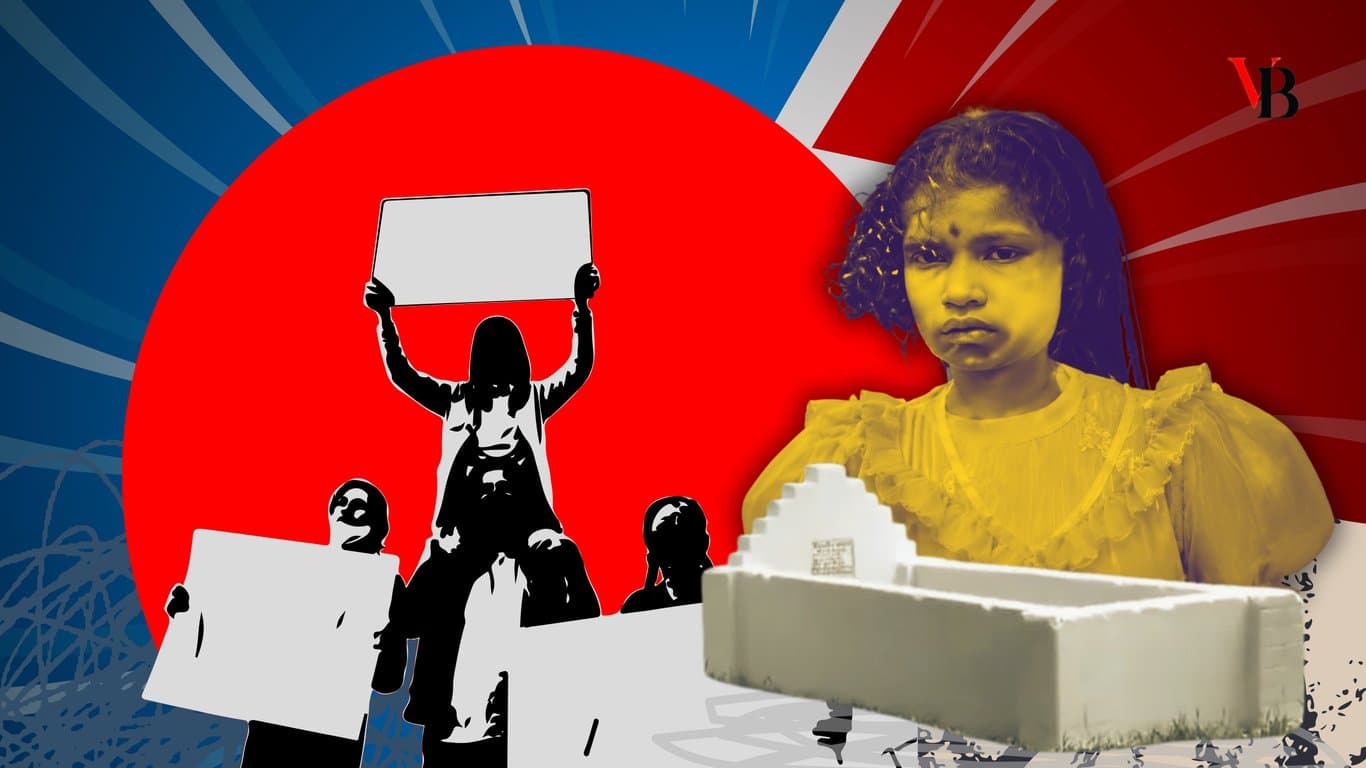

On the dawn of August 24, 1995, the lifeless, bloodied body of a teenage girl lay by the roadside in front of the BRAC office at Raniganj intersection in Dinajpur town. Her name was Yasmin Akter. According to Bangladesh Mahila Parishad and most reliable accounts, she was only 14 years old. At an age when a girl should have been carrying schoolbooks, Yasmin’s lifeless body lay on a city street in the early morning light. She had been working as a domestic helper in a Dhaka household and was travelling by bus to return to her mother in Dinajpur.
She did return home—but not to her mother’s arms. She returned as a corpse on a city street.
According to Bangla Wikipedia and contemporary media accounts, Yasmin was waiting at Dashmile late at night when a police patrol van stopped and offered to take her into town to her mother. The officers also reassured a nearby tea-stall owner that the girl would be taken safely to her destination. But the three police officers—the very people whose uniforms were supposed to represent protection for the vulnerable—raped and murdered her before dumping her body by the roadside. The protectors of the state had become its killers. And the way different layers of the state apparatus subsequently attempted to conceal the crime transformed Yasmin’s story from a brutal criminal case into a question of national conscience.
That single dawn did not end with the destruction of one poor family. It became a bloody turning point in the history of Bangladesh’s women’s movement, the relationship between citizens and the state, and the country’s criminal justice system.
An entire community transformed its grief into fury. The streets were soaked in the blood of protesters, and eventually the state was forced to hang three of its own employees.
Since then, August 24 has been observed in Bangladesh as Women’s Repression Prevention Day—a date marked by both profound grief and unyielding resistance.
Thirty years later, we largely remember Yasmin’s name as a story of victory: one of those rare moments when the principle that “no one is above the law” ceased to be merely a slogan and became reality. That memory is justified. But the state did not deliver this justice through its normal processes. It was forced to deliver it.
Had an entire district—and eventually people across Bangladesh—not taken to the streets; had seven lives not been lost in the suppression of the protests; had a local newspaper not refused to bow even after its electricity was cut off; and had social and legal pressure not continued for nearly nine years, no one can say with certainty whether a teenage girl’s brutal murder would ever have received justice.
The question, therefore, is not simply whether we have remembered Yasmin. The deeper question is this: When a community has to shed blood to obtain justice, should we call that a success of the state—or evidence of its failure?
Because when a popular uprising is required to obtain justice, that is not the rule. It is the tragic exception.
The Most Vulnerable Life—and the Brutal Attempt to Cover It Up
Yasmin was a teenage domestic worker, almost the most vulnerable kind of person in society’s power structure: a woman, a minor, poor, and alone in a large city.
In the 1990s, the safety of countless teenage girls who travelled from villages to cities in search of food and work rarely figured in the calculations of the state. Yasmin’s death suddenly placed the vulnerability of this largely invisible population before the eyes of an entire nation.
And the fact that she was killed by the very institution from which she should have received the greatest protection confronted the country with a terrifying truth: an institution created to provide security can sometimes become the greatest danger to the most vulnerable.
What transformed a horrific crime into a national crisis was the subsequent attempt to suppress the truth.
When the alleged perpetrators wear the uniform of the state, different layers of the state apparatus can instinctively move to protect the institution rather than the victim.
According to accounts published by several media outlets, the authorities initially tried to portray the incident as nothing more than a minor disturbance. There were even attempts to label Yasmin a “prostitute”, effectively shifting the moral burden of the crime onto the victim. Those reports also alleged an attempt to present another woman as Yasmin in an effort to manipulate the evidence.
To destroy the character of a teenage girl even after her death—what could be a more brutal form of injustice?
According to Bangladesh Mahila Parishad, Yasmin had been picked up from Dashmile on the promise that she would be taken to her mother in Ramnagar. Her mother, Sharifa Begum, was waiting for her daughter to return.
But the daughter returned as a corpse, lying in front of the BRAC office at Raniganj intersection.
The cries of that bereaved mother have echoed across the past three decades. Even as the world gradually moved on, she could not forget. In that refusal to forget, Yasmin remains alive.
When a newspaper became the light in the dark
At the darkest moment, the press became a source of light. According to Bangla Wikipedia and media accounts, local Member of Parliament Manoranjan Shil Gopal informed Motiur Rahman, editor of the local newspaper Uttarbangla, that police officers had raped and murdered a teenage girl.
When Rahman sought to verify the girl’s identity and publish the story, police tried to stop him. That night, the newspaper office’s electricity supply was cut off.
But the truth could not be kept in the dark. Borrowing electricity from a neighbour, Motiur Rahman and his colleagues published the shocking truth on August 26.
The first condition of justice is truth. And in Yasmin’s case, the state did not provide that truth. It actively tried to suppress it.
Without a free press, Yasmin’s cries might have disappeared forever among countless other cries that were silenced before they could be heard.
Perhaps most painful of all is the fact that the state’s instinct to suppress the memory of Yasmin did not entirely disappear over the following three decades.
According to a 2024 report by The Daily Star, production of the film Ami Yasmin Bolchi (I Am Yasmin) was halted following pressure from the police. Actress Bidya Sinha Saha Mim said she was prevented from playing the role of Yasmin after intervention by a senior officer of the Dhaka Metropolitan Police.
The state had once been forced to accept justice for Yasmin. Three decades later, even bringing her story back to the screen reportedly faced resistance.
It is difficult not to conclude that Yasmin remains an uncomfortable name for those in power.
An Unprecedented Popular Revolt—and Streets Stained with Blood
Once the truth became public, Dinajpur could no longer be contained.
Long-suppressed anger instantly turned into a spontaneous mass movement. Contemporary accounts describe angry crowds attacking police outposts, setting police vans on fire and erecting barricades of wood, bricks and burning tyres across the city.
It was an explosion of accumulated distrust and humiliation towards the state security apparatus. The death of one teenage girl had become a question of collective dignity for an entire community.
But in trying to suppress the movement, the state shed more blood. According to a report by Jago News, police opened fire on thousands of demonstrators on August 27. Seven people—including Samu, Kader and Siraj—were killed and more than 300 were injured. The Daily Star also reported seven deaths.
There is, however, considerable discrepancy in the reported death toll. Bangla Wikipedia states that 17 people were killed and around 100 injured, while a report in Bangla Tribune put the death toll at five.
That uncertainty over the numbers is itself a silent testimony. According to a more recent report by Deshkal, although the bodies and identities of three of those killed were confirmed, allegations emerged that the bodies of the others were “disappeared”.
When a state not only kills citizens but makes it impossible to count their bodies, one can begin to understand how deeply the deficit of accountability is rooted.
As the situation spiralled out of control, a three-day curfew was imposed in Dinajpur.
According to The Daily Star, almost the entire police force in the city was withdrawn or dismissed, including then Superintendent of Police Abdul Motaleb. Responsibility for maintaining law and order was handed over to the then Bangladesh Rifles, while the Deputy Commissioner was also removed.
The fact that the police administration of an entire district effectively had to be dismantled and restructured speaks volumes about the intensity of public anger.
To commemorate this sacrifice and resistance, August 24 was eventually recognised as Women’s Repression Prevention Day. In Dinajpur, people affectionately came to call it Yasmin Day.
A memorial was built in Dinajpur in 2012, and every year the day is marked by discussions, prayers and the wearing of black badges.
One fact must never be forgotten: this day was not a gift from any government. It was a recognition won from the streets, at the price of blood.
Two opposite faces of political leadership
A national crisis often strips political leadership of its mask. The reactions of the government and opposition to the Yasmin tragedy were almost diametrically opposed. There is also a cruel irony in this history.
According to an Al Jazeera report, then Prime Minister Khaleda Zia was herself born in Dinajpur.
Yet contemporary accounts indicate that she did not visit her birthplace after the incident. Without visiting the grieving city or taking any visible action, she went on to lead Bangladesh’s delegation to the Fourth World Conference on Women in Beijing, held from September 4 to 15, 1995.
The contrast becomes even sharper when we consider her speech at the conference on September 4, in which she spoke forcefully about women’s advancement.
In the speech preserved in United Nations records, Khaleda Zia said that they had gathered in Beijing with the common objective of “renewing their commitment to the advancement of women” and expressed hope that “centuries-old prejudices against women are finally breaking down.”
At precisely that moment, however, a teenage girl in her own country had been raped and murdered by members of the state security apparatus, leaving an entire nation in mourning.
The enormous distance between the rhetoric of Beijing and the blood-soaked reality of Dinajpur inevitably fuelled criticism of the prime minister’s role.
Journalist Foyez Ahmed captured the painful contradiction in the very title of one of his articles: “The Prime Minister Goes to Beijing Carrying Yasmin’s Body on Her Shoulders.”
The opposition response was markedly different.
Then opposition leader Sheikh Hasina travelled quickly to Dinajpur and stood beside the grieving and angry people.
According to Manoranjan Shil Gopal, one of the leaders of the movement and a former MP from Dinajpur-1, she played a leading role in standing beside the people of Dinajpur as opposition leader.
The tragedy therefore quickly evolved into a broader political demand for accountability from the government.
The legal battle: Justice that had to be wrested from the system
Although the trial began under intense public pressure, the road to justice was long and difficult.
According to reports by Sarabangla and Ajker Patrika, the case was transferred from Dinajpur to Rangpur for security reasons.
After hearing the evidence, a special court in Rangpur sentenced the three accused police personnel to death on August 31, 1997: Assistant Sub-Inspector Moinul Haque, Constable Abdus Sattar and pickup-van driver Amrit Lal Barman.
Nearly seven years passed between the verdict and its execution—a stark example of judicial delay.
According to BBC News and other media reports, the death sentences of Moinul Haque and Abdus Sattar were carried out at Rangpur Jail on September 1, 2004.
Amrit Lal Barman was executed on September 29 of the same year after his petition for clemency was rejected. Before his execution, he reportedly expressed remorse to Yasmin’s family.
In Bangladesh’s judicial history, this remains a rare example of members of the state’s own security forces receiving the ultimate punishment for a crime committed in custody.
Yet alongside this victory for justice remains an uncomfortable incompleteness. According to Bangla Wikipedia, five people—including the then Superintendent of Police and officer-in-charge of the relevant police station, as well as the doctor who conducted the initial post-mortem—were acquitted of allegations related to the destruction or manipulation of evidence.
In other words, those allegedly responsible for attempts to conceal the crime ultimately escaped accountability.
Justice won at an extraordinary price
The most uncomfortable truth lies within the success of the Yasmin case itself. The price paid to secure justice was heartbreaking: a district-wide uprising, seven young lives lost, a police administration effectively dismantled, and nearly a decade of waiting.
In a society where accountability functions as a normal rule of governance, the trial of a single murder should never require such an enormous price in blood and tears.
Yasmin’s justice was therefore a victory—but not simply a victory of the system.
It was, to a far greater extent, a verdict wrested from the system by ordinary people.
And that is perhaps the most important lesson of the Yasmin tragedy, thirty years on: justice should never have to be fought for in the streets before it can be found in a courtroom.
Leave A Comment