

77% people unaware of contents of July National Charter: Survey

Public awareness of the 'July National Charter' remains limited ahead of the upcoming referendum, with more than three-quarters of voters saying they do not know what the document contains, according to a new survey.
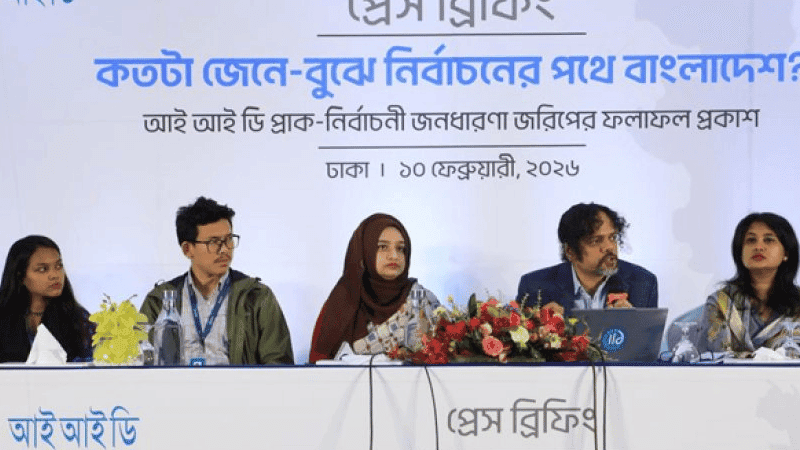
The findings were presented at a press conference on Tuesday at the Pan Pacific Sonargaon hotel in Dhaka by the Institute of Informatics and Development (IID) and Youth for Policy, which jointly conducted the pre-referendum public perception survey.
According to the survey, 77.2 percent of respondents said they were unaware of the contents of the charter, while only 37.2 percent reported having some knowledge of it. Awareness levels varied significantly by age, education and location.
Among voters aged over 35, just 23.2 percent said they were familiar with the charter, compared with 45.7 percent among those aged 18–35. Awareness was higher in urban areas (41.4 percent) than in rural areas (32.4 percent). Among respondents with no formal education, only 8.4 percent said they knew about the charter.
The survey also found limited understanding of reforms related to fundamental rights. Only 43.1 percent said they were aware of such reforms, while 55.3 percent said they were not. Uncertainty was particularly high among older and less-educated respondents.
Concerns were also raised about voters’ preparedness to participate in the referendum. Nationally, 72.4 percent said they could easily understand the ballot text. However, the figure dropped to 57.4 percent among those over 35 and to just 26.6 percent among respondents with no formal education.
Public opinion on the government’s neutrality in conducting the vote was mixed. While 47.9 percent said they believed the government would remain neutral, 11.3 percent disagreed and 33.7 percent said they were uncertain. Uncertainty was higher among women, at 39.7 percent.
Views were also divided on whether losing sides would accept the referendum outcome. About 51 percent believed the results would be accepted, while 35.8 percent said they were uncertain or declined to respond. The uncertainty was again more pronounced among women and voters without formal education.
IID Chief Executive Said Ahmed said the findings suggest the country is heading toward a referendum without sufficient public understanding. He urged the government to ensure a credible voting process and adequate security.
The survey was conducted on February 6–7, 2026, across all eight administrative divisions, with responses collected from 9,892 voters nationwide.
Leave A Comment
You need login first to leave a comment