

Anu Muhammad seeks action against those involved in trade deal with US
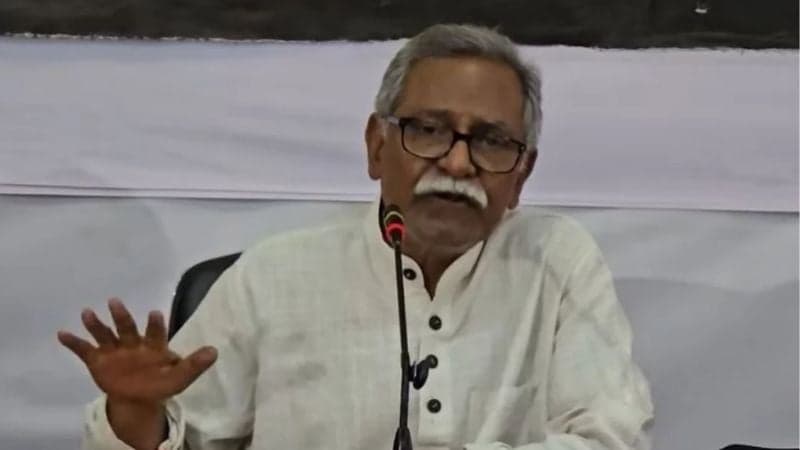

Economist Professor Anu Muhammad has called for the disclosure of the names of individuals involved in trade agreements with the US, insisting that they should be held accountable and face punishment.
He stated that the interim government has left Bangladesh in a precarious situation due to this agreement.
He made the remarks while presiding over a seminar titled 'Why the trade agreement with the US is dangerous for Bangladesh' held in Bijoynagar of the capital, on Friday afternoon, March 13.
Anu Muhammad remarked that the BNP's election slogan is 'Bangladesh first'. If Prime Minister Tarique Rahman genuinely believes that Bangladesh comes first, he must take appropriate action against this agreement and the individuals who signed it.
Expressing his discontent with the actions of certain members of both the previous interim government and the current administration regarding the agreement prior to its implementation, he noted that what has been observed thus far in relation to this agreement in Bangladesh is a prioritization of the United States.
He desires a shift in this situation. He further stated that Bangladesh faced significant peril during the interim government. There are concerns about evading this threat, particularly since one of the proponents of the agreement at that time was Khalilur Rahman, who was appointed as the foreign minister by the BNP. After assuming office, he claimed that the agreement was highly beneficial.
Anu Muhammad asserted, "I believe that anyone who describes such an agreement as favorable is the foreign minister of Bangladesh. He also alleges that the BNP-Jamaat were aware of it."
Anu Muhammad is of the opinion that the BNP should adopt a firm position against the agreement. He emphasized that as a ruling party, it is the BNP's primary responsibility to demonstrate that Khalilur Rahman's assertion is incorrect. Therefore, it must take a resolute stance against the agreement.
Criticizing the actions of the interim government at that time concerning the agreement, he noted that they had raised objections to several matters during the budget discussions of the previous year. The government asserted that imports from the United States ought to be increased. Fish, meat, and arms would need to be imported from the United States. When these statements were made last year, the agreement had not yet been signed. At that moment, the trade-related turmoil initiated by US President Donald Trump had just commenced. In essence, the pressure exerted by the United States outweighed the interim government's enthusiasm for the agreement.
Expressing apprehension that the trade agreement with the United States might pose risks to Bangladesh's economy and national interests, he remarked that the various stipulations of the agreement could have enduring effects on the nation's import-export policies, industrial sector, and employment opportunities. Through this agreement, Bangladesh might be compelled to import and export specific products based on the demands of the United States. This situation could diminish the country's autonomy in economic decision-making.
Anu Muhammad voiced concerns that the trade agreement could adversely affect the employment currently generated in the agricultural sector, rural economy, particularly in various industries such as poultry, fisheries, and dairy.
Anu Muhammad mentioned that during the previous interim government, an effort was made to finalize an agreement regarding the new mooring container terminal at Chittagong Port.
Some individuals exhibited a state of frenzy, a kind of restless agitation in this context. Citing the involvement of the then National Security Adviser Khalilur Rahman, BIDA Executive Chairman Ashiq Chowdhury, the former Chief Adviser's Special Envoy Lutfe Siddiqui, and the then Chief Adviser Professor Muhammad Yunus, the economist indicated that they all had an interest in the agreement. However, they were unable to finalize the agreement solely due to the workers' movement.
Supreme Court lawyer Jyotirmoy Barua, development economics researcher Maha Mirza and Associate Professor Mosahida Sultana of the Accounting Department of Dhaka University also spoke at the seminar.
Leave A Comment
You need login first to leave a comment