

Bangladesh may lose Tk 1,327 crore annual revenue if US trade deal implemented: CPD

The government could lose approximately Tk 1,327 crore in annual import duty revenue if the Bangladesh-US trade agreement takes effect, the Centre for Policy Dialogue (CPD) has expressed concern.
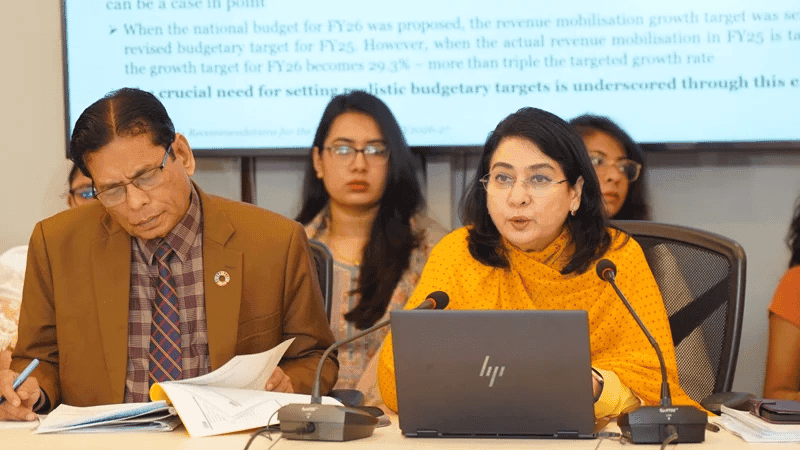
The private research organisation presented the findings at a media briefing titled 'Recommendations for the National Budget for FY 2026-27' held at its Dhanmondi office on Tuesday, March 10, by its Executive Director Dr Fahmida Khatun.
She informed that Bangladesh recently signed an 'Agreement on Reciprocal Trade' with the United States. Under this agreement, Bangladesh will have to provide duty-free benefits on nearly 4,500 products imported from the US. Additionally, similar benefits are to be extended to another 2,210 types of products within the next five to ten years.
Dr Fahmida Khatun said currently, about Tk 1,327 crore in annual import duty is collected from these products. If the agreement takes effect, the government may lose this revenue.
She further said granting unilateral duty-free market access to the US may conflict with World Trade Organisation (WTO) rules. This could prompt other WTO member countries to demand the same benefits.
She also noted that the government's expenditure may increase due to conditions requiring the purchase of specific products from the US. Therefore, the agreement's impact on revenue and government expenditure needs reassessment, and negotiations with the US should be considered if necessary.
CPD Distinguished Fellow Professor Mustafizur Rahman said the recent trend of using trade as a political weapon is weakening the WTO. He said the details of the agreement need to be made public as it involves financial risks.
He further said a significant part of the agreement's implementation depends on the private sector. To encourage the private sector to import products from the US, the government may have to provide subsidies. This could also involve issues of trade relations with third countries and the freedom of product imports.
Dr Fahmida Khatun also highlighted achieving revenue collection targets as a major challenge at the media briefing.
She said revenue growth until January of the current fiscal year was 12.9 per cent, against a target of 34.5 per cent. To achieve the target in the remaining time, revenue would need to be collected at a rate of 59.4 per cent, which is unrealistic.
The revenue deficit currently stands at around Tk 60,000 crore. Until December, the government took loans of Tk 59,655 crore from the banking sector. Conversely, non-bank loans and foreign assistance have decreased.
She said excessive borrowing from banks is creating risks in the financial sector and reducing private sector credit flow. Meanwhile, inflation remains above 8 per cent. If the ongoing Middle East conflict disrupts fuel supply, further pressure could be added to inflation.
She informed that the implementation rate of the Annual Development Programme (ADP) until January of the current fiscal year was 20.3 per cent, the lowest in 15 years. During the same period, export earnings declined by 3.2 per cent, while imports increased by 3.9 per cent.
Dr Fahmida Khatun said ambitious targets should be avoided when formulating next fiscal year's budget. Although the government's election manifesto aims to increase the tax-GDP ratio to 15 per cent, it currently stands at about 6.8 per cent. Achieving this target requires long-term tax reform.
Leave A Comment
You need login first to leave a comment