
Bangladesh-India relations must be based on new reality: PM's adviser
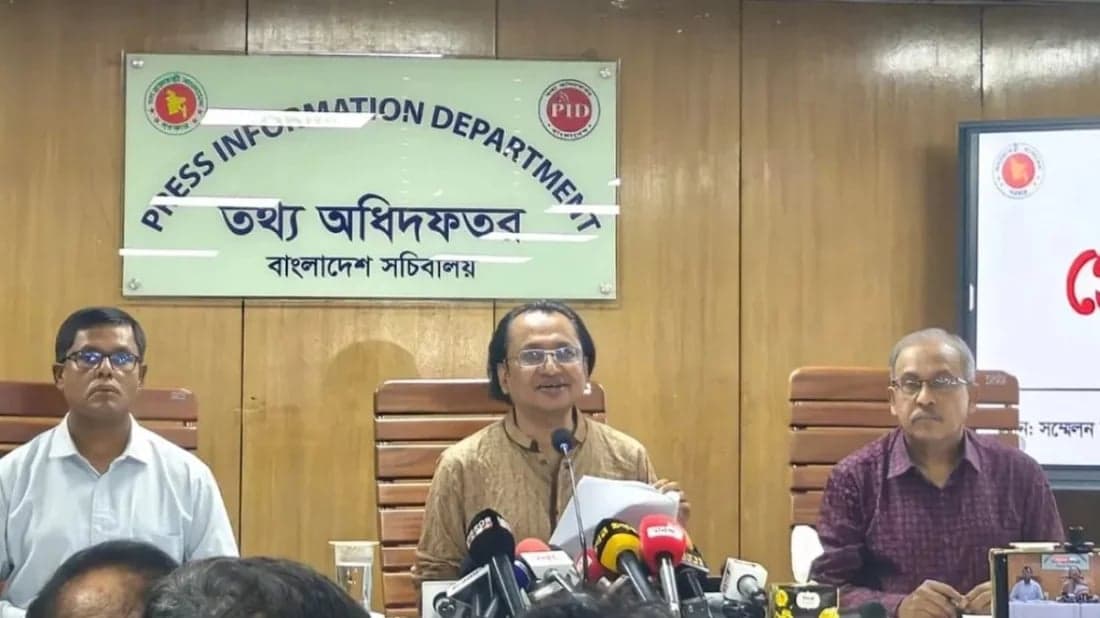

Prime Minister's Information and Broadcasting Adviser Dr Zahed Ur Rahman has said that Bangladesh's relationship with India must be built on a new reality and on the basis of the dignity of two independent and sovereign states, adding that the kind of individual or party-centric relationship that existed over the past 17 years cannot continue and that future relations will be determined by placing the interests of the people and the state of Bangladesh at the forefront.
He also informed that the Prime Minister may address the nation on the occasion of the government's 180-day milestone, though the matter has not been finalised, and that the government has not given any decision or indication regarding a cabinet reshuffle after 180 days. He made these remarks in response to journalists' questions at a weekly briefing at the Information Department's conference room on Tuesday, August 11.
Responding to questions about why scenes of the Felani killing or anti-Indian domination previously displayed at the museum are no longer visible, Zahed Ur Rahman said there will always be debate over what should be displayed in a museum as everyone has a different perspective, adding that border killings have been a long-standing reality for Bangladesh and are not specific to a particular government. He said the museum's main objective was to highlight how a mafia system was created during the rule of Sheikh Hasina and the Awami League, and its political and state structure, with the ground floor showing the process of creating that structure and the upper floor showing how Sheikh Hasina's government was politically defeated and ousted from power. He acknowledged that some parts of the exhibition have been changed.
When asked whether the Prime Minister would address the nation on the government's 180-day milestone, the information adviser said there is a possibility, and quite a high one, but everything has not yet been finalised, adding that an evaluation of the government's six-month performance is underway and that rather than viewing 180 days as just a specific timeframe, it is more important to see what the government has done and where more work is needed.
Responding to media reports on the possibility of a cabinet reshuffle after 180 days, Zahed Ur Rahman said the government has given no such decision or indication, though the Prime Minister will regularly evaluate the performance of ministers and ministries. He said this is not something to be viewed in terms of 180 days or 365 days and that the Prime Minister will certainly evaluate performance and take necessary steps, including redistribution of responsibilities if needed, while adding that external discussion exists about whether changes could be made to ministers holding multiple portfolios, though no decision has been made that a major reshuffle will occur immediately after 180 days.
Responding to questions about Sheikh Hasina's press conference in India and the Bangladesh government's position, Zahed Ur Rahman said Bangladesh has raised the matter very strongly with India and that the government's statement and the Foreign Minister's remarks have made Bangladesh's position clear. He said allowing Sheikh Hasina to engage in political activities or hold press conferences while in India is a matter of concern for Bangladesh, as the person Bangladesh wants to bring back for trial is holding press conferences there, and India must consider these matters sincerely. He noted that Bangladesh has an extradition treaty with India and is seeking the return of a convicted death-row prisoner to bring him under the law, and that New Delhi also has a responsibility to create an environment conducive to future relations with Bangladesh.
Zahed Ur Rahman said there is a long-standing perception among the people of Bangladesh that the previous government benefited from a special relationship with India to stay in power, and due to this public perception and past experiences, the relationship between the two countries needs to be restructured on a new foundation. He said the way India previously wanted to build relations with Bangladesh should not be party-specific or individual-specific but a relationship with the people, adding that India is now also talking about relations with the people and he sees this as positive. He said future relations with Bangladesh must be like relations between two independent, sovereign and self-respecting countries, and while India may have its security concerns and Bangladesh may have its own, these will be discussed the way two independent and sovereign countries speak.
Responding to journalists' questions about the visit of a senior official from India's intelligence agency to Dhaka, Zahed Ur Rahman said unnecessary speculation was being created over the matter, informing that the official came to Dhaka from China and would hold meetings with relevant Bangladeshi officials. He said such communication between intelligence agencies of different countries is normal and that Bangladesh's intelligence officials have also visited India in the past, but such communication must be conducted with respect for Bangladesh's independence, sovereignty and self-respect, and the kind of attitude that any Indian agency may have had in the past cannot continue.
Zahed Ur Rahman said Bangladesh now has a government elected by the people and this government has no scope to build relations with any country at the expense of the interests of the people and the state. He said while one can change friends, one cannot change neighbours, so communication and engagement with India must continue, but the nature of that relationship must change and he repeatedly speaks of realignment, as relations must be built beyond how they have been over the last 17 years. He commented that even in the recent statements of India's Ministry of External Affairs, there are some indications of recognising the reality of Bangladesh's elected government, and expressed hope that the Indian High Commissioner in Dhaka would convey the Bangladesh government's stance to Delhi.
When asked whether the Prime Minister would visit India, the information adviser referred to the Foreign Minister's earlier statement, noting that for a BRICS event, it is not the Prime Minister but the President who has been invited, though the invitation sent to the Prime Minister in the congratulatory message from India after the new government formation did include a visit invitation. He said a visit may take place in the future, but no final decision has been made yet regarding the Prime Minister's India visit centred on BRICS.
Leave A Comment