
Budget could increase tax burden on low-income earners by up to 16.7%: CPD
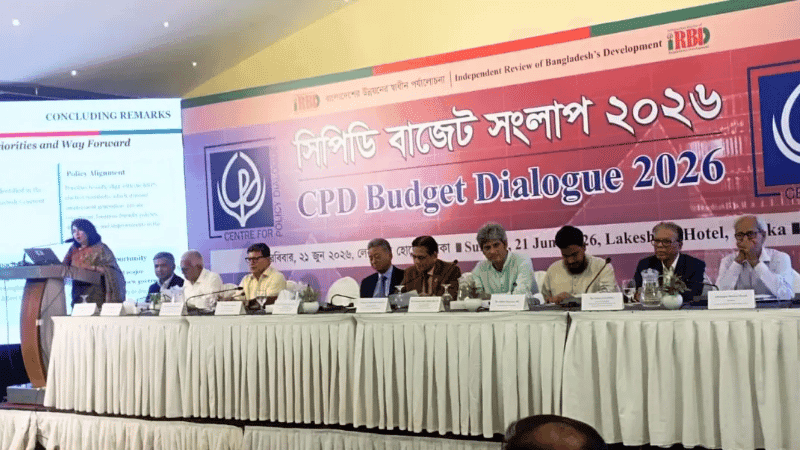

The proposed national budget for FY2026–27 may place a disproportionately higher tax burden on low- and middle-income earners, potentially widening income inequality, according to the Centre for Policy Dialogue (CPD).
Presenting its assessment at a post-budget dialogue in Gulshan on Sunday (June 21), the independent think tank said recent changes to the personal income tax structure could significantly increase tax liabilities for individuals in lower income brackets, while imposing comparatively smaller increases on higher-income taxpayers.
CPD Executive Director Fahmida Khatun said individuals with annual taxable incomes between Tk 6,00,000 and Tk 15,00,000 could see their tax burden rise by 12.5 per cent to as much as 16.7 per cent under the proposed framework. In contrast, taxpayers earning more than Tk 30,00,000 annually are likely to face relatively modest increases.
According to CPD, such a structure raises concerns over fairness and progressivity in the tax system, as lower- and middle-income groups would bear a greater proportionate burden despite having less financial resilience.
The organisation argued that the proposed tax measures do not adequately reflect the principles of social equity and could place additional pressure on middle-class and lower-middle-class households already grappling with rising living costs.
Beyond taxation, CPD also questioned whether the budget sufficiently supports the government's ambitious target of creating 10 million new jobs within 18 months. The think tank noted that allocations for key employment-generating sectors—including labour, expatriate welfare, industry and commerce—have either remained stagnant or shown limited growth.
The organisation further cautioned that the government's target of bringing inflation down to 7.5 per cent may prove difficult without stronger interventions in food and energy supply chains, alongside more effective monetary measures. Persistently elevated inflation, it said, continues to erode household purchasing power and increase the cost of living for ordinary citizens.
While CPD welcomed increased allocations for the education and health sectors, it expressed concerns about implementation capacity and the effectiveness of public spending. The challenge, it noted, lies not only in allocating more funds but also in ensuring that resources are utilised efficiently and produce measurable outcomes.
In its overall assessment, CPD concluded that the proposed budget's tax and expenditure framework risks placing greater financial pressure on lower-income groups and could contribute to a deeper socioeconomic divide unless corrective measures are introduced during the budget approval process.
Leave A Comment