
Business leaders demand uninterrupted energy supply, advance load-shedding schedule
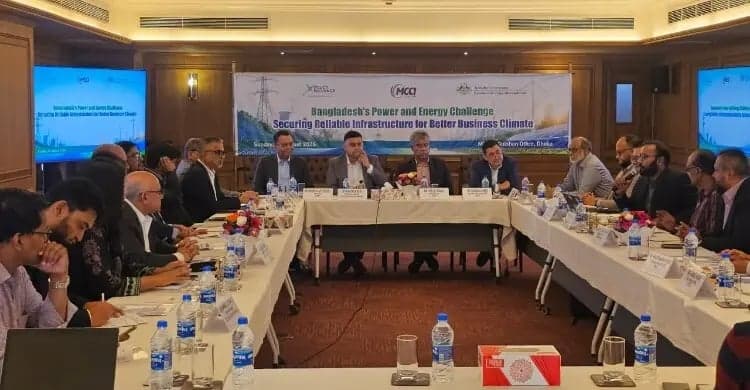

Business leaders and policymakers have called for ensuring long-term, predictable and affordable energy supply to maintain the competitiveness of the country's industries. They also demanded priority gas and electricity supply for industrial zones and export-oriented factories, along with the publication of advance load-shedding schedules.
The demands were made during a roundtable meeting organised by the Metropolitan Chamber of Commerce and Industry (MCCI) at its Gulshan office in the capital on Sunday, August 30.
The meeting, titled 'Bangladesh's Power and Energy Challenges: Ensuring Reliable Infrastructure for an Improved Business Environment', was organised by Policy Exchange Bangladesh and MCCI, with support from the Australian Government's Department of Foreign Affairs and Trade. It highlighted various problems in industrial production, investment and employment caused by the energy crisis.
MCCI Secretary General and CEO Farooq Ahmed delivered the welcome address. Hasib Hasan, Senior Associate of Policy Exchange Bangladesh, presented on 'Business Infrastructure—Power and Energy', highlighting the reliability of power and energy supply and its impact on various sectors.
The presentation cited Bangladesh Business Index (BBX) data for 2024-25, showing that the business infrastructure score dropped from 71.1 in FY2023-24 to 68.8 in FY2024-25. Some 74.2 percent of surveyed businesses reported facing occasional power outages, while only 20.1 percent had seen structural or regulatory initiatives for infrastructure development.
The meeting noted that the ongoing gas crisis, low gas pressure, power shortages and rising energy costs were negatively impacting industrial production and investment plans. Power shortages exceeded 3,000 megawatts in early August, and many factories had to reduce or suspend production due to low gas pressure.
In the panel discussion, BTMA President Shawkat Aziz Russell said the current energy crisis reflects weaknesses in long-term planning and energy procurement. He called for urgent measures to protect export-oriented and energy-dependent industries, as well as a separate industrial energy policy.
Mohammad Iqbal Chowdhury, Director and CEO of LafargeHolcim, said long-term and predictable energy planning is essential to protect existing industrial investments. Energy strategies must be formulated keeping in mind the competitiveness and sustainable development of the next 10 to 20 years.
Moinul Islam, President of the Bangladesh Ceramic Manufacturers and Exporters Association, said gas is not just fuel but a key raw material for the ceramic industry. Long-term supply uncertainty is threatening production, employment and new investment.
Dr Ejaz Hossain, Chairman of ESTEX Foundation, said the energy crisis is no longer just a supply issue but a major challenge for the economy and planning. Attention must be paid to energy pricing, supply management, renewable energy, efficiency improvement and a realistic energy mix.
The panel demanded priority gas and electricity supply for industrial and export-oriented factories, along with the publication of advance and reliable load-shedding schedules. According to participants, this would allow factories to plan production more effectively.
It was announced that a policy paper would be prepared based on the roundtable recommendations, combining BBX data and immediate and long-term reform proposals.
Leave A Comment