

Climate financing must be fair and people-centred: Rizwana Hasan
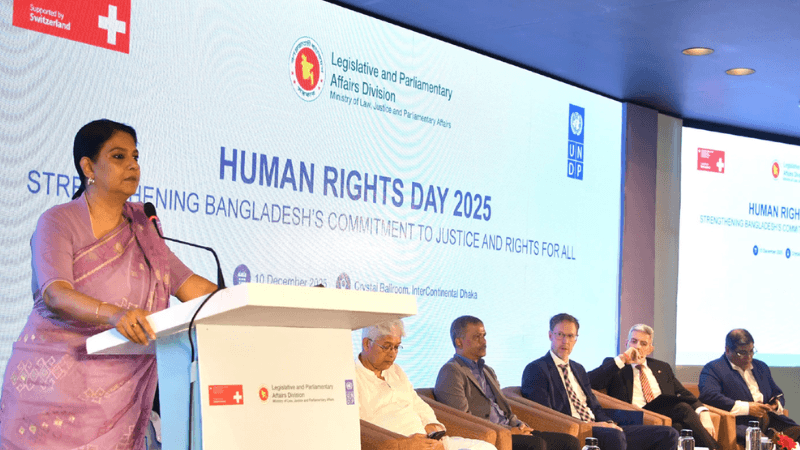

Syeda Rizwana Hasan, Adviser to the Ministry of Environment, Forest and Climate Change and the Ministry of Water Resources, has said that climate finance reform must prioritise the needs of local communities, institutional capacity and transparency. Swift fund-distribution mechanisms, proper planning, coordination with international partners and financing structures that protect vulnerable groups are now urgent.
She made these remarks on Wednesday, December 10, while delivering the keynote speech at a consultation workshop titled “Formulating Bangladesh’s National Climate Finance Strategy”, held at Pan Pacific Sonargaon Hotel.
Senior government officials, development partners and climate finance specialists attended the event.
Rizwana said that the concept of global climate funds was originally built on the principle of new and additional support. Over time, that commitment weakened. Many developed nations responsible for climate damage continue to deny scientific realities, making climate finance complex and unfair. Some countries strategically use climate negotiations, while only a few fulfil commitments.
Highlighting domestic challenges, she said that despite being among the most financially neglected ministries, the environment ministry receives the lowest budget allocation every year, while large infrastructure gets priority. Adaptation, waste management and local-level resilience do not receive sufficient funding. She expressed regret that even after 54 years of independence, Bangladesh still lacks an effective national waste management system.
She said financial allocation alone is not enough. Agencies must demonstrate planning capacity, human resource capability and fast implementation systems. “Even publishing awareness materials takes too long. If the procedure becomes the objective, results will naturally be compromised.” She urged the Ministry of Finance to simplify procedures and ensure transparency.
On equitable distribution, she said that hundreds of funding requests come from river erosion areas, saline zones and drought-prone belts, but only a small portion can be supported. Investment in protecting vulnerable groups yields far more economic benefits than constructing new roads.
She also commented that categorising expenditures in unrelated sectors, particularly defence, as climate finance undermines credibility and accountability.
The session was attended by Adviser to the Ministry of Law, Justice and Parliamentary Affairs Dr Asif Nazrul; Adviser to the Ministry of Housing and Public Works Adilur Rahman Khan; UNDP Bangladesh Representative Stefan Liller; and Secretary of Law and Parliamentary Affairs Dr Hafiz Ahmed Chowdhury.
Leave A Comment
You need login first to leave a comment