
Climate-induced human rights violations in Bangladesh
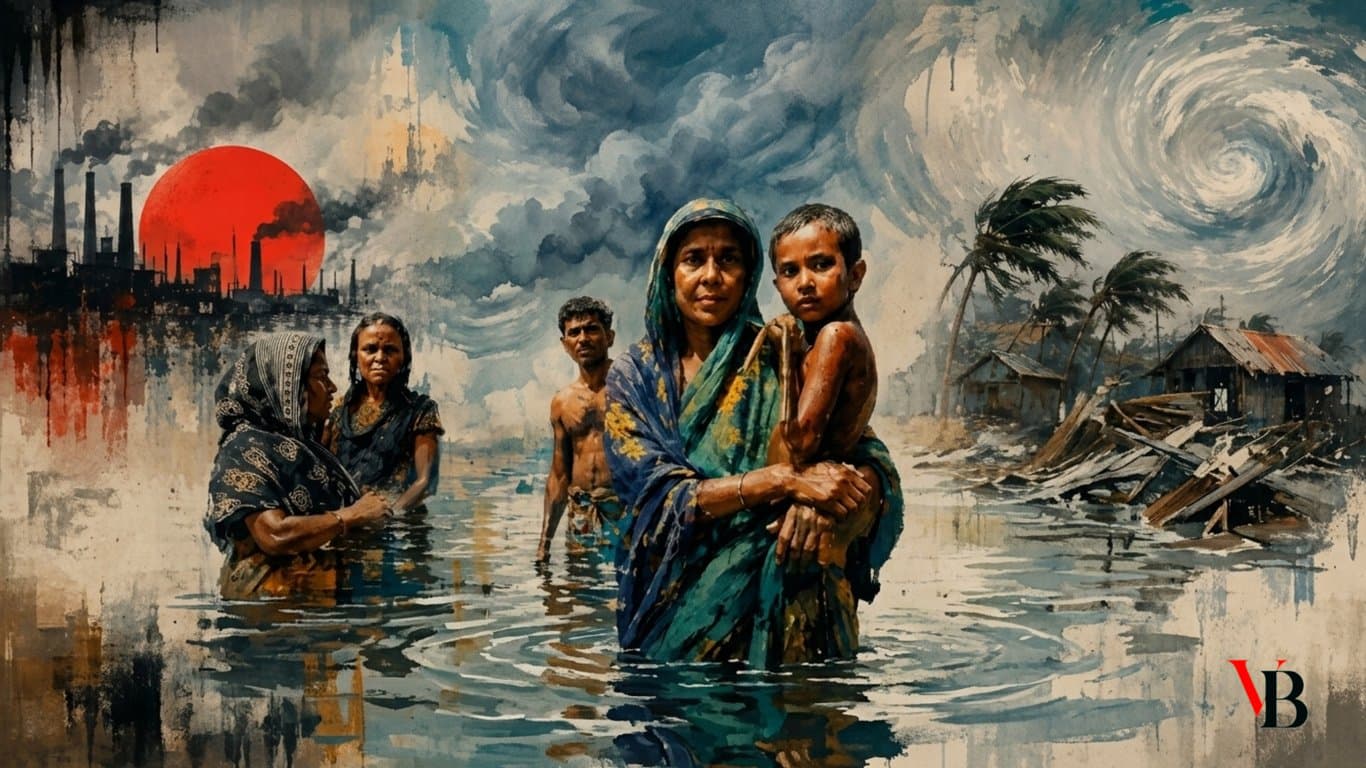
Climate change is a globally pressing issue. And any single country is unable to address climate change-induced human rights violations issues to mitigate. That is why, according to the Sustainable Development Goals (SDGs) regional, international, global partnership and cooperation is imperative to work together for establishing human rights for all in a real sense rather than lip service, experts observed.
So despite overwhelming evidence of climate change-induced human rights violations globally, as well as in Bangladesh, mechanisms to address these issues have yet to be institutionalized within the UNFCCC core framework. Developed countries, despite their historical responsibility for the climate crisis and its corresponding human rights impacts, consistently reject legal liability for these violations. This resistance has been reflected in several critical decisions of the Conference of the Parties (COPs).
There human rights safeguards were excluded from the final Global Stock take decision at COP 28 and the decision for operationalizing the Loss and Damage (L&D) financing arrangements.
The Center for Participatory Research and Development-CPRD, Action Against Hunger (ACF), and the Climate Justice Alliance-Bangladesh mentioned those actionable recommendations recently in their concept note. The title of it: “National stock-take exercise implementation of upr-4 recommendations for safeguarding against climate-induced human rights violation in Bangladesh,”
The concept note further noted that given the context, the civil society organizations worked closely with frontline communities to observe firsthand evidence of climate-induced human rights violations. It leveraged the opportunity to elevate these challenges during Bangladesh's Fourth UPR Cycle in November 2023.
A coalition of 15 civil society organizations, led by the Center for Participatory Research and Development-CPRD, made a joint submission highlighting evidence of climate change-induced human rights violations. And recommended 18 strategic actions across 7 thematic areas.
Those recommendations were highly appreciated and supported by the state representative sat the UN permanent mission in Geneva. It has established a strong context for the Government of Bangladesh to accept as many as 12 recommendations for implementation over the subsequent four years, from 2024 to2027.
As Bangladesh moves through the implementation period of the 4th UPR recommendations and prepares for the 5th UPR cycle, there is acritical need to assess how far the climate-related recommendations supported by the GoB have translated into policies, programs and actions.
It is equally vital to identify remaining implementation and accountability gaps and determine what additional measures are required to safeguard climate-vulnerable populations against the violation of fundamental human rights.
The UNFCCC negotiations continue to defer establishing measures for safeguarding against climate induced human violations. The UN Human Rights Council adopted a resolution in 2019 that reminds the states of their obligations by which the member states are legally bound to defend human rights regardless of the driver- be it climate change, conflicts, or other systemic issues. Those obligations are firmly defined by the different globally reputed organizations.
For example, Universal Declaration of Human Rights (UDHR), ICCPR, ICESCR, Convention on the Rights of Persons with Disabilities, Convention on the Rights of the Child, Convention on the Elimination of All Forms of Discrimination against Women (CEDAW), and the Vienna Declaration and Program of Action, the concept note precisely highlighted.
Civil society interventions and the fourth UPR cycle
In line with the concept note recently the Center for Participatory Research and Development -CPRD, Action Against Hunger (ACF), and the Climate Justice Alliance-Bangladesh jointly organized a national advocacy seminar titled, “Stock-Take Exercise on the Implementation of UPR-4Recommendations for Safeguarding Against Climate-Induced Human Rights Violations in Bangladesh” in the capital city Dhaka. The event brought together policymakers, human rights experts and defenders, climate change experts, academics, researchers, and civil society representatives.
The seminar explored the implementation progress of the relevant recommendations supported by the Government of Bangladesh during the 4th UPR cycle. It also identified critical implementation gaps and practical policy and action pathways to strengthen the protection, promotion, and fulfillment of human rights in the context of climate change.
The seminar also established a CSOs platform and developed an action plan for evidence generation, monitoring, and advocacy for protecting human rights against the worst impacts of climate change.
Dr. Nurun Nahar, Additional Secretary, Ministry of Environment, Forest and Climate Change, spoke as the Chief Guest at the event. She said, “ Climate change is increasingly contributing to human rights violations in Bangladesh, particularly affecting climate-vulnerable and frontline communities. However, international climate negotiations have yet to adequately institutionalize mechanisms for addressing these climate-induced violations, which remains a major concern for us.”
Special guest Dr Fazle Rabbi Sadek Ahmed, Former Additional Secretary, DoE & Former DMD, PKSF, emphasized the need for stronger institutional coordination, systematic monitoring, evidence generation, and sustained policy advocacy. Shaheen Anam, MBE, Executive Director, Manusher Jonno Foundation (MJF) as the special guest urged for continuation of such efforts in protecting human rights violations against climate-vulnerable and frontline communities in Bangladesh. She also emphasized stronger collaborations among human rights defenders, climate change experts, academics, and Civil Society Organizations(CSOs).
Md. Ziaul Haque, Former Additional Director General, DoE, as the special guest highlighted that while the Government of Bangladeshis concerned of the climate-induced violations in the country, it needs to significantly enhance the institutional capacity to ensure adequate safeguards. Consequently, he called for support from both the international community and CSOs.
Md. Shamsuddoha, Chief Executive of CPRD and National Coordinator of CJA-B, facilitated the discussion. In the opening session, he said, “During Bangladesh’s third UPR Cycle in 2018, the Government of Bangladesh (GoB) supported two climate-related recommendations for addressing and mitigating the negative impacts of climate change.”
“Building on this, a coalition of 15 CSOs led by CPRD made a joint submission during the 4th UPR Cycle in 2023, with evidence of climate-induced human rights violations and a proposed set of strategic actions across seven thematic areas. Eventually, the GoB accepted 12 recommendations for implementation during 2024–2027. We have the responsibility to follow up on how far these pledges have been translated into policies, programs, and actions, and to identify the pathways to address the gaps,” Shamsuddoha concludes.
In the keynote presentation, Sheikh Nur Ataya Rabbi, Program Manager–Research & Advocacy, CPRD, disseminated evidence of climate change-induced human rights violations since the 3rd UPR cycle. Also the CSO recommendations under the 4th UPR and their implementation progress.Civil society must begin systematically documenting emerging evidence, monitoring state enforcement, and consolidating its policy and advocacy priorities ahead of the next review cycle.
Very importantly, this exercise will also establish along-term collaborative effort among the civil society organizations to generate and compile first-hand evidence of climate-induced human rights violations. Furthermore, it will establish a mechanism of multi-actors coordination to advocate for safeguarding against climate-induced human rights violation in the lead-up to Bangladesh’s Fifth UPR Cycle, anticipated in early 2028, the stakeholders anticipated.
Parvez Babul is an award-winning investigative climate change, health, environment journalist, columnist, essayist and researcher. Email:parvezbabul@gmail.com
Leave A Comment