
Cultural bonds key to Bangladesh-India friendship: Cultural Minister
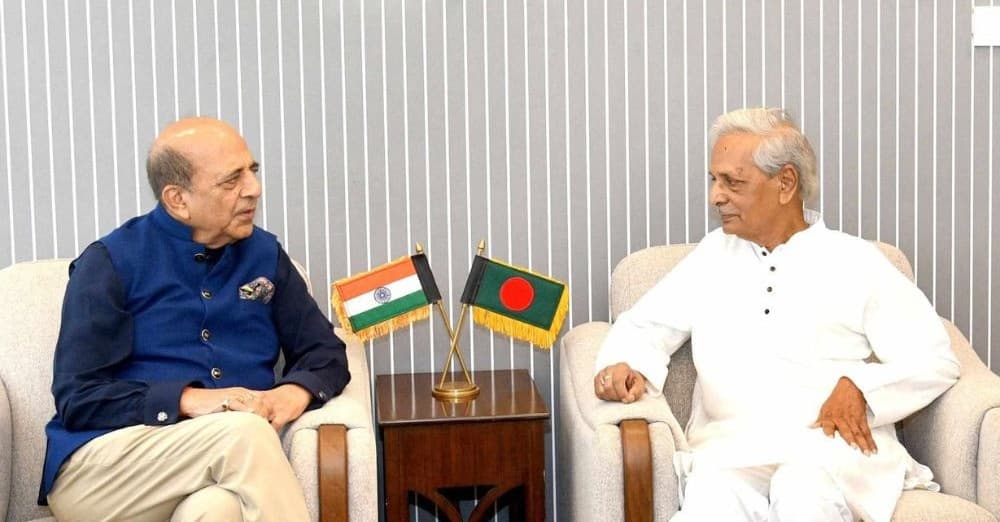

Cultural unity can play an important role in further strengthening the relationship between Bangladesh and India, said Cultural Minister Nitai Roy Chowdhury. According to him, the true identity of a nation lies in its culture. Culture creates mutual unity and harmony among people, not division.
The minister made these remarks during a meeting with Indian High Commissioner to Bangladesh Dinesh Trivedi at his office on Sunday morning, September 6. The hour-long meeting discussed various aspects of the historical relations between the two countries and ways to further expand cultural ties.
The meeting focused on joint initiatives to celebrate Nazrul Year, exchange visits of artists and researchers, classical music, folk culture, skill development of young artists, and the preservation of maritime cultural heritage. Cultural Affairs State Minister Ali Newaz Mahmud Khaiyam, Secretary Miz Yasmin Begum, Joint Secretary, Indian High Commission Deputy High Commissioner, and the director of the Indira Gandhi Cultural Centre were also present.
The minister said the depth of the relationship between Bangladesh and India cannot be fully understood if viewed merely as that of two neighbouring countries. There is a long-standing commonality among the people of the two countries in language, literature, music, folk traditions and human values. This cultural bond is one of the strongest foundations of the bilateral relationship.
Citing examples of legendary artistes of the subcontinent, Nitai Roy Chowdhury said the creativity of Mohammed Rafi, Hemanta Mukherjee, Alka Yagnik and Pandit Ravi Shankar is equally popular among people of both countries. Art and culture have no borders and have a direct connection with human hearts. He also commented that cultural practice can play an effective role against religious extremism, intolerance and communal divisions.
The minister invited renowned Indian Nazrul researchers, artists and cultural figures to participate in various national and international events organised in Bangladesh during the ongoing Nazrul Year. He also described Rabindranath Tagore, Kazi Nazrul Islam, Lalon Shah and Bengali folk music as important parts of the shared cultural heritage of the two countries. The state minister also proposed creating a classical music network between the two countries. It was discussed that two classical musicians from India would initially be brought to Bangladesh to conduct workshops.
Additionally, importance was placed on renewing the Bangladesh-India cultural cooperation agreement and adopting a new action plan. High Commissioner Dinesh Trivedi also expressed a positive attitude towards further strengthening cultural relations. He highlighted the commonalities in food habits, language, history, heritage and culture between Bangladesh and India.
The High Commissioner assured India's cooperation in organising a larger-scale international event at Kazi Nazrul Islam's birthplace in Churulia, West Bengal. He also expressed interest in personally attending that event. At the same time, he emphasised organising regular joint events between cultural institutions in West Bengal and Bangladesh.
Proposals to launch joint training, residency programmes and cultural exchanges for the youth of the two countries were also discussed. The High Commissioner also expressed the view that there are opportunities for joint research and cultural initiatives to preserve the maritime cultural heritage surrounding the Bay of Bengal.
At the end of the meeting, both sides expressed their commitment to further advancing the cultural relations between the two countries on the basis of mutual respect and shared cultural heritage.
Leave A Comment