
Directive to close 24 resorts built adjacent to Sundarbans
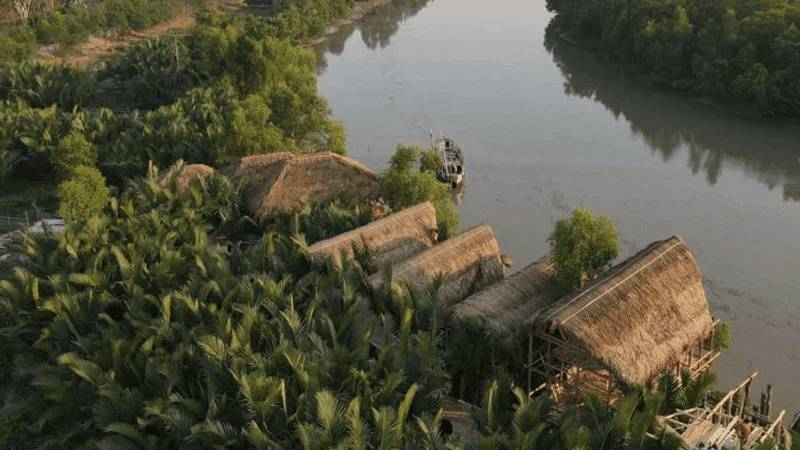

The Department of Environment has directed the closure of the activities of 24 resorts that have grown up adjacent to the Sundarbans in Khulna, Bagerhat and Satkhira. At the same time, it has been asked to remove these structures within the next 30 days.
Notices had been given earlier to the authorities of the concerned institutions as there is no permission to operate resorts in the environmentally critical area. However, the Department of Environment has informed that the directive to close the activities has been given as the replies given by them were not satisfactory.
Director of the Khulna Divisional Office of the Department of Environment Khondaker Md. Fazlul Haque said that no resort can be operated in the environmentally critical area. Notices had been given to the authorities of the resorts as per the law. As satisfactory replies were not received, the directive to close the activities has now been given.
Among the 24 resorts that have received the closure directive, there are 18 in Khulna, two in Bagerhat and four in Satkhira.
The 18 resorts of Khulna are Aronyachaya, Aronyabari, Keorabon, Mayabon, Gahan, The Forest Retreat, Nikunja Valley, La Silva Cottage, Bonbibi, Sundari, Irabati, Bonmali, Golkanan, Piyali, Mangrove, Junglebari, Bonbas and Bonlata Eco Cottage.
Environment and forest experts think that the pressure on the sensitive ecosystem of the forest is increasing due to the construction of resorts adjacent to the Sundarbans and the increase in the number of tourists. According to them, uncontrolled tourism, excess sound and light and weak waste management may become a cause of harm for the wildlife.
Professor of the Environmental Science Department of Khulna University Abdullah Harun Chowdhury said that the Sundarbans has a more sensitive and complex ecosystem than St. Martin’s. The ecosystem of the forest is being damaged due to the growth of one resort after another adjacent to the forest and the excess movement and shouting of the tourists. If it continues like this, the wildlife may leave that area.
He informed that there is also concern over the waste of the resorts. He also mentioned that the waste left by the tourists is entering the forest through the canals and damaging the environment.
Conservator of Forests of Khulna region Imran Ahmed said that the negative impact on the forest is increasing day by day due to the resorts. Many tourists enter the forest without permission. Besides, excess sound and light and the left waste are also harmful for the wildlife.
However, he informed that the direct control of the Forest Department is limited as the resorts have been built on privately owned land outside the boundary of the Sundarbans. According to him, effective measures of the Department of Environment are needed to control these resorts.
On the other hand, the Resort Owners Association of Sundarbans, the organisation of the resort owners, does not agree with the decision of the Department of Environment. General Secretary of the organisation Zakaria Hossain Shaon said that these resorts have not been built inside the Sundarbans; they have been built in the adjacent populated areas outside the forest.
He claimed that the tourists who come to the resorts do not enter the Sundarbans. They stay in the local settlements, become acquainted with the lifestyle and culture of the people and enjoy the natural scenery of the Sundarbans from a distance. This kind of community tourism has grown up centred on the homesteads and settlements of the local people on their initiative.
According to Zakaria Hossain Shaon, presenting these initiatives as the cause of destruction of the environment of the Sundarbans without considering the geographical and functional differences is one-sided. They have been demanding the formulation of a clear, coordinated and realistic government policy for the resort sector for a long time.
He said that the rules for establishing and operating resorts, the necessary approvals and the responsibilities of the concerned government offices need to be clearly determined. They want to play a role in the development of the tourism sector, employment of the local people and the expansion of alternative livelihoods by operating in accordance with the law and government policy.
According to the experts, there is potential for tourism surrounding the Sundarbans. However, this sector will have to be developed by protecting the forest and wildlife.
Executive Director of Sundarban Academy Professor Anwarul Kadir said that the expansion of the tourism business surrounding the Sundarbans is necessary. However, it has to be compatible with the protection of the forest and wildlife. He also commented that the mistake like St. Martin’s should not be made in the Sundarbans.
Professor Anwarul Kadir emphasised determining the impact of the resorts on the Sundarbans before and after construction. According to him, tourism centred on the Sundarbans can become promising if a policy is formulated on the basis of the impact and it is strictly implemented.
Professor of the Forestry and Wood Technology Department of Khulna University Dr. Wasiul Islam also thinks that there are some positive impacts along with the negative aspects of the resorts. Through this, the opportunity of alternative employment for the forest-dependent people is being created. Alongside, the economy of the local villages is also growing with the infrastructural development.
The commercial construction of resorts in the areas adjacent to the Sundarbans started in 2009. In that year, the non-government development organisation Sushilan constructed a resort named ‘Tiger Point’ in Munshiganj of Satkhira for the stay of forest-dependent people, representatives of foreign donor agencies, researchers and government officials. After that, more commercial resorts grew up in the areas adjacent to the Sundarbans of Khulna, Bagerhat and Satkhira at various times.
After the latest directive of the Department of Environment, the question of how the balance of the two aspects—protecting the sensitive ecosystem of the Sundarbans and the development of the local economy—can be ensured has newly come to the front.
Leave A Comment