
Enayetpur police killings: Survivors recall horror two years on
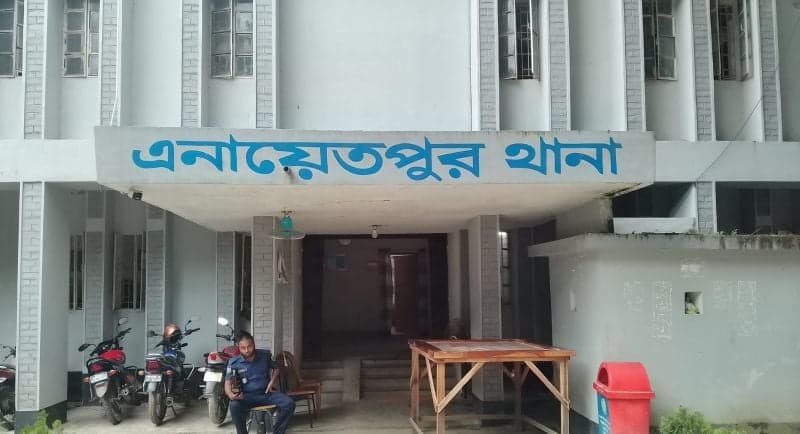

Two years after 15 policemen were bludgeoned to death by anti-government protesters at Enayetpur Police Station, the screams of that afternoon still echo for those who witnessed it. An elderly woman living directly behind the station in Sirajganj says she still hears the cries of dying officers in her sleep. Her seven- and eight-year-old granddaughters wake up screaming "save me, save me, I'm dying" in the middle of the night, unable to shake the trauma of what they saw.
The attack took place on August 4, 2024, at the height of the mass uprising against the Awami League government. Thousands of protesters stormed the police station, killing officers, setting the building ablaze and looting it. Among the dead was the then officer-in-charge, Abdur Razzaque, along with 14 other policemen — all men. Three protesters also died in the violence.
According to police records, 59 officers were on duty at the station that day. Fifteen were killed — 13 at the scene and two later at hospital.
Witnesses said fleeing policemen took shelter in nearby homes, but attackers went door to door searching for them, warning residents that any house sheltering an officer would be burned down. Fear kept most from resisting.
Some officers tried to hide in bathrooms, homes and even a pond, but were dragged out one by one and beaten to death. Several who hid in the pond were pelted with bricks and stones before being killed, their bodies left floating in the water. At least seven bodies were later gathered together in front of a house behind the station, while another victim's body was hung from a tree in the market area in front of the station.
The elderly woman said several officers who had taken refuge in her home were begging for their lives, weeping, before the mob dragged them out and beat them to death. No one dared intervene given the size of the crowd, though she said many residents also worked quietly to save officers where they could.
She said the trauma left her with a heart complication requiring treatment, and that bloodstained police uniforms were left scattered in her house afterward. Her family sheltered at a relative's home for about a week and struggled to sleep normally for six months, gripped by fear that attackers might return.
Another elderly resident said officers who had hidden in his bathroom were also dragged out and killed, with soldiers arriving later that night to remove the bodies.
A senior villager recalled bodies scattered in front of his house before being collected in one place. He said many officers, while being beaten, pleaded to be spared, promising to quit their jobs and repeatedly begging for forgiveness — but none of it saved them.
The same resident said he and others risked their own lives to help two officers escape by changing out of their uniforms.
Police said a group of officers, including one policewoman, had taken shelter in a house behind the station. As the mob closed in, constable Robiul Alam — who served as the station's "munshi," or record-keeper — pleaded with the attackers not to harm the woman, falsely claiming she was pregnant. Some protesters urged others to spare her, but a section of the mob beat her regardless, leaving her unconscious; she later regained consciousness in hospital. Robiul was killed in front of her moments later.
Officer-in-Charge Zahid Hossain said a rumor later spread that a pregnant policewoman had been killed that day, but confirmed she was not pregnant — Robiul had lied in a desperate bid to protect her. Hossain noted that of Enayetpur's six women officers, three were on maternity leave at the time. He said four cases have since been filed over the incident, and that three protesters died of gunshot wounds during the unrest, though it remains unclear who fired those shots. "But 15 of our officers were killed," he said.
Four policemen also lay injured beneath a water tank at the station that day; army personnel rescued them that evening and took them for hospital treatment. Police maintain no lethal firearms were used by officers at the scene, only tear gas and rubber bullets, which failed to disperse the crowd before officers retreated and scattered into nearby homes.
The Awami League government was toppled by the mass uprising the following day, on August 5, 2024. A case over the police killings was filed at Enayetpur Police Station on August 26, 2024, with sub-inspector Abdul Malek as the plaintiff.
Investigators say the case has led to the arrest of Awami League leaders and activists linked to the unrest. The case's prime accused, Enayetpur upazila Awami League president Ahmed Mostafa Khan Bacchu, died in custody. Nine people have been arrested so far, though police have withheld their identities. Sources say all those arrested are linked to Awami League politics.
As the second anniversary of the killings approaches on August 4, OC Zahid Hossain said the investigation remains active. Asked why a final report has not been submitted after two years, he said police were determined not to punish innocent people and were relying on video evidence to identify those responsible. "We don't want any innocent person to be punished or prosecuted. We are investigating the matter. Those of you who are journalists, please help us — if you have video footage, give it to us. We will analyze the footage to identify and arrest those involved," he said. Of four named accused in the case, one has died and the rest remain fugitives.
Leave A Comment