
Enforced disappearances were politically motivated: Report
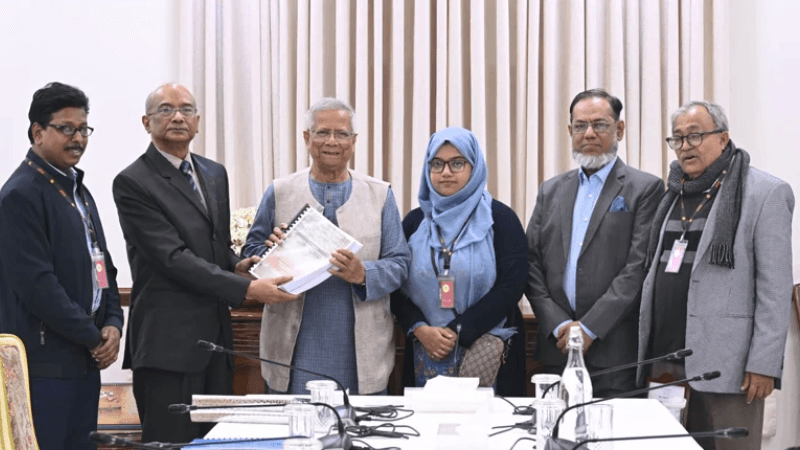

The final report of Inquiry Commission on enforced disappearances has find out that the majority of these were politically motivated.
The commission submitted its final report to Chief Adviser (CA) Professor Muhammad Yunus on Sunday, mentioning the remark.
The report handover event was held at the state guesthouse Jamuna, in presence of the Commission’s Chairperson Justice Moinul Islam Chowdhury, and members-- Justice Md. Farid Ahmed Shibli, Nur Khan Liton, Nabila Idris and Sajjad Hossain.
Advisor Adilur Rahman Khan and CA’s Chief Secretary Sirajuddin Mia were also present.
The findings reveal that thousands of citizens were abducted, with many victims belonging to major political parties and some cases directly linked to high-ranking officials.
According to the commission, a total of 1,913 complaints were filed related to enforced disappearances. After verification, 1,569 of them were classified as disappearances under legal definitions, with 287 falling into “missing and deceased” category.
Commission member Nabila Idris noted that reports continue to arrive and the actual number of enforced disappearances could range from 4,000 to 6,000.
She explained that many victims have either not contacted the commission, are unaware of its work, or have moved abroad. Some were approached by them but were unwilling to provide information on record.
Firmly stating that the enforced disappearances were primarily politically motivated, the commission members firmly said, “The data we have clearly shows these are politically motivated crimes.”
The report detailed the political affiliations of the victims: among those who returned alive, 75% were leaders or activists of Jamaat-Shibir and 22% were affiliated with BNP and its allied organizations. Among those still missing, 68% were BNP-affiliated and 22% were Jamaat-Shibir members.
Evidence suggests that high-profile disappearances involved the direct participation of then-Prime Minister Sheikh Hasina, her defense adviser Major General (Ret.) Tarique Ahmed Siddique and then-Home Minister Asaduzzaman Khan.
Key figures affected included BNP leaders Ilyas Ali, Hummam Qader Chowdhury, Salahuddin Ahmed, Chowdhury Alam; Jamaat leader Brigadier General (Ret.) Abdullahil Amani Azmi; Barrister Mir Ahmad bin Qasem; and former diplomat Maruf Zaman.
Commission members revealed that the former Prime Minister personally issued instructions for multiple disappearances. Additionally, evidence of the extrajudicial rendition of victims to India indicates these actions were carried out under directives from the highest levels of government.
Chief Adviser Professor Yunus praised the Commission for their tireless work and steadfast resolve. “This is historic work. The Commission documented atrocities that can only be described as monstrous. Engaging directly with survivors allowed the Commission to witness the brutal reality of these crimes,” he said.
He emphasized that the report serves as a documentation of how institutions were manipulated to commit inhumane acts while maintaining a facade of democracy.
The Chief Adviser also called for the report to be communicated to the public in simple language and instructed the Commission to provide recommendations and guidelines for preventing future occurrences.
He ordered the mapping of sites where extrajudicial killings and disappearances occurred.
The investigation found that the highest number of killings and disappearances took place along the Baleshwar River in Barisal, with additional cases documented in the Buriganga River and Munshiganj.
Commission members expressed their gratitude to the Chief Adviser for his unwavering support, acknowledging that his firm stance enabled them to complete this challenging work.
National Human Rights Commission has urged the Chief Advisor to continue these efforts through restructuring and strengthening the Commission and requested that the government ensure the protection of victims.
Leave A Comment
You need login first to leave a comment