
First meeting of wage board begins to set new minimum pay for garment workers
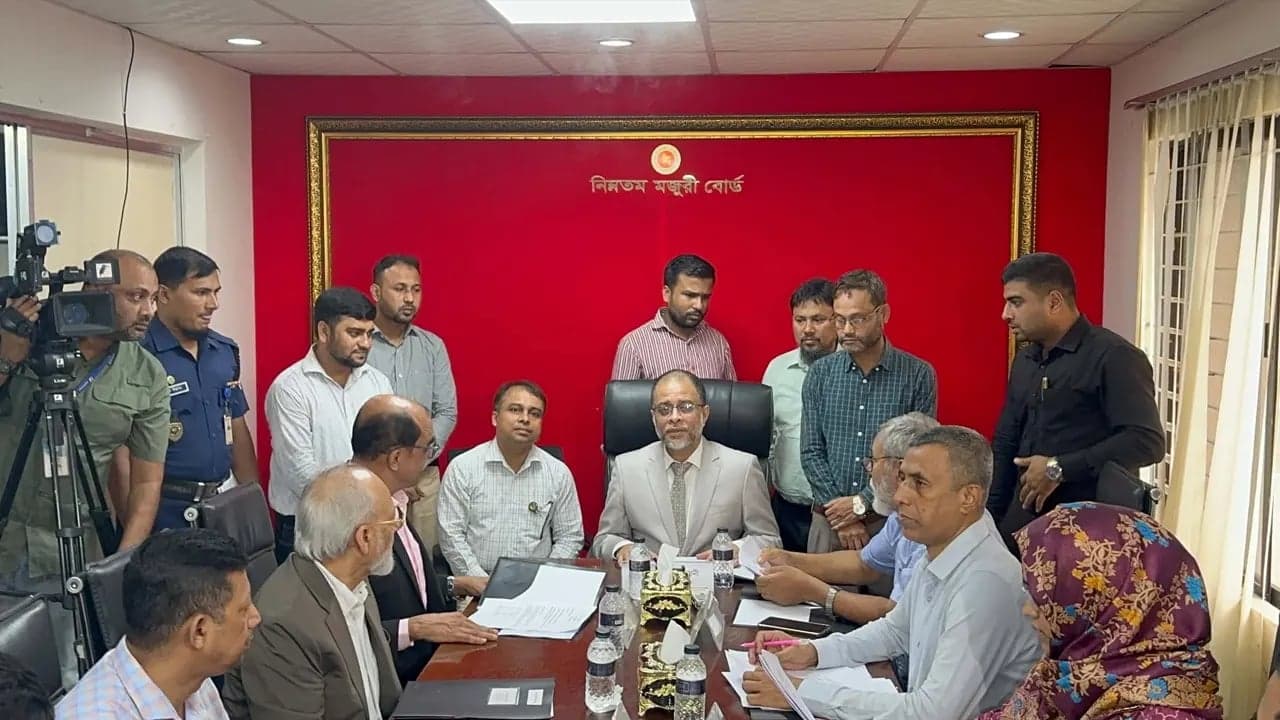

The government has formally begun the process of setting a new minimum wage for workers and employees in Bangladesh's readymade garment industry, with the government-appointed Minimum Wage Board holding its first meeting amid nationwide protests demanding higher wages.
The meeting began at 11:25am on Wednesday, November 4, at the Minimum Wage Board office in Segunbagicha, Dhaka. Judge Azad Subhani has been appointed as the board's new chairman.
According to a meeting notice issued by the board under the Ministry of Labour and Employment, the main objective is to recommend new minimum wage rates for all categories of workers and employees in the garment sector in accordance with Section 139 of the Bangladesh Labour Act, 2006.
The meeting was scheduled to begin with an introduction of the board members, followed by discussions on determining a new wage structure for workers and employees. Other relevant issues were also included on the agenda.
The government formed a six-member Minimum Wage Board on November 1 to determine new wages for garment workers. Initially, Justice Ashfakur Rahman was appointed chairman, but the government later changed the appointment.
Dr Mosleh Uddin Ahmed, a professor in the Department of Public Administration at the University of Dhaka, is serving as the board's independent member. Asif Ayub, joint secretary-general of the Bangladesh Employers' Federation, represents the employers, while Anwar Hossain, president of the Bangladesh Jatiyatabadi Sramik Dal, represents the workers.
Additionally, ABM Shamsuddin, a director of the Bangladesh Garment Manufacturers and Exporters Association (BGMEA), is serving as another employers' representative. Babul Akhtar, general secretary of the Bangladesh Garments and Industrial Workers Federation, represents the workers.
Garment workers have recently staged protests and other programmes in several industrial areas, demanding that the minimum monthly wage be set at Tk 30,000. The start of the new wage board's proceedings marks the beginning of a formal institutional process to address workers' longstanding demand for higher wages.
Leave A Comment