
From newborn to 6-year-old: Innocent childhood in prison
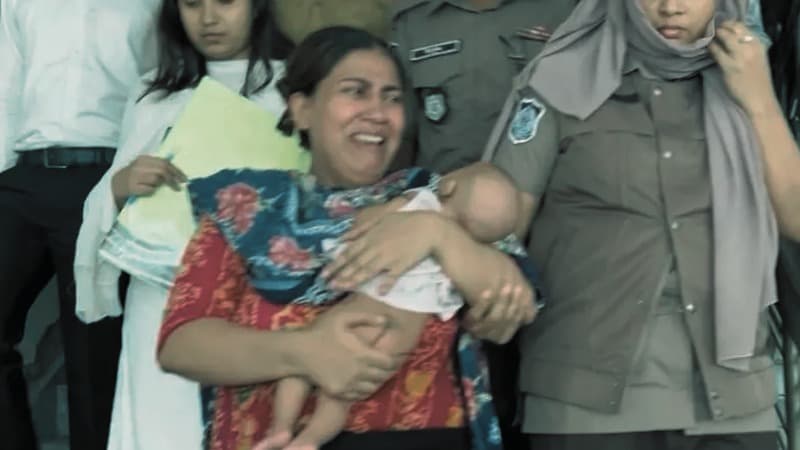

A mother is nursing her 46-day-old infant on the balcony of the court. Lawyers are present in abundance, police are on patrol, and the atmosphere is filled with the commotion of legal documents. Amidst this chaos, the mother, along with her breastfeeding child, is being escorted to jail. She is in tears. This cry does not signify personal frailty. Rather, it serves as a stark condemnation of the judicial system in Bangladesh.
Shilpi Begum, the head of Ward 26 of the Dhaka Metropolitan North Youth Women's League, was apprehended under the Explosives Act at the Tejgaon Police Station in the capital. She faces accusations of orchestrating an armed assault, committing vandalism, and looting the residence of an activist involved in the anti-discrimination movement in July 2024. If these allegations hold any truth, only a principled individual would assert that legal action should be pursued.
However, what charges can be leveled against Shilpi Begum's one-and-a-half-month-old daughter? Did this infant partake in the assault? Did she engage in vandalism? No. She has merely entered the world. And for that 'offense,' she was subjected to incarceration.
During the court proceedings, the investigation officer requested the detention of Shilpi Begum in jail. Her attorney, Farzana Yasmin Rakhi, appealed for bail on humanitarian grounds, highlighting that the accused has a one-and-a-half-month-old daughter who has undergone surgery and is seeking bail under any conditions. Initially, this request was denied. Consequently, both the mother and child were taken to Kashimpur Women's Central Jail.
Eventually, however, bail was granted, leading to their release. Yet, the lingering question is - why was bail denied initially? Was there any consideration given before incarcerating a one-and-a-half-month-old infant? Just days prior to this event in Tejgaon, another alarming incident occurred in Ukhia, Cox's Bazar - one that sends chills down the spine upon reading.
A police raid was conducted one night in Sheikhpara, Rajapalong Union, Ukhia. On the allegation that an accused had escaped while wearing handcuffs - the police raided his house and arrested his family members. A 75-year-old man, two housewives—and a six-year-old child were arrested.
Consider this. Can any rational individual truly assert that a six-year-old child assisted a handcuffed adult in escaping? Would such a claim withstand scrutiny in a civilized court for even a moment? Certainly not. However, by that time, the child had already been incarcerated. Argument after, prison before—has this become the guiding principle of our legal system?
The authorities claim that the child was not ‘formally arrested.’ His mother supposedly took him with her ‘voluntarily.’ Is this assertion genuinely acceptable? Arrest the mother, and then assert that the child ‘voluntarily’ went to jail. Is it conceivable for a mother to abandon her six-year-old child on the street while she goes to prison? The state engineers this untenable situation and then claims the mother made a ‘voluntary’ choice. This represents the most refined language of state-sanctioned cruelty.
In a report by Views Bangladesh, Barrister Badruddoza Badal, a Senior Lawyer of the Supreme Court, explicitly stated, ‘In real-life scenarios, it is impossible for a mother to forsake her child, thus labeling it a voluntary decision is inconsistent with reality.’
Contrarily, local residents assert that an innocent family has been detained to provide ‘compensation’ for the escape of the accused. This is not the enforcement of the law; it is an act of vengeance. Consequently, the childhood of a six-year-old has been consumed in the flames of this retribution.
Now, let us discuss the law. For those who claim ‘the law operates at its own pace’—let the law advocate for them. Article 31 of the Constitution of Bangladesh affirms that every citizen possesses the fundamental right to be treated in accordance with the law. Article 32 stipulates that no individual may be deprived of personal liberty without legal protection. Article 35 asserts that no one shall be subjected to torture.
The most fundamental tenet of criminal law is that an individual is accountable solely for their own offenses, not for the transgressions of their family. This principle is upheld not only in Bangladesh but throughout the entire civilized world.
Bangladesh has signed the UN Convention on the Rights of the Child. Article 3 of that convention states that the state has the primary responsibility to ensure the best interests of the child. Article 37 states that no child shall be subjected to torture or inhumane conditions and that imprisonment shall be the last resort. Bangladesh’s Child Act 2013 states that children shall not be kept in adult prisons.
Are these laws just for writing on paper? Or are they supposed to be obeyed?
In a report by Views Bangladesh, Supreme Court attorney Fawzia Karim Firoz stated, ‘Attributing the responsibility of an individual's crime to their family contradicts the constitution of Bangladesh and the fundamental principles of the criminal justice system. If there is no evidence of direct participation in the crime, then detaining him is entirely unlawful.’
Additionally, senior attorney Omar Farooq remarked, ‘If a defendant flees, apprehending their family members is a retaliatory measure, which does not conform to the rule of law.’ Lawyers assert that while the constitution and international charters exist, children are still being incarcerated. Should we then conclude that there is legislation in this country, but no adherence to the rule of law?
Let's think about those children
Consider the one and a half month old infant in Tejgaon. What are the essential needs of a child at this stage? Mother's breast milk, which is crucial for building immunity. Safe sleep, which is vital for brain development. A clean environment, as any infection at this age can be life-threatening. Timely vaccinations. Regular consultations with a pediatrician.
Which of these necessities is assured in our prisons? In facilities where there is a lack of basic medical care for adults, a scarcity of clean water, overcrowding, and a heightened risk of infectious diseases—how can a one and a half month old child maintain good health? Every moment poses a health risk for that infant. A perilous situation.
Now, consider the six-year-old child in Ukhia. At six years old, it marks the beginning of school. The time to make new friends. The age to run freely in the fields. The stage to view the world with curiosity. Yet, at this age, he has witnessed police raids, family distress, and prison gates.
Psychological studies indicate that such childhood trauma—referred to as Adverse Childhood Experience or ACE—has lasting effects throughout a person's life. This experience can lead to anxiety, depression, distrust, and difficulties in relationships. The psychological scars inflicted by the state on this child's mind may never completely heal.
Who will be held accountable for this harm? The investigating officer? The judiciary? The government? Or perhaps no one, as it will simply be labeled a 'process'.
Was there no alternative?
In the Tejgaon incident, bail could have been granted under strict conditions. House arrest might have been mandated. Regular attendance at the police station could have been required. Passports could have been surrendered. Even if any of these measures were implemented, the child would not have been incarcerated. In numerous instances, even in cases involving serious allegations, such alternatives are utilized. Therefore, why were they not considered in this case?
In the Ukhiya incident, what specific evidence was presented regarding assistance to the family? Barrister Badruddoza Badal stated, ‘If the police assert that the family members aided the accused in escaping, there must be concrete evidence to support that claim. An arrest based solely on a verbal complaint will not be upheld in court.’ Furthermore, regarding the child, an alternative arrangement could have been facilitated through the court. The child could have been placed in a secure shelter under the oversight of the Department of Social Services.
There were indeed alternatives available. However, no effort was made to pursue any alternative. This is because humanitarian considerations were not deemed more significant than the ‘process’ in this situation.
Sending a woman to prison while she is in the physical state of a newly pregnant mother effectively transforms her body into a means of punishment. The Convention on the Rights of Women and Children, CEDAW, and the Bangladesh Women’s Development Policy all assert that it is the state's duty to safeguard the physical safety and dignity of women.
What has happened to that duty? These two incidents differ significantly. The context varies, the charges are distinct, and the locations are not the same. However, there exists a disturbing similarity between these two events—in both instances, the state has incarcerated a child. Furthermore, in both situations, that child has committed no offense.
This sets a perilous precedent. If these matters are resolved without a trial today, it is likely that tomorrow another child will be imprisoned, with the state justifying it by saying, 'This has occurred before.' Gradually, this could become the accepted 'norm.' Once it is established as the norm, we will lose any moral foundation to advocate for human rights or to discuss child rights.
Those who choose to remain silent today should bear in mind one crucial fact—today it is someone else's child who is affected, but tomorrow it could be any child who becomes a 'victim of the system.' The expectations placed on the state are neither complex nor unfeasible.
For newly pregnant women and their newborns, it is essential to establish alternative measures outside of prison—such as bail, house arrest, or regular check-ins—as mandatory. The vindictive practice of using the families of the accused as leverage to exert pressure must cease. The Child Act 2013 and the UN Convention on the Rights of the Child must be enforced in practice—not merely in theory, but in every police station and every court. The judicial system must embody both humanity and legality. Additionally, those accountable for these two incidents must face consequences.
The civilization of a state is not evaluated by its skyscrapers. It is not determined by the depth of its development plans. Rather, it is assessed by how the state treats its most vulnerable citizens, particularly its children.
The initial exposure of that child in Tejgaon to the world was through the steps of a prison. The six-year-old child in Ukhia experienced a childhood confined within an iron gate. In the perception of these two children, what does the state represent now—a sanctuary or a source of fear?
These children do not belong to any political party. They are not implicated in any legal matters. They are simply children—whom the state was obligated to safeguard. This obligation was not met by the state.
We do not desire a trial where the pleas of a child are drowned out in the hallways of the court. We do not wish for a state where infants are treated as 'components of a case'. We reject a legal system that allows a six-year-old child to be imprisoned due to 'insufficient evidence' and then reassured that all is well. Prisons should be reserved for offenders. Not for children. Never.
Leave A Comment