
Government aims to raise literacy rate to 86-90% by 2031: State Minister
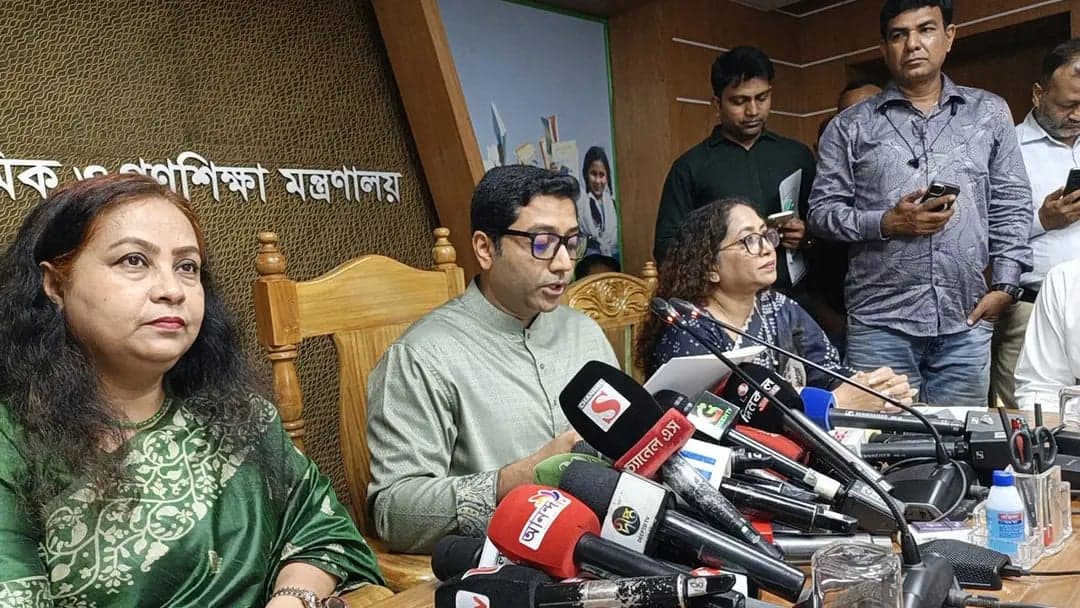

The government is working with the target of raising the country's literacy rate to 86 to 90 percent by 2031, said State Minister for Primary and Mass Education Bobby Hajjaj. He said literacy is not just the basic ability to read, write and calculate; it is a foundation for holistic human development, environmental responsibility and sustainable economic prosperity.
The state minister made these remarks at a press conference at the ministry's conference room in the Secretariat on Monday, September 7, marking International Literacy Day. This year's theme emphasises establishing literacy not merely as the ability to read, write and calculate, but as a foundation for holistic development, environmental responsibility and sustainable economic prosperity.
Bobby Hajjaj said Article 17 of the Constitution commits the state to providing universal, free and compulsory education and eliminating illiteracy. The government is implementing programmes to bring the education-deprived population into the mainstream through non-formal education, adult education, life skills and vocational training.
He said Bangladesh has achieved significant progress in literacy expansion over the past decades. According to the Labour Force Survey 2024, the literacy rate for the population aged 7 and above is 78.98 percent. While promising, a significant portion still lacks effective literacy and necessary skills.
The state minister said a programme on 'Effective Literacy and Practical Skills Training (Pre-Vocational Level)' is being implemented in the upazila headquarters of all 64 districts. In the first phase, a total of 5,120 dropout adolescents aged 15-24 (80 per district) have been brought under training. Each course provides 460 hours of training, including 100 hours of effective literacy and 360 hours of skills training.
One of the key features of this programme is creating pathways from education to employment. Among the 4,312 learners enrolled, 4,198 passed as competent, of whom 3,882 (92.47 percent) have secured employment or self-employment opportunities.
Bobby Hajjaj outlined future plans to expand non-formal education, including providing basic education up to class V for 19,200 out-of-school children and livelihood skills for 19,200 youths aged 15-24 across selected upazilas. Plans also include expanding skills-based literacy to 16 more districts to reach 100,000 adolescents, and launching an adult literacy programme under the 'Each One Teach One' model, targeting 35,000 adults in the pilot phase.
He expressed hope that successful implementation would play a vital role in raising the literacy rate to 86-90 percent by 2031. International Literacy Day will be observed globally on Tuesday, September 8, with the theme 'Literacy for People, Planet and Prosperity'.
Leave A Comment