
Government to address journalists’ benefits alongside new pay scale: PM’s info adviser
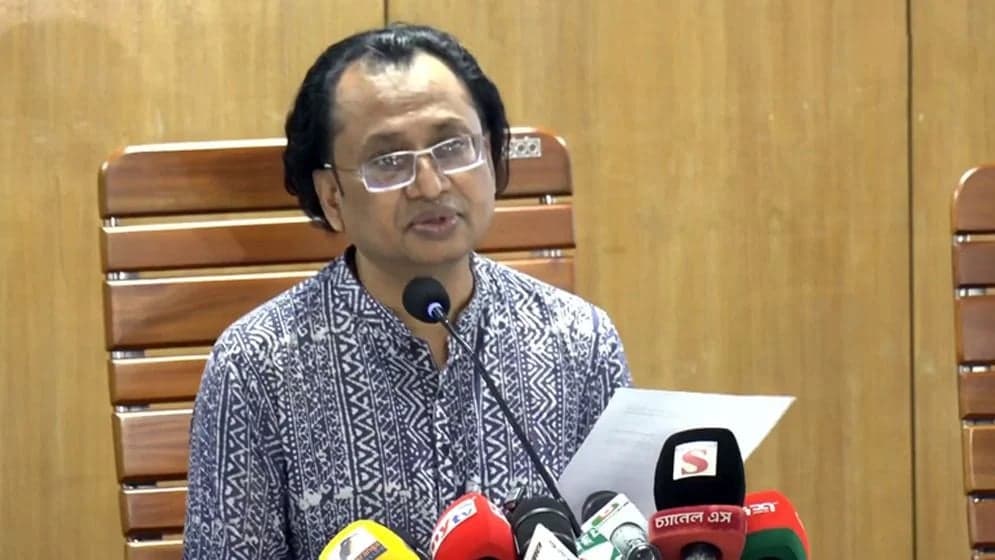

The government will consider the job and livelihood security of journalists as a priority alongside the implementation of the new national pay scale, said Prime Minister’s Adviser on Information and Broadcasting Dr Zahed Ur Rahman.
He also said it would be difficult to ensure quality journalism without professional and financial security for journalists.
He made the remarks on Tuesday (1 September) in response to questions from journalists at a briefing on the progress of various government initiatives.
Asked about government benefits for journalists working at private newspapers and television channels and the implementation of the Wage Board, the adviser said the government was taking the existing crises in the media sector seriously.
The ministry concerned is also working on issues affecting electronic media, he said.
Journalists raised the issue of the proposed Ninth Wage Board, following the Eighth Wage Board, which was discussed but never implemented, as well as the long-standing demand for a Tenth Wage Board.
In response, Dr Zahed Ur Rahman said he agreed in principle with implementing both the Ninth and Tenth Wage Boards.
He said the government would take initiatives to implement both simultaneously.
He further said quality journalism would not be possible without ensuring job and livelihood security for journalists.
The government would therefore take prompt steps on issues concerning journalists’ interests, he said.
He also said the government was considering bringing television and online media under the Wage Board and forming a new board in light of the recommendations of the Media Reform Commission.
The prime minister’s information and broadcasting adviser also discussed the new national pay scale and inflation at the briefing.
He said a significant increase in the salaries of a large number of people could create some pressure on inflation.
However, he clarified that the introduction of a new pay structure would not mean everyone’s salary would immediately double.
As a new pay scale has not been introduced for a long time, regular increments have brought the current salaries of many government employees closer to the proposed new structure.
As a result, their salary increases may be comparatively smaller, he explained.
Bangladesh Bank will use its policy instruments to tackle inflationary pressure, while the government will also take necessary measures, he said.
At the same time, the government aims to bring 4 million families under the Family Card programme by the end of the year to support the most vulnerable sections of the population.
The government also plans to expand food assistance, Open Market Sale (OMS) and Trading Corporation of Bangladesh (TCB) programmes, he added.
Leave A Comment