
Govt sets new rules for battery rickshaws
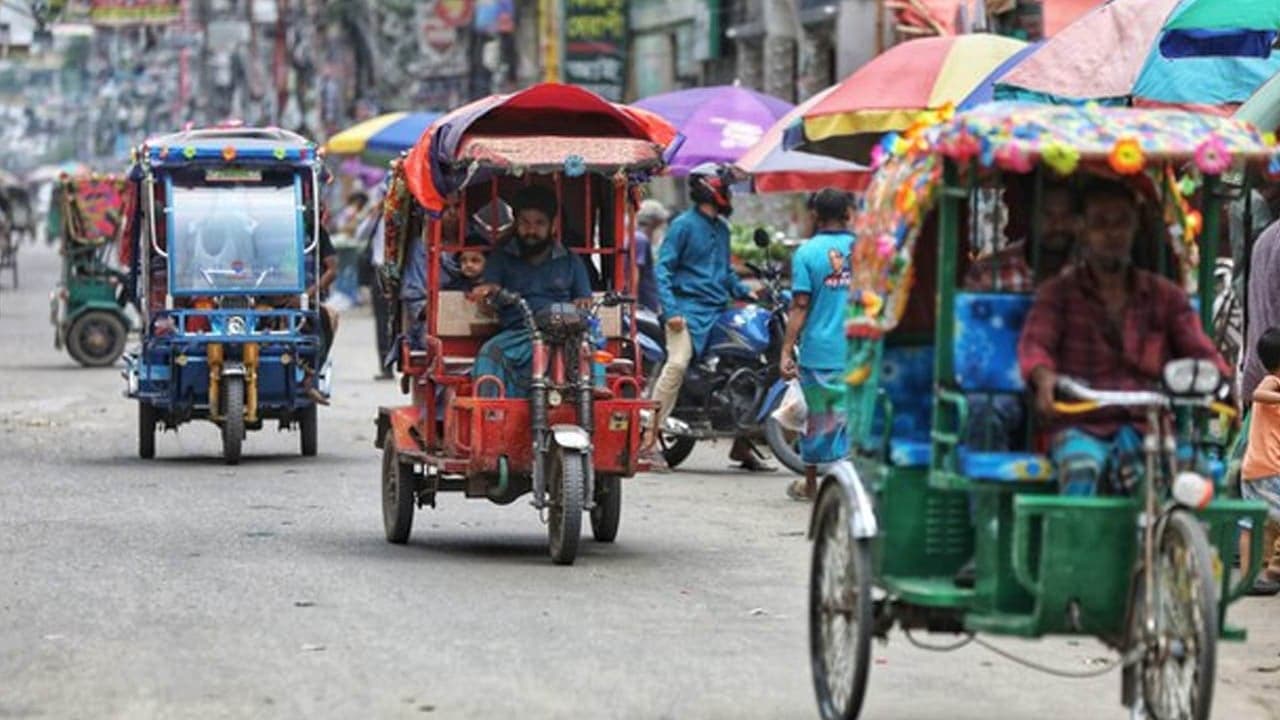

The government has issued new regulations to control the movement of slow-moving battery-powered three-wheelers, or e-rickshaws, in city corporation areas, setting fees, speed limits, passenger capacity, routes, parking and battery-charging requirements.
The new rules also classify operating unregistered e-rickshaws, carrying excess passengers and driving on prohibited roads as offences.
The Local Government Division under the Ministry of Local Government, Rural Development and Cooperatives issued a notification on Thursday (October 29), bringing the City Corporation Areas Three-Wheeler Slow-Speed Battery-Operated Rickshaw (E-Rickshaw) Movement Rules, 2026 into immediate effect.
Under the rules, the one-time registration fee for an e-rickshaw designed to carry two passengers has been set at Tk 8,000, with an annual renewal fee of Tk 4,000. For vehicles with a four-passenger capacity, the registration fee is Tk 10,000 and the annual renewal fee Tk 5,000. A fitness certificate will cost Tk 1,000 for all e-rickshaws.
Applicants must submit an attested copy of their national identity card, two attested passport-size photographs, proof of payment of the registration fee and the prescribed fitness certificate. If satisfied with the application, the authority will issue registration within 30 working days. If an application is rejected, the reasons must be communicated in writing within seven working days. Applicants may appeal to the higher authority within 10 working days.
Each registered e-rickshaw will receive a unique QR-code-enabled registration number, a number plate and a blue book containing detailed vehicle information. Registration will remain valid for five years.
A person may register up to five e-rickshaws across one or more city corporations against a single national identity card. However, an e-rickshaw registered in one city corporation cannot operate commercially in another city corporation area.
The maximum speed limit has been fixed at 25 kilometres per hour, reduced to 15 kilometres per hour near schools, hospitals, places of worship and crowded areas. Depending on the vehicle's design, an e-rickshaw may carry a maximum of two or four passengers, excluding the driver.
Vehicles will not be allowed to transport commercial goods other than passengers' hand-carried belongings. Horn noise must not exceed 40 decibels.
E-rickshaws will be barred from national highways, expressways, elevated expressways, Bus Rapid Transit (BRT) corridors, roads restricted by the authorities and footpaths. Drivers must use the left lane. Using mobile phones while driving, unlawful overtaking and improper lane changes will also be prohibited.
City corporations and traffic authorities will jointly determine routes. City corporation areas will be divided into zones, with the number of e-rickshaws, permitted roads and designated colours specified for each zone. Vehicles authorised to operate in one zone will not be allowed to enter another. Authorities will also arrange designated parking areas in each ward or other suitable locations.
The rules set an economic service life of 12 years from the registration date for each e-rickshaw. Once this period expires, its registration and number plate must be cancelled. Installing a speedometer or odometer will be mandatory.
Vehicle design and fitness must comply with the technical standards and safety features prescribed by the Bangladesh University of Engineering and Technology (BUET). E-rickshaws with mechanical or safety defects, as well as unregistered vehicles, cannot operate on roads.
Battery charging will be restricted to authority-approved charging points licensed by the relevant city corporation or designated garages. The rules also encourage greater use of renewable energy and solar power in charging infrastructure. Illegal electricity use for battery charging may invite penalties under existing laws.
To protect the environment, dumping or burning old or unusable batteries in open spaces, soil, water bodies or general waste has been prohibited. When selling a new battery, retailers must collect an old battery from the buyer and ensure that it is sent to an authorised recycling facility. Battery breaking or melting will not be permitted without clearance from the Department of Environment.
The rules also provide for driver training in traffic laws, road safety, battery handling and vehicle maintenance. In the event of an accident, drivers must stop immediately, assist injured people and inform the police.
Offences under the rules include operating without registration, exceeding speed limits, carrying excess passengers, using unauthorised batteries, altering the motor or vehicle structure, entering prohibited areas, reckless driving, violating traffic signals and fleeing after an accident. Legal action may be taken against offenders.
A committee will recommend measures to regulate e-rickshaw production and approve manufacturers. Production licences will be issued subject to government approval after vehicles are assessed against BUET-prescribed technical and safety standards.
With the new rules taking effect, the City Corporation Areas Three-Wheeler Slow-Speed Battery-Operated Rickshaw (E-Rickshaw) Movement Rules, 2025, issued on December 14, 2025, have been repealed.
Leave A Comment