
I won’t use power-gas crisis as an excuse to avoid responsibility: PM
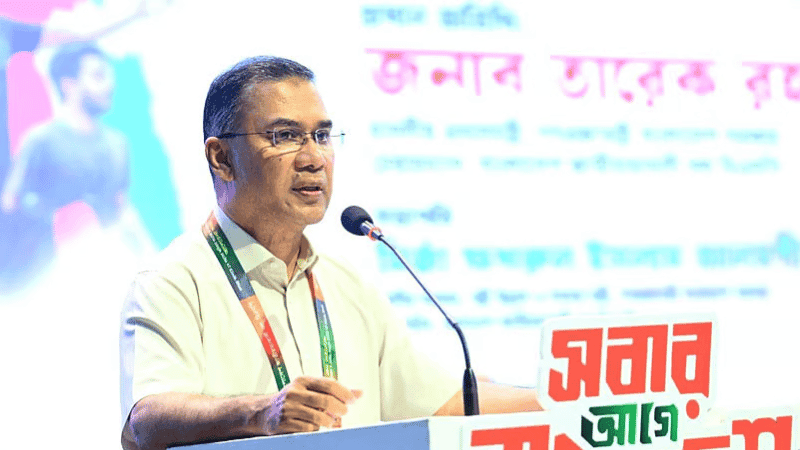

Prime Minister Tarique Rahman has said his government will not use the country's electricity and gas shortages as an excuse to avoid its responsibilities, stressing that the administration is identifying the problems and working continuously to resolve them.
He made the remarks on Tuesday afternoon while addressing a discussion titled "Seventeen Years of Relentless Struggle for Democracy and the Blood-Stained July Awakening" at the Krishibid Institution Bangladesh (KIB) auditorium in Farmgate, Dhaka. The programme was organised by the BNP to mark the second anniversary of the July uprising.
Acknowledging the hardship faced by the public due to the power and gas shortages, the prime minister said people were undoubtedly suffering.
He added that the government was working, based on its capacity, experience and expert advice, to help ease the crisis.
"We do not want to avoid our responsibilities by making excuses," Tarique Rahman said. "We know the problems exist. We want to identify them properly, and we are making continuous efforts to solve them."
He said people across different parts of the country were facing electricity and gas shortages, adding that years of mismanagement had severely weakened the energy sector.
The prime minister alleged that the previous "fascist government" had treated the energy sector as a means of enriching itself.
"After years of looting that devastated the sector, rebuilding it will naturally take time," he said.
On the gas shortage, Tarique Rahman said discussions were underway with several countries to secure additional supplies. He said the process of importing gas from Myanmar had begun and that Malaysia had also assured Bangladesh of its cooperation.
Referring to the challenges inherited by his administration, the prime minister said the government had taken office with a fragile economy, a weakened healthcare system and a divided civil administration.
He added that state institutions required comprehensive reform and reconstruction.
Speaking about the July-August movement, he described it as a people's movement driven by public demand for change. He said its success should not be attributed to any single individual or political party.
Commenting on the BNP's 31-point reform agenda, Tarique Rahman said the public had endorsed the programme through the election, making it "no longer just the BNP's 31 points, but the people's 31-point programme."
He said the central objective of the programme was to establish the political and economic rights of the people while rebuilding the state.
Leave A Comment