

Indemnity can't be given haphazardly, investigation needed: Anu Muhammad
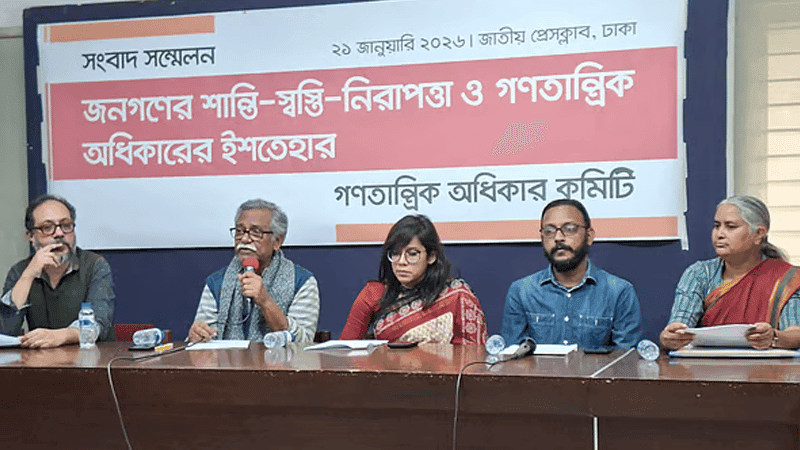

Economist and Democratic Rights Committee member Professor Anu Muhammad has said that granting criminal indemnity to those involved in political resistance activities during the July mass uprising must be preceded by case-by-case investigations. He stressed that blanket indemnity should not be granted without proper scrutiny.
He made the remarks in response to a question at a press conference titled “Manifesto for People’s Peace, Security, and Democratic Rights”, held at the National Press Club in the capital on Wednesday (January 21).
The press conference was organised to present a 25-point manifesto proposed by the Democratic Rights Committee, with Anu Muhammad presiding over the event.
He stressed that thorough investigations are necessary to determine which incidents were genuinely part of the mass uprising and which were driven by personal motives or criminal intent. Granting immunity without investigation, he warned, would further entrench a culture of impunity.
Asked at the press conference about granting indemunity in cases involving the killing of police officers during the July unrest, he said that any decision on indemnity should be made strictly on the basis of proper investigations.
The first point of the manifesto announced by the Democratic Rights Committee stated that the next elected government must complete, within three years, the trials of those responsible for the July mass killings, including Sheikh Hasina, accused Awami League leaders and activists, bureaucrats, and members of the police, RAB, BGB, and the armed forces. It also called for a transparent judicial investigation into the alleged escape of more than 600 Awami League leaders and activists to India, and demanded legal action against those who assisted them.
Other points in the manifesto include ensuring judicial independence and accountability, ending the culture of impunity, guaranteeing equal opportunities in elections and eliminating campaign discrimination, ensuring budget transparency and economic security, protecting the rights of farmers and working people, safeguarding informal sector and migrant workers, improving education quality, strengthening healthcare services, protecting the environment, ensuring freedom of expression, safeguarding women’s rights, ensuring the security of indigenous peoples and religious minorities, and protecting cultural and religious freedoms.
Leave A Comment
You need login first to leave a comment