
Jamaat did not want a country in '71, there is no Islam in its manifesto: Home Minister
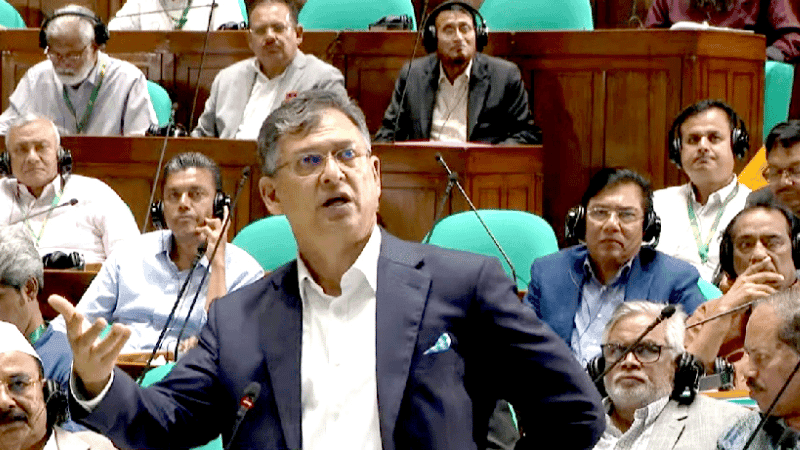

Home Minister Salahuddin Ahmed has strongly criticized the position of Bangladesh Jamaat-e-Islami in current politics, starting from its role during the war of independence. He said that although the party talks about Islam, there is no commitment to establish Sharia law, an Islamic state or an Islamic social system in its 93-page election manifesto.
He made these remarks while addressing the budget session of the National Parliament on Sunday (June 28). During this time, he also spoke about the law and order situation in the country, the economy, transactions of Islamic banks and the sale of shares of Ibn Sina Trust.
At the same time, the minister gave a strong response to various controversies arising from the law and order situation in the country, the economy and transactions of Islamic banks. Stating that there is no mention of establishing Sharia law, an Islamic state or an Islamic judicial system anywhere in the party's 93-page election manifesto, he raised the question, what kind of Islamic party is Jamaat? At the same time, the Home Minister strongly criticized the opportunistic behavior of the party at various times, drawing on its long political history.
Terming Jamaat-e-Islami as a branch of an international organization, the Home Minister said that although Jamaat-e-Islami has Islam in its name, its political manifesto has no real reflection of it.
He presented the party's election manifesto in Parliament and said that nowhere in such a beautiful and colorful manifesto is there any mention of imposing Sharia law, establishing an Islamic state, an Islamic social system or an Islamic economy.
He even criticized the clause on the education system, saying that only the modernization of madrasa education has been mentioned there, whereas the majority of the country's people study in primary and general high schools.
Highlighting the party's history, he said that this party, founded in Lahore, British India in 1941, did not want Pakistan in 1947, nor did it want Bangladesh in 1971. On the contrary, he also reminded the parliament of the history of Jamaat leaders becoming ministers in the cabinet of Governor Malek's government as a friend of the country during the Liberation War. Later, in 1979, he also accused them of reorganizing after getting an opportunity for religion-based politics and forming opportunistic alliances at various times.
The Home Minister also spoke in detail in the parliament about the law and order situation in the country. Refuting the opposition's allegations, he said that the law and order situation in the country has not deteriorated, but has improved compared to the past. Now, no one's order or advice is needed to register a case at the police station. Citing crime statistics from the past few months, he claimed that the police are now taking action very quickly if any crime is committed in the country.
Referring to the cases of missing Zishan in Cumilla, Shishu Faria in Chattogram or the murder of Ramisa, he said that in each case, the police arrested the accused as soon as possible, gave charge sheets and are assisting in the trial.
He also assured the parliament that the government is determined to reduce the crime rate in the society to zero and that modern laws are being formulated to prevent drugs and gambling.
Speaking on economic issues, the Home Minister firmly said that this huge budget of Tk 9.37 trillion has been formulated with the aim of freeing the country from the shackles of dependency and making it self-reliant. Rejecting the criticism of the debt-based budget, he said that all countries in the world take bank or foreign loans while formulating the budget. However, the government is focusing on increasing development expenditure by reducing the size of revenue expenditure.
He also spoke about the government's strong will to implement bold mega projects like the Teesta Project and the Padma Barrage.
In addition, the Home Minister also gave a strong response to the debate that arose in the parliament regarding the sale of shares of Islami Bank and Ibn Sina Trust. Citing specific statistics and audit reports, he said that around Tk 10,527 crore was released from Islami Bank from August 2024 to January 2026. He challenged his earlier claim that this was given for political reasons, saying it was completely correct. At the same time, Home Minister Salahuddin Ahmed assured the parliament that he had documentary evidence of selling a large number of shares of Ibn Sina Pharmaceuticals at a nominal price.
Leave A Comment