
JU budget has Tk 100 crore revenue deficit, zero allocation for research
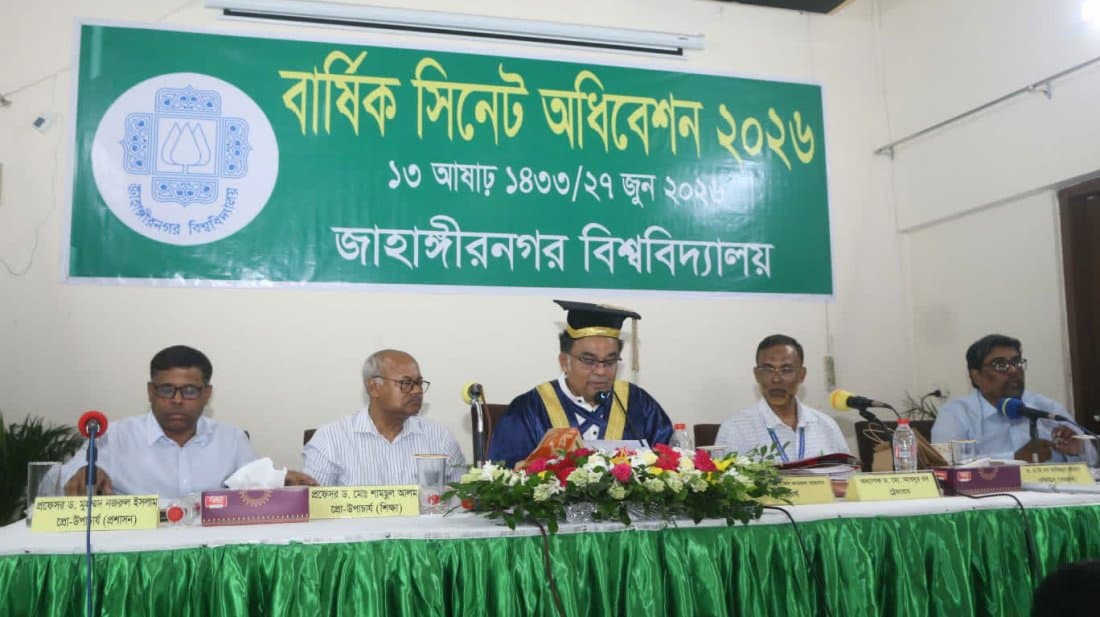

The Jahangirnagar University (JU) Senate has approved a budget of Tk 348.70 crore for the 2026-27 fiscal year. However, no allocation has been made from the university's own revenue fund for research and innovation. The senate meeting also revealed that the university's accumulated revenue deficit has reached nearly Tk 100 crore.
The budget was presented by Treasurer Professor M Abdur Rab at the 43rd annual senate session held on Saturday night, June 27, chaired by Vice-Chancellor Professor Dr Mohammad Kamrul Ahsan.
Of the approved budget, the largest allocation — Tk 201.43 crore, or nearly 58 per cent — has been set aside for the salaries and allowances of teachers, officials and employees. Administrative supplies and services have been allocated Tk 78.03 crore. Separate allocations have been made for pensions and retirement benefits, equipment purchases, infrastructure maintenance, information technology, vehicles and healthcare.
Notably, no funds were allocated for research and innovation from the university's own funds. The administration has claimed that research funds will be provided directly by the University Grants Commission (UGC) later.
According to the senate report, the revenue deficit has been increasing due to the growing gap between expenditure and allocated funds. The accumulated deficit, which was approximately Tk 62 crore in the 2022-23 fiscal year, rose to Tk 99.07 crore by the end of the 2024-25 fiscal year. With the current fiscal year's accounts, the deficit is expected to exceed Tk 100 crore.
The university had requested over Tk 441 crore from the UGC for the 2026-27 fiscal year but received only Tk 348.70 crore, creating financial constraints in various sectors.
Treasurer Professor M Abdur Rab said financial shortages are affecting research, student services, administrative expenses and welfare activities for teachers and staff. Additional expenditures such as school and college operations, research allowances, health insurance subsidies, guard bonuses and salaries for temporary dining hall staff are also putting pressure on the revenue fund.
The senate meeting also saw disagreement over the proposed establishment of the Institute of Islamic Studies and Theology. Several senators alleged that the matter was brought as a supplementary agenda during the Academic Council meeting, which lacked a quorum, violating the university's rules.
Professor Dr Mohammad Golam Rabbani of the History Department and Professor Dr Borhan Uddin, Treasurer of Dhaka Central University, both criticised the process, stating that such an important decision should not have been brought as a supplementary agenda.
Vice-Chancellor Professor Dr Mohammad Kamrul Ahsan informed the senate that the university plans to hold its seventh convocation in February 2027.
Currently, the university has 12,197 undergraduate and postgraduate students, 916 MPhil researchers and 954 PhD researchers. There are 707 teachers, 392 officials and 1,451 third and fourth-class employees.
Senate member and IIT Professor Shameem Kaiser proposed restoring the name of Bangabandhu Sheikh Mujibur Rahman Hall. He also called for a long-term academic master plan before opening new departments, addressing the infrastructure crisis of IIT and IBA, expanding research facilities and improving international rankings.
Research and innovation are the core strengths of a higher education institution. Yet the zero allocation for research in JU's own budget, along with the nearly Tk 100 crore revenue deficit, raises questions about the university's financial capacity. While the administration has cited dependence on UGC grants, the lack of self-funded research may negatively impact JU's research activities and international competitiveness in the future.
Leave A Comment