
LNG terminal glitch cuts gas supply to half of demand
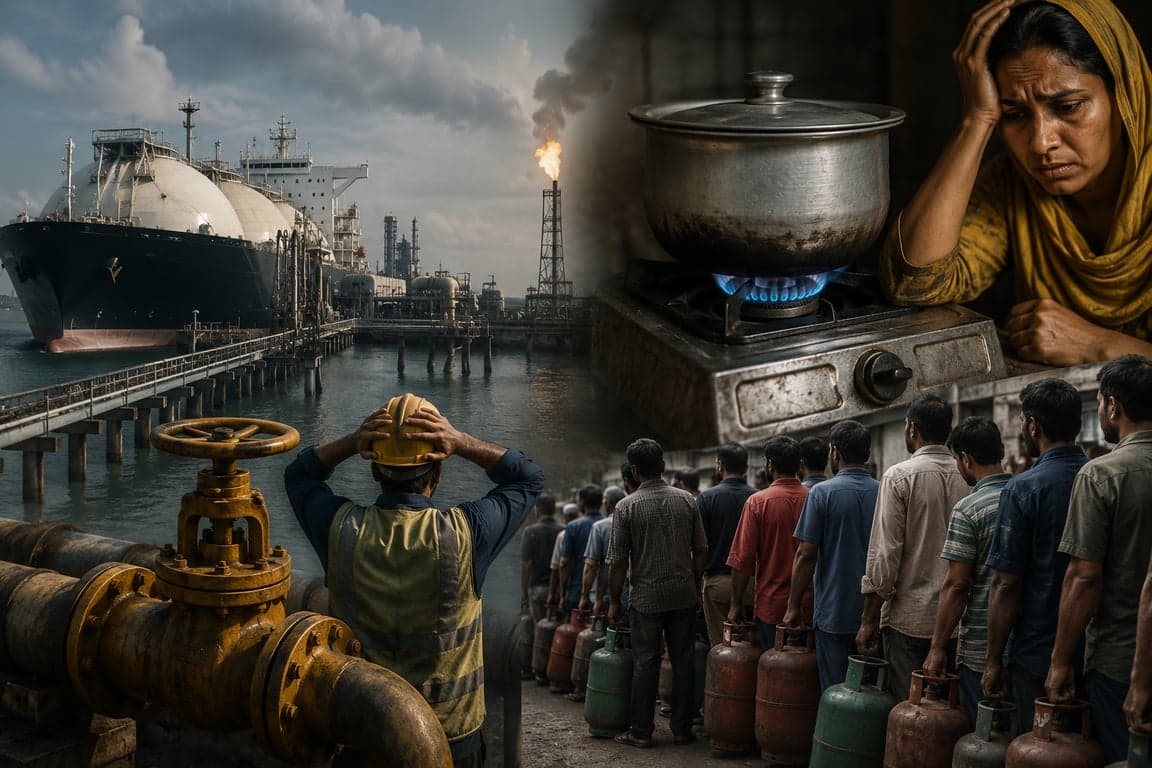

A mechanical failure triggered by a fire at the floating LNG terminal in Moheshkhali, Cox’s Bazar, has significantly deepened Bangladesh’s ongoing gas crisis, disrupting industries, CNG stations and households across the country. More than a week after the incident, Petrobangla is supplying only 56 percent of the country’s daily gas demand, leaving a 44 percent shortfall. Authorities say it remains unclear when the situation will fully return to normal.
A senior official of Titas Gas said the sudden shutdown of one Floating Storage and Regasification Unit (FSRU) quickly depleted the gas already stored in the pipeline network, making the shortage more severe. Although the terminal has resumed operations, supply has yet to stabilise.
The disruption began after an electrical short circuit caused a fire at the Excelerate Energy-operated LNG terminal, halting the supply of around 500 million cubic feet of gas per day. As a result, gas pressure at CNG filling stations has fallen to nearly half of normal levels.
The State Minister for Energy recently said the situation could improve next week. The government has also announced plans to increase domestic gas production through fresh exploration, new drilling and expanded offshore activities.
Meanwhile, the CNG Filling Station Owners' Association has withdrawn its planned nationwide shutdown scheduled for July 30 after discussions with the authorities. However, the association warned it would begin an indefinite strike from August 23 if its four-point demand, including an increase in gas sales commission, is not met.
The industrial hub of Gazipur has been among the worst affected. Factories in Konabari, Mouchak, Chandhra, Tongi, Sreepur, Kaliakair and Board Bazar are receiving only 1–3 PSI gas pressure against the required 10–15 PSI, while some areas are experiencing no gas supply at all. At least 50 small and medium-sized factories have suspended production completely, while many others have reduced output by 50 to 60 percent.
Industry officials said many factories have been unable to continue operations despite repeated efforts to manage the crisis. They noted that at least 4 PSI pressure is required to keep production running, whereas in many cases even 1 PSI is unavailable, leaving workers idle for extended periods.
Export-oriented garment factories in Savar and Ashulia have also been forced to scale back production. Although gas is available during the morning hours, pressure drops sharply later in the day, raising concerns about meeting delivery deadlines for overseas buyers.
The situation has become even more critical for the dyeing industry in Narayanganj. Previously, some factories managed to continue operations by transporting compressed gas from CNG stations in cylinders, but that alternative has now been stopped following instructions from Titas Gas.
According to the Bangladesh Knit Dyeing Owners Association, interruptions in gas supply during the dyeing process can ruin entire batches of fabric. As a result, production at around 150 member factories has fallen to just 20 percent of normal capacity. The association warned that if the crisis continues, many factories may be forced to shut down completely.
One notable exception is Mithila Textile & Woven Dyeing Ltd in Araihazar, which has maintained normal production after investing in a biomass-based energy system before the crisis.
In Mymensingh's Bhaluka, although gas supply has not been completely suspended, repeated pressure drops and intermittent disruptions are creating growing uncertainty for manufacturers.
Mokhlesur Rahman, General Manager of Shepherd Industries, warned that with production costs already rising, prolonged gas instability could force many factories to cease operations.
CNG users are also facing severe hardship. Drivers at filling stations in Uttara, Mirpur, Malibagh and Airport areas of Dhaka, as well as in Brahmanbaria, Mymensingh and Narsingdi, reported waiting for hours without being able to refill their vehicles. The CNG Filling Station and Conversion Workshop Owners Association said stations require at least 15 PSI pressure for normal operations, but many are currently receiving only 4–5 PSI or even less.
Residential consumers are also struggling with prolonged gas outages. Households in Mohammadpur, Dhanmondi, Kalabagan, Mirpur, Badda, Rampura and Basabo have reported little or no gas supply for most of the day. Many families have switched to LPG cylinders, induction cookers or electric stoves, while others are cooking late at night when gas pressure temporarily improves.
Although the government has expressed optimism that conditions will gradually improve in the coming days, there is still no clear timeline for a full restoration of normal gas supply nationwide.
Leave A Comment