
New law to curb human trafficking, migrant smuggling effectively: Home Minister
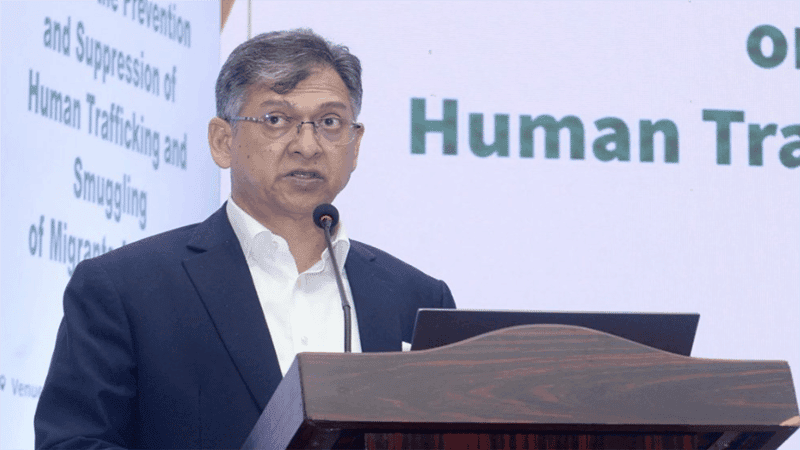

Home Minister Salahuddin Ahmed has said the new law will play an effective role in curbing human trafficking and migrant smuggling, alongside preventing the misuse of technology and digital platforms by organised criminal gangs.
He made these remarks as the chief guest at a national-level orientation meeting on the 'Prevention and Suppression of Human Trafficking and Migrant Smuggling Act, 2026' at the Hotel InterContinental in the capital on Wednesday (July 15).
The Home Minister said that in keeping with the constantly evolving tactics of organised criminal gangs, Bangladesh's legal and institutional capacity has been upgraded to international standards. The government is working to curb human trafficking and migrant smuggling through strong laws, effective institutional coordination and a victim-centred criminal justice system.
Salahuddin Ahmed said the newly enacted 'Prevention and Suppression of Human Trafficking and Migrant Smuggling Act, 2026' is a significant milestone for the country in combating transnational organised crime. However, successful implementation of the new law requires close cooperation among government institutions, law enforcement agencies, the judiciary, development partners and civil society.
The Home Minister said the new law defines human trafficking and migrant smuggling as separate offences. At the same time, an integrated legal framework has been established for the suppression, investigation and trial of migrant smuggling.
He further said the law has strengthened provisions for the protection of victims and witnesses. In line with international standards, opportunities for international cooperation have also been expanded. Additionally, the internationally recognised principle of non-punishment of victims has been upheld to ensure their dignity, rights and safety at every stage of the judicial process.
Speakers at the event said human trafficking and migrant smuggling are currently among the most severe forms of transnational organised crime. Through these crimes, vulnerable people are exploited, the rule of law is undermined and national and regional security is threatened. Therefore, coordinated cooperation at both national and international levels is needed to prevent these crimes, protect victims, dismantle criminal networks and bring perpetrators to justice.
The event, jointly organised by the Ministry of Home Affairs and Justice and Care, Bangladesh, was attended by Foreign Secretary Asad Alam Siam, British High Commissioner Sarah Cooke, US Ambassador Brent T. Christensen, Inspector General of Police Md Ali Hossain Fakir, Director General of Bangladesh Coast Guard Rear Admiral Md Ziaul Haque, Director General of Border Guard Bangladesh Major General Md Ashrafuzzaman Siddiqui and Additional Secretary of the Ministry of Home Affairs Dr Ziauddin Ahmed as special guests.
Leave A Comment