
No clear indication of reduced pressure on lower, middle classes in budget: Debapriya Bhattacharya
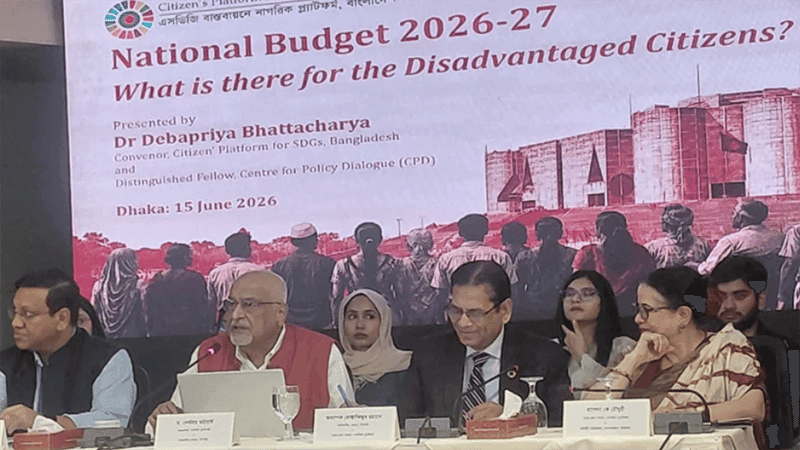

There is no clear indication in the proposed budget for the 2026-27 fiscal year that the pressure on lower and middle-income groups will decrease. Convenor of the Citizen's Platform and Distinguished Fellow of the Centre for Policy Dialogue (CPD), Dr Debapriya Bhattacharya, believes the lower and middle classes will have to endure three types of pressure: inflation, employment and wage crises, and erosion of savings .
He made these remarks at a press conference titled 'National Budget 2026-27: What is there for the distressed people?' organised by the Citizen's Platform at the BRAC Centre Inn in Mohakhali, capital, on Monday, June 15.
Dr Debapriya said that while there are positive indications of increased allocations in the social protection, health and education sectors, the large lump-sum allocations in the budget are a cause for concern. This raises the risk of fiscal discipline being compromised. In many cases, questions arise about the actual capacity to disburse the funds.
The convenor of the Citizen's Platform said non-development expenditure remains extremely high. As a result, financing development programmes from revenue surplus is very limited. If revenue collection targets are not met, where the government will cut expenditures is also a major question. If subsidies are reduced, the impact may fall on marginalised communities.
Explaining why pressure on the lower and middle classes will not decrease, Dr Debapriya said although the tax-free income limit has been raised, the pressure on people earning Tk 30,000 to Tk 35,000 per month will not significantly decrease compared to before. He also noted that a large portion of future revenue collection is planned to come from VAT, which will impose a tax burden on people regardless of their income level.
He believes the impact of VAT will fall on ordinary people through LPG cylinders, dining at restaurants, construction materials, and various consumer goods. Consequently, the cost of living for lower and middle-income groups is likely to increase further.
However, Dr Debapriya views the expansion of TIN and BIN registration, digitalisation of the tax system, steps to prevent tax evasion, and some business-friendly tax reforms as positive measures.
He said the upcoming budget contains various initiatives to facilitate investment and business. However, to reap the benefits of these initiatives, investment-related reforms must be effectively implemented. If this creates employment, it could have a positive long-term impact on the economy.
Dr Debapriya further said that although the budget contains some social protection initiatives, they are insufficient for lower and middle-income people. As a result, they will not be able to quickly free themselves from the triple pressures of inflation, uncertainty in employment and wages, and loss of savings.
Leave A Comment