
Open discussion needed on process of forming caretaker government: Home Minister
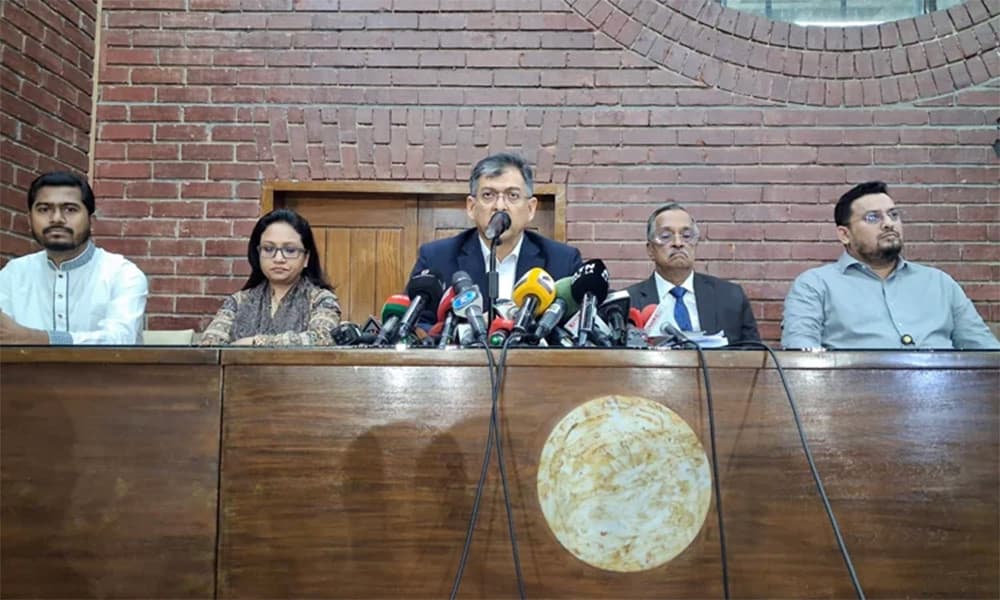

Chairman of the Special Committee on Constitutional Amendment and Home Minister Salahuddin Ahmed has said various opinions and proposals have been received on the caretaker government system and its formation process. The matter needs more open discussion.
He said the process that parliament considers appropriate for the people will be adopted. No final decision has yet been made on how the caretaker government will be formed and who will be included in it.
He made these remarks while briefing journalists after the fourth meeting of the Special Committee on Constitutional Amendment at the Media Centre of the National Parliament on Tuesday, September 29.
Salahuddin Ahmed said opinions were taken at the meeting from representatives of electronic media, television channels, online portals, news agencies and various media and journalists' organisations, as well as media personalities.
In today's discussion, opinions came on various issues, including the caretaker government system, independence and decentralisation of the judiciary, a bicameral parliament, the preamble of the Constitution and the fundamental principles of state policy.
Regarding the caretaker government, he said the July National Charter contains some proposals and dissenting opinions on the matter. Multiple alternative processes could be discussed on which steps will be followed in forming a caretaker government. Proposals have been sought from all concerned, including political parties, on this matter.
Salahuddin Ahmed said the committee has called on all political parties to come to the discussion to make the constitutional amendment initiative participatory. If the opposition has any statement or proposal, it can be considered through discussion.
Noting that opinions were also received at the meeting on the proposal to set a maximum of 10 years for serving as prime minister, he said some believe setting a time limit for anyone to hold the post of prime minister could conflict with democratic rights. The opinion was also expressed that if people want to see a leader in office again, that opportunity should remain. However, the proposal to set a 10-year limit has been made considering that no opportunity should be created for establishing personalised or authoritarian rule.
He said, however, as a political party, BNP has not yet moved away from the position it took in favour of setting a 10-year limit when the July National Charter was formulated.
Salahuddin Ahmed said the committee is committed to implementing the July National Charter in the manner it was formulated and signed. However, if any political party has a different proposal on any matter of the charter, it can be considered through discussion.
Regarding a bicameral parliament, he said since Bangladesh is a unitary state, a question was raised at the meeting on whether the country needs a bicameral parliament. However, as there was consensus on forming a bicameral parliament in the July National Charter, the committee wants to move forward based on that decision. If any new proposal comes in parliament on the matter, there will be scope to consider it.
The committee chairman said a report will be prepared after taking opinions from people of various classes and professions and consulting constitutional experts. The report will then be presented in the National Parliament, and a constitutional amendment bill will come to parliament based on it. Alongside discussions on the bill in parliament, there will be scope for taking opinions outside parliament as well. The committee will also hold discussions with former members of the National Consensus Commission and those who played a role in formulating the July National Charter. A decision on this was conveyed earlier.
Salahuddin Ahmed said the basis for formulating the July National Charter was the reports of six reform commissions. Discussions were held with almost all political parties by these commissions, and the National Consensus Commission subsequently worked based on the relevant reports. The reports of the other reform commissions are not currently a mandatory part of the constitutional amendment process. However, if the government deems it necessary, it can form a new reform commission on a specific matter in the future to obtain recommendations. For example, if a separate commission is formed on media reform, its implementable recommendations could also be considered later.
He further added that the Special Committee on Constitutional Amendment will, in phases, hold discussions with constitutional experts, lawyers, judges and former judges, academics, various social forces, organisations and personalities involved with the July mass uprising, and representatives of families and surviving individuals who were subjected to various forms of persecution over the past 17 years. Opinions will also be exchanged with the families of the July martyrs.
Committee members and National Parliament Chief Whip Nurul Islam Moni, committee member and President of the Parliamentary Standing Committee on the Ministry of Home Affairs Joynul Abedin, committee member and State Minister for Planning Md Junaid Abdur Rahim Saki, committee member and State Minister for Expatriates' Welfare Md Nurul Haque, committee member and State Minister for Land Mir Mohammad Helal Uddin, committee member and State Minister for Social Welfare Farzana Sharmin, and committee member Md Mahmudul Haque Rubel were present at the meeting.
Leave A Comment