
PM calls for job-oriented, technology-driven higher education
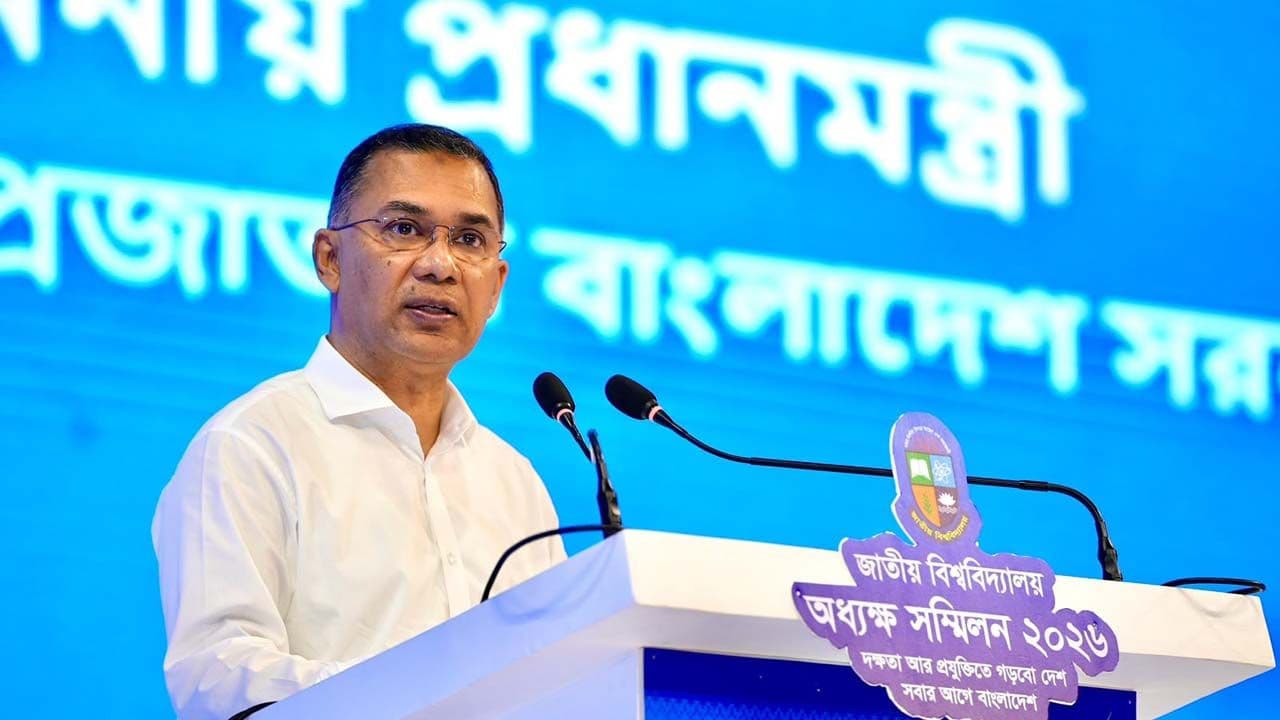

Prime Minister Tarique Rahman has stressed the need to make higher education technology-driven, skills-based and employment-oriented, saying that without reforms to keep pace with changing times, the number of educated degree-holders will continue to rise every year while unemployment remains unresolved.
He made the remarks while addressing a principals’ conference of the National University at the National Stadium in Mirpur, Dhaka, on Saturday (November 28).
The prime minister said formal education alone cannot guarantee employment. Students must acquire practical and technical knowledge, as well as the skills required in the workplace. To address the challenges of the Fourth Industrial Revolution, higher education institutions must move beyond conventional teaching methods and redesign their curricula by combining technology, innovation and practical skills.
Addressing principals of more than 2,300 colleges affiliated with the National University, Tarique Rahman said they play a crucial role in shaping students’ futures. Their responsibilities go beyond administration, as they also provide leadership in creating an appropriate academic environment and promoting ethics and educational standards. Students’ potential largely depends on their decisions, competence and foresight, he added.
He said former prime minister Khaleda Zia established the National University on October 21, 1992, to expand access to higher education for people in both urban and rural areas. Since its establishment, the number of affiliated colleges and students has increased, widening access to higher education. However, he said, it is necessary to assess how much the quality of education has improved alongside the expansion of institutions.
Referring to the state of the education sector in the past, the prime minister said the education system, like other sectors, had suffered during the fascist regime. The system now needs to be reformed and modernised through the participation of all stakeholders. The government has taken initiatives to formulate and implement plans towards that goal, he said.
Emphasising the need for teacher training, he said there was no alternative to equipping teachers with the knowledge and skills required for technology-based education. Conventional teacher-centred methods should be replaced with student-centred and research-based teaching. He said a “Train the Trainer” programme could play an effective role in this regard.
Highlighting technological changes driven by the Fourth Industrial Revolution, Tarique Rahman said artificial intelligence, robotics, big data, the Internet of Things, blockchain, automation, genetic engineering, biotechnology, cybersecurity and fifth-generation wireless technology were transforming the nature of work. While these technologies are reducing demand for some traditional professions, they are also creating new fields of employment. It is therefore essential to prepare students for the labour market of the future, he said.
The prime minister said effective cooperation between educational institutions and industries was needed to turn academic knowledge into practical skills. Educational institutions would provide the foundation of knowledge, while industries would create opportunities to translate that knowledge into real-world work experience. Such cooperation would help students become innovators, entrepreneurs and contributors to economic development, he added.
He urged industrial entrepreneurs to expand opportunities for internships, industry placements and hands-on training for students. Gaining practical workplace experience during their studies would give them an advantage when entering the job market, he said. It would also help them develop the capacity to become entrepreneurs and create jobs for others rather than simply wait for employment.
The prime minister also stressed the importance of developing human values and creativity alongside technical education. Education should not be limited to preparing students for jobs, he said. Studies in literature, philosophy, history, science, sociology and culture should help develop their reasoning, ethics, creativity and leadership qualities.
Tarique Rahman also called for opportunities to learn multiple languages to improve students’ competitiveness in the international job market. He urged colleges to introduce courses in Arabic, Mandarin, Japanese, Korean, French, German and Italian alongside English.
He further recommended expanding career counselling, internship programmes, skills development activities, language clubs and entrepreneurship initiatives at colleges affiliated with the National University.
Stressing the need to address the requirements of teachers and educational institutions alongside improving academic standards, he urged the Ministry of Education to work in coordination with relevant agencies.
He called for effective measures involving the Directorate of Secondary and Higher Education, the Non-Government Teachers’ Registration and Certification Authority (NTRCA) and the National University authorities to identify teacher shortages at individual colleges, fill vacant posts, recruit and assign teachers where necessary, and improve their skills through training.
Leave A Comment