
PM proposes scrapping black money whitening provision alongside key budget reforms
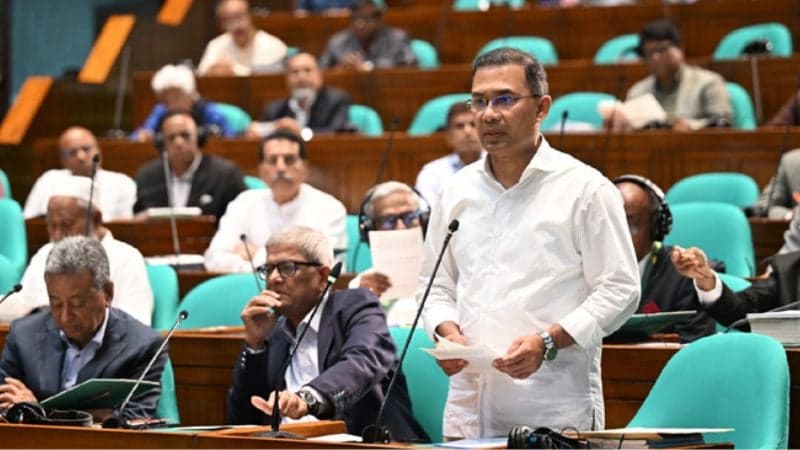

Prime Minister Tarique Rahman has proposed several people-friendly amendments in the proposed budget to reduce the tax burden of the common man, withdraw the provisions for laundering black money, and develop domestic industry and education.
He presented these proposals while participating in the discussion on the proposed budget in the National Parliament on Monday.
The Prime Minister said that without increasing the tax burden, the tax coverage should be expanded and a harassment-free revenue system should be established. He proposed to set the tax-free income limit of individual taxpayers at 4 lakh taka in the fiscal years 2026-27 and 2027-28, 4 lakh 50 thousand taka in the next two fiscal years, and 5 lakh taka in the fiscal year 2030-31.
Highlighting the public opinion that there is an opportunity to launder black money in the case of land registration, he called for the complete withdrawal of the relevant provisions. At the same time, he requested that the obligation to submit TIN for opening bank accounts, registering allotment deeds, and transferring property be withdrawn.
Proposing to reduce the 10 percent tax imposed on private universities to 5 percent, the Prime Minister called for expanding opportunities for research, language education and free education for poor and talented students.
To develop domestic industries, he proposed reducing or withdrawing customs duties and VAT on the import of raw materials for various industries including shrimp farming, medicine, LED, PVC, copper and cashew nut processing. In addition, the Prime Minister also recommended reducing the existing 15 percent VAT on advertisements on OTT platforms, social media and search engines to 5 percent.
Tarique Rahman said that the government has already started international legal processes to bring back money laundered abroad. At the same time, he expressed his determination to build a just and inclusive Bangladesh by establishing good governance in the judiciary, public administration and economic sectors.
Leave A Comment